May 16, 2012

Concept Tea (11) - Orchid and sheep droppings...

(Concept Tea (10) is here.)

This is not about orchid. But, several years ago, I learned very nice tips about orchid fertilization from my roommate, who is from Taiwan and is so knowledgeable about gardening, especially anything tropical. He is a tropical fish lover too and kept a big fish tank. He never used commercial "plant food", but fertilized all his plants with the tank water (a.k.a. fish feces water). He often says, fish feces is wonderful! Indeed, when I was with him, my orchids enjoyed his fish feces and thrived.

This blog is not about orchid, but about tea and poops... A Tie Guan Yin with outstanding orchid aroma cultivated with sheep droppings.

My favorite Tie Guan Yin producer is a very young guy from a Tie Guan Yin family. He inherited a lot of traditional wisdom of tea cultivation and received higher education from a first-tier technology university in China. He is always keen to integrating modern science with the traditions of tea production. He is crazy at experimenting on things and likes to cooperate with other tea guys to do crazy things.

Once I asked him what was his "secret" of making delicious tea. I have to admit it was more of a compliment than a question, as I didn't expect him to explain to me in details. But, "goat droppings!" is his answer. He said, winter fertilization is key to tea cultivation, and goat droppings is heavenly winter food for Tie Guan Yin tea trees. I was a little surprised and said, "so, that's the most important thing in Tie Guan Yin cultivation, and you just told me the 'secret'?" Then he told me that it's nothing secret. Basically many tea farmers in Fujian know it, and goat droppings are still commonly in use, yet few people would do it perfectly, due to the intensive labor and high costs involved. Only crazy people would bring "goat droppings fertilization" to an ideal level.

This year, I got this tea from their factory. It's not a routine product. The leaf materials are from their partner organic farm run by another young man who has the financial security to do crazy things without restriction of budget or profit outcome. Besides organic cultivation and generous use of traditional fertilizers, what's interesting is a lot of their fertilization is from sheep droppings that are transported by cargo train from inner Mongolia - it's like transporting sheep droppings from Wisconsin to Florida.

Why from Mongolia? A very practical reason is, Fujian is a small and highly populated province, and you can hardly collect that much sheep droppings :-p Besides, with agricultural development and higher density of tea plantation and orchards, there is even less space for goats or other domestic animals. Most other southern provinces have the similar situation. In Inner Mongolia, livestock is a backbone industry, and sheep droppings are abundant. In addition, in the north, animals are bigger and fatter, and droppings are supposed to be more nutritious :-D But anyway, I see this sheep droppings fertilization as more of an exploration than some long-term operation. If sheep droppings can demonstrate great values in promoting quality of the tea, then this experiment may encourage people to open a lot of options of organic fertilizers.

This tea, in short, is my favorite modern green style oolong throughout the years.


I used a small porcelain teapot to brew it and this was proved to be a good idea! A porcelain teapot or a gaiwan makes it convenient to experience the "lid aroma", aroma from under the lid of the brewing vessel. The lid aroma of this tea is wonderful. The taste is rich of orchid aroma and the buttery protein kind of taste usually found in tea from environments abundant of natural nutrients. The liquor texture is smooth and soupy. And the extra soupy feature is something in common that I've noticed from quite a few organic oolong. This may have to do with the rich pectin contents resulting from carbon nutrients in organic fertilizers. Synthesized fertilizers simply don't have such outcome because they are rich of nitrogen but short of carbon nutrients. 


The leaves are not perfect. Due to the weather of the harvest period, this tea was harvested when leaves were slightly older than preferred. In spite of that, the tea is still my favorite modern green style oolong. And the imperfect leaf condition gives me hope that the tea could be even better in a future year with better weather conditions and better processing.


Although the leaves of this tea are not perfectly young and tender, the leaves look succulent and lively. Against the current trend of Tie Guan Yin leaf materials, these leaves are not from new bushes either.

In recent years, Tie Guan Yin lovers may have noticed that towns of Anxi County (where Tie Guan Yin originated) took turns to be the new "hot spot" of Tie Guan Yin. These towns, Gan De, Xiang Hua, Long Juan, Jian Dou... are old producing areas turning into new stars one after another. If you ever wonder why, here is an important fact behind this phenomenon: these towns, one following another, cultivated new bushes either by removing older bushes or by converting other agricultural fields into new tea plantations.

In modern green style Tie Guan Yin production, New Bush is a key word. Why is that? Because new bushes have the best-nutritious leaves to support the taste of freshness and orchid aroma emphasized in modern green style Tie Guan Yin. Then, what's wrong with old bushes? Why aren't their leaves as good? It's largely because the tea bushes don't receive the best nutrients over the years, and synthesized fertilizers can never do as well on them as the traditional organic fertilizers. Nowadays, many modern green style Tie Guan Yin are advertized as from "new bushes", or 2-3 years old bushes. But what are people going to do with them after they are no longer new? A tea bush is a plant. It shouldn't get "old" or "weak" after merely a few years. It's getting "old" and "weak" only because the original nutrients in the soil are exhausted and they are not taken care of properly.

So far, what has been happening is, after one "hot spot" has its tea bushes growing older, people's interests all go to the next "hot spot" with newly planted bushes. Then, what will happen to the "no longer new" bushes? Some tea bushes, as they get older and "weaker", would be used to make cheaper and cheaper teas. Some farmers would chop them down and make space for planting new bushes all over again. But then there are problems. The soil may have already been exhausted by the previous cultivation. How long will it take to recover? Besides, typically the new tea bushes will take in all the human labor without any yield in the first year. Then, at certain point, these factors, along with the ever increasing labor costs in China, would make some farmers think, is tea cultivation still worth it? Wouldn't fruit orchards and many other things be easier and more profitable?

The pursuit of "new bush" creates dead circles (I have to mention that it's not everybody's opinion, as many people, consumers, tea sellers, producers all included, are very enthusiastic about new bush Tie Guan Yin), because new bushes can't stay new forever, and all the endeavors on new bushes are only for short-term gain. But a different way to view the whole situation is: if soil and tea bushes are well fertilized, then old bushes are not inferior to new bushes, and then there is no need to run after new bushes. Instead of staying busy chopping down old bushes and growing new bushes, the money and efforts could be spent on maintaining good nutrients for the established plantations. There might be more input than profit in the initial years, and it may not bring in a lot of quick money, but the benefits seem long-term and sustainable. I've exchanged some conversations with quite a few Tie Guan Yin producers on this, and I think it's their vision of ecosystem and effective fertilization that convinced me this is a much better approach than the cycle of planting new bushes.

So the concept behind this tea is very simple - many other things are by far not as important or useful as, em... poops!

May 12, 2012

circa 1990 Menghai 8972 brick purely dry storage

In China, many aged puerh products are emphasized to be "purely" dry storage. The "purely" doesn't just stress how dry the storage is. Most purely dry storage puerh has been stored in drier regions in Yunnan, which are not very dry regions to begin with. Some humidity data are mentioned in this post about another of my beloved dry stored tea. In Chinese puerh industry, the "purely" in "purely dry storage" mainly emphasizes that the tea has been dry stored in its entire life, without intentional or accidental dampness. By this definition, not all Yunnan stored tea can be called "purely dry storage", because there is a rain season in many regions of Yunnan and "accidents" happen.

Besides, I can't say there isn't any emphasis of dryness in the word "purely", because it's mostly used in Yunnan stored puerh. It seems many merchants and collectors in Guangdong and Hong Kong would call their dry stored tea just "dry storage" and rarely use the term "purely dry storage". I don't have enough experience to compare the pros and cons of Yunnan dry storage and Guangdong dry storage. But a currently popular hypothesis is, tea ages more slowly in Yunnan, which is much drier than Guangdong, but the aroma is maintained better. Here, "better" depends on one's preference though, and an alternative is to say "the aroma is different from that results from Guangdong storage". But when people say the aroma is maintained better in Yunnan, my understanding is, the aroma referred to is the prominent honey and floral aroma. In this sense, I do believe the aroma is maintained better in drier Yunnan.

This 8972 brick, I would call it "circa 1990" because as many tea of its time, the production date is not labeled anywhere and the date document (sometimes found in a whole box of puerh bricks or cakes) is nowhere to find. 

This tea is sometimes referred to as "Cultural Revolutionary Version brick", as it's made following the formula of Menghai factory's famous "Cultural Revolution brick" issued during the Cultural Revolution era. The word "Version" should be emphasized because it's not a CR brick but rather a brick that's made after the CR era following its formula. The first batch of "CR Version brick" was made in 1989. These bricks that I've got are said to be the 1989 batch. But there isn't really a way to confirm it. Besides, it's a little too convenient to say it was made in 1989, as that's the earliest possible time. But then, with dry storage, the age of a tea is actually less confusing. There is basically no way to fake the age of a dry stored tea. Any faking method would ruin the aroma and/or the outlook of the leaves. So after tasting this tea, with its leaves and aroma typical of dry storage, I would guess, still guess, but with confidence, that this tea is very likely from 1989 or shortly after it. Hence I arbitrarily call it "circa 1990".

Upon opening this tea, my first impression is, it's so clean, even for a dry stored tea! "Clean" doesn't mean it won't have any stones, grain shells or hairs in it :-p So far I haven't seen any, but who knows! It feels clean mainly because its leaves look handsome and "unambiguous".

Then this impression of "cleanness" remained all the way in my drinking. At this point, the brick is tight enough to hold together but easy enough to break. So I manage to pry off leaves without many crumbs. The brick doesn't have "covering layer" (many big factory products have higher grade leaves on the covering layer and lower grade leaves inside), and the leaf material is consistent inside out.

I guess, being clean isn't really an important thing in aged puerh. But I myself like clean tea. I do drink "dirty" tea sometimes, but I like clean tea! And I deeply appreciate how clean this tea is - probably not as clean as a new green or oolong, but it's really clean! For this tea, I didn't even use a strainer between teapot and teacup, which I used a lot for most puerh.

The taste of this tea is where I made my guestimation that this tea is from "circa 1990", or as early as 1989. It tastes smoother than the "butterfly tuo", the liquor feels more soupy, yet the aroma is still prominent. I guess 20 something years is the only way for the tea to get all these characters.

Overall, I like this tea even better than the "butterfly tuo", which I already like a lot and of course it can still further "grow up". I almost wanted to include this brick as a "concept tea", but dropped the idea because the concepts in it are quite similar to the concepts in the "butterfly tuo", which I've already included in the "concept tea" series. But probably this tea is an even stronger representative of this type.

I will not repeat the thoughts that I included in the post about the butterfly tuo. But there are a few interesting things that I want to mention about this tea:

1. I think it's quite drinkable now and guess that's the peak or near the peak stage for this tea. This is just my guess and I don't really know it. The tea still has some light bitterness background in the taste, and is not as smooth as a lot of shu puerh. But the aroma is rich and pleasant. I somewhat believe you can't have all the great things all at once. I guess (without much confidence but still an "educated guess" haha...) with time being, both the bitterness and the aroma will get weaker. At certain point, when the bitterness almost disappears and aroma is still strong, that will be my favorite stage of the tea. And I think the tea is very close to that stage now. But I value aroma very much and it may not be the preference of everybody's. If somebody values mellowness more than aroma (and I know a lot of people do), then they may have quite different definition about the tea's peak stage. I've seen people saying it must take dry storage forever (or at least quite a few decades) to make a tea drinkable. I guess those people simply have very different flavor preferences from mine.

"When would a tea reach its peak", and "how old is old" is a very interesting topic and I would like to write a different post later to compare what some tea professionals think of it (I will only go over what they say because I don't have much to say on the topic but have great interests in learning about people's thoughts of it.)

2. Overall I like this tea better than the butterfly tuo. And this tea is more "mature" than the butterfly tuo. But currently this tea is not more expensive than the butterfly tuo, which is already less expensive than many other aged teas. I'm not the one who made the prices. But I think their prices do follow the market rules. This brick comes "naked", with a standard CNNP wrapping for a whole pack of 4 bricks, but without wrapping for each individual brick. "Clothing" matters, not just in social events :-p Besides, the butterfly tuo, although rare, does have some established market among people who know about it. And so far I've only seen one batch of it from 1996. In contrast, the 8972 brick was made in different years. Late 1990s ones are not naked anymore and have individual wraps. But overall, most of them don't bear production dates. If under the same dry storage, a late 1990 version can't taste anywhere similar to an early 1990 version. But I somewhat believe prices are often made far before the tasting takes place. I think the multiple batches are confusing enough to affect the price. For collectors who buy in bulks and expect to sell them in bulk after a number of years, this tea may not be a good investment choice.

3. It's pretty much unknown to me how various regions, harvest seasons, leaf grades and other factors contribute to the taste of a tea after years of aging. Interestingly, I've noticed some common flavors between this brick and the butterfly tuo. I have a 1996 Menghai tuo (which I will blog about later) that's from the same factory as this brick, and is in the same age period as the butterfly tuo. However, the 1996 Menghai tuo doesn't share much commonness with either is brick or the butterfly tuo. This seems just too complicated!

May 8, 2012

brewing green teas with Petr Novák shibo set

Well, I guess shiboridashi was meant to be for green tea to begin with! But for a long time I forgot about this fact, as I enjoy using Petr's shibos for oolong and puerh - they have the perfect size and hand-grab feeling. The little "teeth" at the spout does a great job filtrating liquor out of brewed tea leaves. And, they don't get your fingers burnt! I never feel 100% comfortable using gaiwan for gongfu tea, and used to take teapots as much as possible. But suddenly, Petr's shibo became my new "gaiwan" :-D

Last time when we got a bunch of Petr's hand made tea ware (tea bowls, shibos, teapots...) for the web store, I selfishly grabbed this cute red shibo set for myself before showing it to anybody :-p Then in this spring, when new green teas arrive, I suddenly realize this is a perfect set for green tea! Oh well I guess I'm the last one to realize this :-p But I mean, many people use shibos for Japanese greens, and they are actually perfect as well for Chinese greens. And this specific set has everything I love as a green tea set!

For green tea that requires a lower temperature, the shiboridashi with lid removed serves as a perfect water cooler, and the small tea bowl that comes with it can be used as a brewing and drinking vessel. It's quite small, but perfect for tea that you've got to be thrifty on.

Cooling water:

Pouring water in the little tea bowl and throw in some Bi Luo Chun:

Bi Luo Chun "germinates" at the bottom of the bowl!


An Ji Bai Cha brewed in a similar way:


Tea that can tolerate hot water well can be brewed in the shibo directly, such as this Huang Shan Mao Feng:

Somehow I feel the color of the red glaze matches spring green very well! And the white inside is perfect for appreciation of green tea leaves.

Brewing Yong Xi Huo Qing is as easy as throwing tea grains into a bowl of hot water.


Then the tea grains would "germinate" in water.

 Then it takes a couple of minutes for the leaves to get fully expand.

 The monkey seems as thrilled as I am!

Teas like Bi Luo Chun and Yong Xi Huo Qing stay put at the bottom of the vessel and don't usually get into the way of your drinking. For some other teas whose leaves would go up and down in the water, or float around, the lid could be useful.

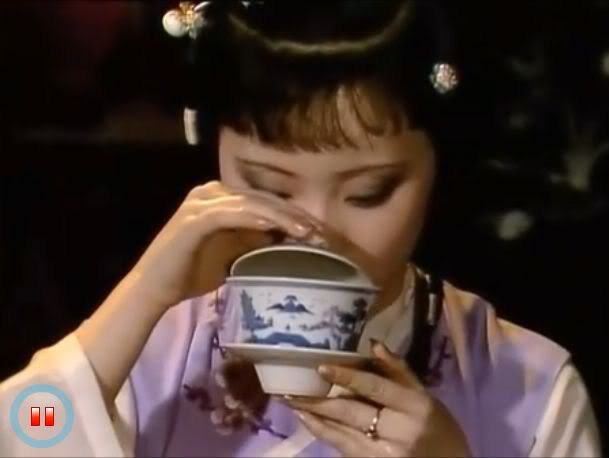
This is how people use the lid of a traditional gaiwan to wave away tea leaves when drinking green tea. You can do pretty much the same with the lid of a shibo :-)
(This is my favorite actress in my favorite Chinese TV version of my favorite book, The Story of the Stone.)
For most Chinese green teas, I would use hottest boiling water, or water temperature very close to boiling point. Hot water could be very helpful for green tea leaves to open their cells and release flavors. Then a tea bowl with wide opening is really handy. It allows hot steam to escape fast so the water wouldn't stay too hot to get the leaves "cooked". Meantime, the thick wall prevents water from cooling down too fast. I didn't analyze all this before using this shibo. But once I started, I found myself using it most of the time since the green teas arrived a few week ago. Then I came up with all these guess-analysis about why it seems so great for green teas!

May 4, 2012

Discussion on Long Jing (7) - What's in the debris of Long Jing?

(Other discussions on Long Jing are here.)


When I bought Long Jing this year, my friend in Long Jing Village send me a small pack of "Long Jing debris" (sifted broken pieces and older leaves) as gift. I appreciate this gift very much, for a few reasons.


First, the gifting culture in China has a lot of subtleties. Usually, expensive, delicate gifts symbolize great respect. But sometimes, casual, inexpensive gifts indicate very close friendship. Every time I get a gift like this Long Jing debris, the Da Hong Pao teabag, and the "granny tea", I feel glad that I'm not just seen as a client, but a friend.

That being said, for those of you who would send gifts to some Chinese in the future, don't take my words about casual gifts too seriously. Follow your heart, and when you are not sure, choose relatively formal gifts :-p Chinese society is full of these subtle manners. Another subtle culture is about paying restaurant bills. I've educated my husband (who is a Chinese Canadian yet "not Chinese enough") about when to pay the bill and when to let others pay the bill, using numerous examples, analogies and historical stories. Sometimes, paying the bill is a big sign of respect, but sometimes allowing somebody else to pay it is a big sign of respect. The opposite of the "big sign of respect" could lead to very bad outcome! After all these years, he hasn't got it yet :-p and often take the wrong choice! But people like him anyway :-)


Secondly, the Long Jing debris tastes good. I know a Long Jing lover who visits the villages in the central producing region every year around Qingming (Qingming is April 4 or 5) for tea shopping. He is a very savvy buyer and always looks for the best quality/price ratio. Once he told me that sometimes he would ask the farmers to sell him the Long Jing debris the farmers take as daily drink, because it's for sure authentic, inexpensive and tasty.
 
The Long Jing debris doesn't taste as mellow and smooth as a normal Long Jing product. The flavor is a little inconsistent with a mix of grassy, sweet, floral and nutty tastes. But after all, the debris of a good Long Jing is way better than a mediocre tea. I used a little strainer over a tea bowl to brew it, and it went for 2-3 infusions, and I could go for more!
 
Thirdly, it's quite interesting to peep into the Long Jing debris and see what's there. Actually, it could tell a lot about the tea!


Taking a close look at this dish, we could see some broken pieces, some "yellow/brown/red flakes", some "fluff balls" (by the way, I would like to discuss more about fluff balls later. Meantime,here is an interesting and lengthy discussion on teachat that's dedicated to those "fluff balls")... and, there are quite a few small whole leaves and buds! The leaves and buds are part of the reason why the savvy Long Jing shopper says tea debris is a good deal. When the Long Jing product is sifted at the end of the processing, the sifting method tend to throw out smaller and lighter pieces. Therefore, there are always some "escaped" leaf buds.


Then I picked out a few "representatives" of each type of things in this pile, including: some tea crumbs, some broken leaves, some normal-to-small leaf buds, some tiny small buds, and some "fluff balls". Long Jing's harvest season is very short. Traditionally, summer and autumn harvest yielded cheaper teas. Nowadays, due to the high operational costs, farmers in the central production regions of Xi Hu Long Jing no longer make summer or autumn teas. All the harvest and production happens between the end of March and the near the end of April - this is also why when tourists visit Long Jing region in other months, they should be cautious about their tea purchase, as most farmers (actually all of those I know) no longer have any new tea for sale after early May. 


Within this short time period, tea changes a lot. Therefore, there is the old saying in Long Jing region (and some other green tea regions as well), "It takes 3 days for treasures to turn into grasses." On the young leaves and buds in this photo, we can see some fish leaves (such as on the one at lower left) - the one or two small, undeveloped, nonfunctional leaves at the bottom of the leaf stem. Not all spring tea harvests keep the fish leaves, and some fish leaves are broken off in the tea processing. But when you see fish leaves, they indicate first harvest of the spring. In mid- to late-April harvest of Long Jing, fish leaves wouldn't be seen, neither in the debris or in the regular products. Similarly, the little "fluff balls" are tiny leaf hairs accumulated in tea processing. The tea leaves are rich of tiny hairs in early spring. Harvest of a few weeks later will not have so many leaf hairs. In Long Jing processing, these little fluff balls are sifted out in the last stage, but usually there are still small amount left in the tea. If a Long Jing doesn't have any single one fluff ball, there are two possibilities, (1) the tea is from the very top layer of a batch, as the fluff balls and any crumbs tend to "precipitate" to the bottom of a container; (2) the tea doesn't have many tiny hairs to give rise to fluff balls, and this has to do with either the tea cultivar, or the harvest date. There is a small chance of the third possibility which I would like to discuss later in a "fluff ball" post.


Farmers from various tea regions have told me that they take sifted broken leaves, tea debris, "yellow flakes", or "granny tea" as daily drink. More or less, it's because the farmers are very thrifty. If a tea can be sold for a lot of money, they would see it as a terrible waste if they drink it themselves instead of selling it. Sometimes the head of the household (usually the old father) simply forbids family members from taking any high grade tea as daily drink. However, this life style is changing as farmers' living standards improves. One farmer once said to me, "We are farmers of the 'new society' of 21st century. Why live a miserable life when you could have a better one?" But even not for being thrifty, many tea farmers and even tea dealers drink all kinds of "debris" and "yellow flakes". It's because those broken leaves are all good stuff. Besides drinking them up, what can you do with them otherwise? It's a sin to throw them away, and don't ever expect teabag manufacturers would care to collect these "deluxe" types of debris ;-) 

May 1, 2012

ecastasy of green tea season

"This is crazy!"
When I lived in Beijing, every four years, there would be a "crazy summer" - the summer when FIFA (of the soccer) World Cup happened. During the time, everybody was in sleep deprivation (because usually the World Cup schedule follows that of European audience). Every night was a carnival. The air was sweet. The sidewalks of the city were full of beer parties and large screen TV with live soccer games going on. In weeks, everybody would feel this light dizziness day in and day out (due to sleep deprivation). But everybody was dreamy and happy.

It was quite a phenomenon, especially considering China has never got a passable soccer team!

I thought of those crazy summers because in recent years, the only time when I have the similar dizzy, dreamy, sleep-deprived days are during the "April madness" - the green tea harvest season! Most of the green teas that I buy each year are small-production teas, which would be sold out shortly after the harvest. And some of those relatively large-production ones, such as Long Jing (still small production but already much larger than many rare teas), also require frequent attention and contact with the producer - that's the price to pay if you want to buy famous tea directly from farmers for much lower price than in a large-city tea store, yet of much higher quality! And, there is 12-13 hours time difference between Massachusetts and China. I guess that's why everything in the green tea season feels so similar to World Cup season to me!

Usually, my "April madness" starts in mid March, when the weather forecast starts to be important for Long Jing. For Da Fo Long Jing, it's relatively easy - just grab the early harvest and done! For Xi Hu Long Jing, since I can't afford (or don't want to pay for) the earliest harvest, I would check out the price change twice a day and aim at the day that (I guess) has best quality/price ratio. I'm very privileged to have my friends reserving the tea for me every year in recent years. But still I've got to keep in touch with them every day, so to make the purchase decision at the earliest possible time.

Then there are the battles for other first harvest famous green teas. Then there are waves and waves of first harvests of less famous Anhui green teas. Anhui is probably my favorite green tea province. I never know how many various green teas you could get there! In traditional Chinese tea industry, there is an old saying, "Spend you entire life learning about tea, and at the end, don't expect you know all the names of teas." In fact, give me another 30 years, I wouldn't expect myself to know all the names of Anhui teas. There are so many hidden gems.

This year, I actually made a plan for green tea purchase - the first year ever that I had actually made a green tea plan :-p But then there are always some accidental discoveries or good tea with good prices that bumped into me. So I guess, in the future, if I make a plan to buy 10 teas, it would be a relatively accurate estimate that I would end up with 20-30 teas :-p Then I get tea samples from producers and suppliers. Many of those teas would be unknown to me, and (fortunately? unfortunately?) many of them would be already sold out by the time I taste the sample. Then there would be such resolutions, "Next year I'm sooo getting this tea!"

Then there is the annual green tea group purchase that I participate in China. In the group purchase, one would get a dozen or so various new green teas, quite a few of them would be rare or small-production teas that are unknown to me. A micro blog sale I run last year included quite a few teas I obtained from the group purchase. Obviously, the group purchase has been more and more popular over years. In the past, I didn't remember I had to wait in front of my computer at 2:30am to sign up. But this is what I had to do this year. Again, there was the deja vu feeling of World Cup summers! The online sign-up started in the afternoon of Chinese time. Within 10 minutes after the sign-up program was opened, all of the 100 orders were taken - which means those of my peer green tea drinkers in China weren't doing any work under the noses of their bosses in an afternoon of a Friday :-p I managed to sign up in the second minute and there were already more than 2 dozen people signing up before me! So I know how it feels when you have to compete against people of the most populated country for green tea :-D

If the "April madness" sounds a little crazy, I'm just glad that I'm not the only one :-) There are many, many green tea drinkers who are as crazy, or even crazier!

Apr 27, 2012

guess guess guess... how much is this tea? (2)

Part (1) is here. Take the guess before you read on, and make sure to answer the "bonus question" at the end of this :-)

And here is the answer :-)

Zheng Xi Cha.

Zheng Xi means "authentic Anxi". That's the traditional advertising title traditionally used in Fujian and Guangdong for some southern Fujian tea, which may or may not be tea from Anxi.  

Have you seen this tea in your local Chinatown stores? I've never seen it in North America. But it's an export product. I wonder if it's in large amount in America, or mainly exported to southeastern Asia.


This label says, Se Zhong (without specifying cultivars and maybe it's a blend of various Sezhong cultivars), Grade 2. 

Now, how much is this tea?
Taobao price is ¥7.2 per box (125g). It's official price is around ¥8 per box :-) US$1 = CN¥6.3


This tea is probably one of the two cheapest teas I've ever had :-D Another one with comparable price was a cheap phoenix Shui Xian that I once logged on steepster. The phoenix Shui Xian is even cheaper, but consider this one comes with proper packaging (sealed foil bag in a paper box which is sealed with plastic film), the tea part of its price is probably even lower than that one.

Another surprisingly cheap tea I got a few years ago is this Da Hong Pao by the same company and of the same brand. It was that Da Hong Pao that made me start paying attention to this brand - Sea Dyke. Obviously, I'm too young to know it well :-p It turned out that this is one of the most popular brands among Chinese oolong lovers of 50 (?) years old or older :-)  It has been a very popular brand in Southeastern Asia as well.

To me, this tea is not as tasty as the above-mentioned red-box Da Hong Pao, which is not as tasty as many other oolongs. But I think both of them taste better than some other teas many times of their prices. And this Zheng Xi Cha sets a new price record for me on "cheap and drinkable" tea. These types of teas help me understand why some of those old guys from Fujian and Guangdong are so savvy at tea shopping. If you grow up drinking cheap and passable teas, you are less likely to buy in some expensive but merely passable teas - that's my interpretation :-)

Those of you who mentioned aged oolong in your guesses, nice hit! I was told it's a 2011 product upon purchase. So it never came to my mind there could be some connection to aged oolong. But just these a couple of days I've been reading about this brand (Sea Dyke). And it's said (by a mid-aged tea business man who started his career by black market trade of exactly this tea...) that this tea is blended with tea products of various years to maintain its consistent style. I thought it was entirely "puerh behavior", didn't know they had been doing this kind of big-factory blending to oolong too, and find it quite interesting!

So I actually paid more for its shipping than the tea itself. I wonder if it's sold in the States. A similar product (probably the same tea of same grade) is of the same package style but in 500g volume metal tin.

I bought this tea because I heard a lot about it, and because I was buying some aged oolong released by Sea Dyke (which I also think is a very interesting phenomenon and I would like to discuss later). All these days I was wondering why Sea Dyke has kept so much aged oolong. There was almost no commercial market of it in mainland China for the past decades, or anytime before this current time. And even now, aged non-puerh is not popular at all in mainland China (with a potential growth in aged oolong and aged white tea). I just couldn't believe Sea Dyke could predict 15 years ago that aged oolong would be "hot" someday and saved aside tea then :-p But after reading about their blending secret, now I guess probably that's why they have aged oolong in stock to begin with.

I said earlier that if this tea is imported to America, probably it's price would be 150%-200% of its Chinese price, which would be $2-2.5 per 125g. But that's just a guess and still need to be verified. I took this guess mainly because many of Sea Dyke products are cheaper overseas than in China (that's also an interesting and rare phenomenon). But since this tea is already cheap, maybe it's hard to make it even cheaper. I guess importers of this tea would mainly be Chinatown store types of businesses and I guess they are not the type that would have big price mark-up. That's how I guess the US price of this tea could be 1.5-2 times of its Chinese price.

Now, a bonus question :-) The above-mentioned cheap red-box Da Hong Pao, its Canadian price is (or was, in 2009) $5.49 (200g box). And as mentioned in that blog post, its Chinese price is more than that. Without doing a real search on its Chinese price, what would you guess its Chinese price is? Just take a guess. Prices don't always make sense. So, guess, don't think :-)

Apr 23, 2012

2012 Long Jing

2012 Long Jing harvest season started with great expectations, yielded some great tea, and, unfortunately, ended too early. This has turned out a shortest harvest season in years.

Due to the cold and dry weather in early spring, 2012 Long Jing harvest season started rather late. Cold and dry weather caused the tea leaves to grow slowly, which was actually very good for the quality of tea. Due to the late harvest, there was very small production of pre-Qingming tea. The price was very high, but tea farmers had lower pre-Qingming income than past years due to the low production. Harvest of the few days after Qingming (Apr. 4) was rather low too. So in Chinese market, tea drinkers have been complaining about Long Jing prices, yet farmers' income actually decreased. And then, due to the rapid rising of temperature and strong sunshine from early to mid-April, tea leaves have been growing faster than the pace of harvest. Then some precious Long Jing leaves grew old on the tree before ever having a chance to be harvested. With a lot sighs, farmers in Hangzhou ended their spring harvest at an unusually early time.

I was lucky to have obtained some post-Qingming (Apr. 6th) harvest from my buddy in Long Jing Village. I think it's comparable to, if not better than, the Apr. 3rd harvest of last year. But I will not be able to get the good deal of pre-Guyu Long Jing as last year's Apr. 8th harvest, because this year, 5 days of high temperature makes much bigger difference than the 5 days of last year (here is a blog post comparing the pre-Qingming and pre-Guyu Long Jing of last year) in terms of flavor change, yet the low production causes the price to remain relatively high.

Here is the 2012 Long Jing that I've got. 

Dry leaves on top of 1/3 bowl-ful of water:
(I used the similar "mid-way" method as described in this post, but this time I was stingy and used a small tea bowl and smaller amount of tea leaves :-p Besides, I'm in love with this red shibo set made by Petr Novak!)


With more water:


In China, price of Xi Hu Long Jing has been so high that it's not affordable to a lot of people. Many tea drinkers have switched to other Long Jing districts or switched to other green teas. This has also generated certain degree of resentment among some tea drinkers, who would say Long Jing farmers are so spoiled by their natural resources and the high market prices of Long Jing.

Although Long Jing price is very high to begin with, a more expensive Long Jing doesn't always mean more money to the tea farmer. A few years ago, a tea farmer showed me a selling receipt of their pre-Qingming tea to a brand-name Long Jing company. It was a price equivalent to about $140 per pound. I can't say I could predict the exact market price of a tea, but the above-mentioned tea looked to me comparable to the $600-700 per pound level products offered by a few top notch brand-name companies in China. I wouldn't say $140 is not a fair price, considering a brand-name company would have to hire a lot of people and invest a lot of money all over its operation. But at least, we could see there is much opportunity that tea farmers could grab in the difference between their selling price to large companies and the Long Jing price in the retail market.

In recent years, more and more Long Jing farmers sell tea themselves, to friends, tourists, acquainted vendors and sometimes through family-run tea houses. If my estimation of the nearly $600 market price for the above-mentioned tea is not too far off, then for a tea like that, a price anywhere between $200 and $500 would benefit both farmers and tea drinkers. Meantime, I have to admit this is only a rather abstract and simplified discussion, and brand names sometimes do have their unique values. But there is a lot to explore about the "middle-ground" price for farmers and tea drinkers/sellers/wholesalers. In addition, some local farmers/wholesalers associations are seeking for good ways to get fair prices, and sometimes, such efforts benefit both producers and consumers. An example of such exploration is the price index of Da Fo Long Jing in its local wholesale market.

Below I want to quote some writing from my Long Jing Village friend 家在龙井村. Long Jing farmers are already financially doing well compared with many other tea farmers. But still, life is not easy! The article is rather sad, not because Long Jing farmers can't make a living out of tea cultivation, but mainly because they feel their hard work is not always respected, and their voices are often not heard.

Here is the article, and I added some notes at the end.
_____________________________________

          Our 2012 Long Jing harvest started on March 29. It was mainly because according to the weather forecast, there would be heavy rain and temperature would drop. My cautious parents were worried that there would be disastrous weather to ruin the new leaves. Therefore, our first harvest was carried out on March 29, with 2 liang (100g, or 3.4 oz.) of tea produced.(*) The real start of formal harvest was on March 31. In the days that followed, my whole family and 20 tea harvest workers worked from 5:30am to 6pm every day and all day in the tea field, exhausted day in and day out.(**)

          But this is a bad year for Long Jing farmers. In a regular year, the harvest would end after Gu Yu till around April 25. (***) But this year, the harvest had to end on April 15, as there was already no good tea leaves to pick off. My parents worked hard for a whole year with great expectations on the harvest season, but are poorly rewarded by the yields of tea. They can do nothing but working hard on the tea fields for another year, and hoping the next year would be better. They belong to the most underrepresented group of our society.


          What's really outrageous is, the news media are ridiculously enthusiastic about the speculation of ¥180,000 per jin (1 jin is about 1.1 pound, this price is equivalent to $26,000 per pound) Long Jing.(****) The nonsense news reports drove away a lot of our clients, as people don't believe they could afford authentic Long Jing anymore. When we were selling good tea of reasonable prices to some clients, we had to make extra effort to convince them over and over that the tea was authentic, because all they had heard from the media was authentic Long Jing was supposed to be many times more expensive...
_______________________________________

* This is not paranoia, as it happens from time to time tea leaves are ruined by disastrous weather right before harvest. However, such concern of weather conditions sometimes would cause tea harvest to be earlier than its "natural time".

** Many tea harvest workers are from surrounding counties and provinces. It's estimated that this year, the typical average cost of hiring each migrating tea worker is about $16-20 per day, and the labor cost is probably one of the largest expenses in Long Jing cultivation. According to some Long Jing Village farmers, a tea worker typically can harvest 1 - 6 pounds of fresh tea leaves per day (1 pound when it's first day harvest, and 6 pounds when it's near the end of the harvest season and tea leaves are larger). About 4 pounds fresh leaves are used to make into 1 pound of final product of Long Jing. The pan-frying of the tea is usually done by the one or a few skillful family members (usually men). The tea is usually fully manually processed when harvest is low earlier in the season, and semi-manually processed when harvest is high later in the season.

*** Traditionally, lower grade tea was also produced in summer and autumn. But in recent years, summer and autumn harvests are no longer carried out because the income of low grade tea cannot justify labor costs.

**** The ¥180,000 per jin price was from a charity auction on first day harvest Long Jing, run by a large tea company before the harvest started. This is not the fist time a super high auction price of a tea is created. I don't know what's behind this one, but I suspect many of such charity or commercial auctions mainly serve for advertising purposes and intend to manipulate public attention. Just my cynical thought... This is not the first time either, that news media are obsessive about reporting the high auction price of a famous tea (probably many of you have heard of auction prices of Da Hong Pao and other teas before). Often in their reports, the media omit the fact that prices of such charity auctions mean to be symbolic (as the money is supposed to be donated for charity causes) and have nothing to do with market prices. Therefore such news reports could be very misleading but continue to draw broad public attention.

***** Long Jing Village is dominated by Jiu Keng Group cultivar, the traditional cultivar of Long Jing. The above-mentioned harvest dates are all about this cultivar. In Haongzhou region, harvest of Long Jing #43 cultivar started and ended earlier than Jiu Keng Group cultivar.

****** This late start and rapid progress of warm temperature affected harvest of quite a few green teas this year. I will write about a few other teas later.

Apr 20, 2012

guess, guess, guess... how much is this tea?

I'm drinking this tea now and will write more about it. But before writing more, I just want to ask this question to you, how much do you guess a 125g (4.6oz.) pack of this tea is?

I'm not trying to trick you, and you won't be punished for wrong answers :-p Pictures can't tell everything about a tea. But it's only a guess! So just take a guess! I promise I will tell more about this tea, and I thought your responses will help me frame what I'm going to write!

Dry leaves:
(you can click photos to enlarge them)


So far I've had about 6 infusions. When it steeps for half a minute in an earlier infusion, it looks like this:
(no filter used)

When I let it steep for several minutes in a later infusion, it looks like this. 

I'm still continuing with it.

Some hints:
1. It's not expensive by 99% of the people's definition - I guess :-)
2. It's not torturing me - you probably could tell from the number of infusions I've already had :-)

So, take a guess! :-D

Apr 16, 2012

development and tea opportunities (1)

I have been thinking about this for a while, on a few teas and tea regions. But I wasn't sure where to start. So I will just write whatever comes to my mind first, under the influence of recent green tea influx :-)

First of all, over the past weekend, a lot of new green tea arrived :-) including 2 different Huang Shan Mao Feng. I wrote about the semi-wild Huang Shan Mao Feng before. These days, it's the other one, the 1400m Huang Shan Mao Feng, that makes me think.

This is the dry tea leaves of the first harvest.

The supplier, Mr. Wang told me, some tea vendors asked him if he could supply "even higher grade". First he didn't understand - "This is already the earliest harvest from the highest elevation. It's our highest grade!" But then he was told that the demand of "even higher grade" has no offense to the current tea. But if the tea could get their larger leaves removed and mainly buds and young leaves of consistent size remained, then the tea would look of "much higher grade" and would be sold out very fast. (In Chinese market, people are crazy about physical appearance of green tea!) Some vendor says, "Nowadays there are more and more affluent people in my region. They don't hesitate to spend big money but they demand the best of the best."

But I told Mr. Wang that I vote for no more removing and trimming of leaves! I don't think it will improve the taste a lot, if at all. And it cost a lot of labor hours, hence money! I don't think I speak just for my own economic interest and because I don't want t spend more money. Indeed I don't want to spend more money just for better look, but my main concern is, over-refining an already good tea product just doesn't make sense to me and isn't something the tea world should nurture.

Besides, I think although the untrimmed tea may not look as good as trimmed tea in dry tea leaves, it looks just as beautiful once brewed in hot water. I've found this in quite a few rough looking tea, including the Tong Cheng Small Orchid that I love.

What do you think? ;-)


What led me to this tea was sort of "tea karma". In April of 2010, earthquake catastrophe broke out in Yushu, Qinghai, very close to the hometown of a best friend of mine (who shares hometown with Dalai Lama). Then, on a Chinese online tea forum, I saw an announcement of charity sale of Huang Shan Mao Feng run by Mr. Wang. He put some of his best tea on sale and donated all the money to the earthquake region. So I bought some tea from him. It didn't cost me any extra. I just bought some very nice tea for a very fair price. It was him who made the donation of tea and money. But still he thanked me for a few times and told me I was the first buyer in the charity sale. Because of this charity sale, I've known Mr. Wang as a man who cares a lot for people and society beyond his own life. And Mr. Wang appreciated my support in the sale. Hence started our friendship.

Later I learned that Mr. Wang is a part-time tea seller (just as I am!) who is son of a farmer's family from a remote village of Yellow Mountain (Huang Shan). He has a well-paid job in Hefei, a big city 100 miles away from Yellow Mountain, and selling tea by far can't compensate him as well as his day job. But he feels like to do it because he strongly dislikes the tea middlemen who come to his village every year and offer lowest price for their high quality tea. Their village is 8km (5 miles) away from the nearest road. In all those years, most farmers have no other choice but selling tea to middlemen for a rather low price, despite that their village is one of the most elevated ones for Huang Shan Mao Feng cultivation, and their tea is of the top quality. So a few years ago, Mr. Wang started to take his family tea to Hefei City, selling it to his colleagues, friends, and then, later on, friends' friends. Then, some neighbors in his village asked him to help sell their tea too. So he started taking pre-orders each spring, among friends and on a popular online tea forum, to determine how much tea he could sell from various farmers in his village. Each year, the tea would be carried by either Mr. Wang or a cousin of his, on foot, for 5 miles down the mountain. Usually it takes multiple carriers or multiple trips of some carriers. Then the tea would travel by train to Hefei City. Then, as you know, some of the tea would travel by air to America :-)

In the past a few years, Mr. Wang told me, again and again, that besides selling tea for his family and village, another issue that he can't get off mind is getting a road built toward his village. Currently, his village is the only one in the region that's not accessible by an automobile road. The road project has been on the agenda of the county for more than 10 years, but was delayed again and again due to budget or various other reasons. As a young man who has the most education among his villagers and works in the "big city", Mr. Wang carries a lot of hope of his fellow villagers. He often says he is determined to use all his network and "lobbying power" to make the road happen as soon as possible.

When I first heard of Mr. Wang's dream of a road, my first response was, "No...!" Mr. Wang convinced me for a few times that his village is the one in the deepest mountain, and therefore will be the end of the road and will not have much passing traffic even with a road. He said, "You don't have to worry about automobile contamination on the tea fields." But actually my concern was not the contamination problem. What stroke me was thinking of a paradise lost. Yellow Mountain is the dream paradise of Chinese people of generations. The village in the mountain is like where paradise and human world connects. But, have you seen a paradise with automobile roads? No...! Meantime, I knew it was not my say, and it would be rather selfish to want the village stay road-less. But deep in my heart, I felt I was still 70% against the road. Then, recently, Mr. Wang showed me a few pictures he took on their mountain trails. The pictures left me speechless and now I think I'm mostly for the road project (although I don't have any power to push it forward anyway...)


This is the best part of the mountain trail. Villagers need to travel on it every a few days to buy food and household items. Children need to travel on it every day to go to school, all the 5 miles, round trip! Patients need to be carried down the mountain to see the doctor in the nearest town. In fact, when seeing these pictures, I feel even the previously mentioned "tea middlemen" are not that bad. They buy tea for low prices and villagers don't like them. But they have to work harder than many other middlemen anyway, because they have to travel on this trail up and down too, to carry the tea out of the mountain. A traveler would think the remote village at the end of the scenic trail is paradise. But only people living there know how hard life could be. So I feel if I can't handle every day life in a remote village like this for many years, I shouldn't expect local people to live like this without access to a road.

I believe there will be a road in a few years. Mr. Wang is still fighting for it. But I'm sure he will make it happen. I have all the best wishes for the road and for the village, and I believe the road will bring better life to local people. Not without a little sentimentality though, and it reminds me of many other things we have gained and lost in modern life.

Apr 12, 2012

Yunnan coffee - is it enemy of tea?

What?! Coffee?!  :-D

Probably some of you know I love coffee, and I've told my story about how I started drinking coffee.

Last time when I bought some arbor tree green tea from Yunnan (which, by the way, is great! and I will write about it later), the seller told me they had coffee too. I had always been curious about Yunnan coffee. In supermarkets of Beijing, coffee products are not yet common, and most of them are imported. So by that time, I hadn't got a chance to taste Yunnan coffee yet. Therefore, I bought some Yunnan small-grain arabica coffee beans with my tea :-D


It's not bad at all. The taste is strong, not has as much "kick" as the coffee we got from Guatemala, but overall is quite ok. If not counting most of the Chinese consumers of Starbucks who enjoyed the environment of a cafe more than coffee itself, consumers of coffee are still very few in China. But a blank market often means a market with great potential to grow. In recent years, more and more people are talking about coffee cultivation in Yunnan. Many people believe Yunnan is very suitable for coffee cultivation, and many people believe coffee would be more profitable than a lot of other cultivations in Yunnan.

In fact, it has happened in some regions of Yunnan where farmers chopped down tea trees to convert the fields into coffee plantations. Traditionally, Yunnan teas has been the least expensive ones among Chinese teas, and tea has been very inexpensive within Yunnan. But coffee is foreign, novel, fancy, and supposedly expensive. In recent years, the rapid increase in Yunnan tea prices somewhat reversed the trend. But in the long run, coffee cultivation still seems more profitable than tea cultivation.

So, is coffee a threat to Yunnan tea? First of all, I hope not. And secondly, I don't believe coffee is a large threat to tea. And here are some of my thoughts about why.

1. From what I've learned about coffee, good coffee requires good ecosystem. Such requirement is consistent with that of good tea cultivation. In this sense, coffee and tea are not enemies of each other. At certain point, coffee may take away some agricultural fields from tea. But I don't believe it will turn tea cultivation upside down.

2. In Yunnan, threats to tea exist. Some of them are very bad, and could potentially be threats to both tea and coffee.

Rubber tree plantation is one of the worst. Rubber tree (that produces raw material of industrial rubber) is fast growing and highly profitable. Nowadays in Yunnan, many people know that if you pass by a village surrounded by rubber tree forests, then you know this village is rich, or is going to be very, very rich in near future. Many people are highly motivated to convert hundreds of acres of fields into rubber tree forests, and there is a whole industry behind it, urging/enticing people to do it. There are quite a few detrimental effects of rubber tree plantation. First of all, it ruins the soil and make it unsuitable to grow anything with delicate flavors, such as tea and coffee. Secondly, it's typical industrialized monoculture and destroys the biodiversity of the ecosystem. The consequence is what people would call "green desert" - a poor ecosystem with pretty much of nothing by one type of plants. Thirdly, because of its monoculture, it will require heavy use of pesticide. And because rubber is not food material, use of pesticide is quite loose on it, and much worse than in regular crops. On the other hand, tea and coffee usually have the most strict regulations in pesticide use among all food materials.

Besides rubber tree forests, paper industry is another great potential threat to the ecosystem. In the past decades, large international corporations have expanded their fast growing eucalyptus forests, another type of "green desert", in southeastern Asia. Eucalyptus is a native economic tree species in Southeastern Asia, and has unique values when blended nicely with the rest of the ecosystem. But the paper companies are interested in creating large areas of monoculture of eucalyptus. This does not only have many detrimental effects similar to those caused by rubber tree forests, but also changes local climate. Many tea drinkers, especially puerh lovers, are familiar with the 2010 drought disaster. In fact, 2010 was only the worst year, and drought is becoming a repetitive phenomenon in some regions of Yunnan. Many scientists believe climate change caused by fast growing eucalyptus monoculture is the single leading cause of the drought of Yunnan.

In addition, the modern paper making industry also threats Yunnan's traditional paper production. I personally use some hand-made traditional paper from Yunnan as additional wraps to some older puerh cakes whose original wraps wore. These traditional paper wraps look and feel more coarse than modern paper, but they are sturdy, clean and eco-friendly. Traditional paper making is as much an art as tea making, and Yunnan has been historically the paper supplying province to the entire country. But nobody knows if traditional paper will continue to be made when modern paper industry encroaches more and more, and when more local people are busying working on rubber tree or eucalyptus forests. In recent year, I've seen some art works of Yunnan traditional paper, made and purchased by people who care about the traditional paper and want to preserve the culture. On one hand, it's a good thing. On the other hand, I can't help feeling a little sad that the traditional paper, once most common and for daily use, is now gradually becoming a cultural specimen.

Now I realize this is too much to think over a cup of coffee! :-p

But in general, I feel coffee and tea are never enemies to each other, although sometimes tea people and coffee people like to tease each other :-) Personally I see food and drink as some of the most important things in my life. Love of food and drink is deeply rooted in Chinese culture and many other traditional cultures. Currently, Yunnan and the rest of China are facing great challenges of agriculture and food safety. On top of all other problems, Monsanto has been permeating into China and has been more active in China in recent years - I'm worried this could become a bigger problem than most of the already existing ones, yet many Chinese people aren't even aware of what Monsanto is. With all these problems and challenges, I feel a lot of our hope is on people's love of food and drink. If we refuse to compromise with industrially made inferior food products, if we keep demanding high quality tea, coffee, fresh fruits and fresh eggs, if we don't allow junk food to ruin the taste of our next generation, then we are probably helping with some of the problems of the world. In this sense, coffee and tea are not enemies, but allies!

Apr 5, 2012

top 10 search keywords in this blog

It was only recently that I discovered that blogspot has this "statistics" function and can track "traffic sources" of blogs. It's quite interesting to look into it! On the "traffic source" page, there is a list of top 10 search keywords. My understanding is, these are the keywords that lead people to my blog when they carried out a web search with them. I'm not sure if this understanding is correct, and some of the search key words really puzzled me!

The first one in the list, or the number 1 search keyword... I almost didn't want to tell you, and feel somewhat embarrassed by it! But I will go ahead and tell you anyway. It's a phrase - "real human skull". When I first saw it, I was like, "what???" Ok, I do remember I wrote one (and only one!) blog with an image of human skull. But it puzzles me why people would search for "real human skull" and how they are led to my blog for 65 times :-p

The second one is "petr novak". This is a little surprising to me but not entirely surprising. I remember the first time when I looked for Petr Novák's tea ware, I searched it online and visited quite a few websites that contain information about it. I guess that's what other people are doing too!

The third one is "jin jun mei". That's quite out of my expectation. I wrote about Jin Jun Mei only once and I'm not crazy about this tea (although I did enjoy those two that I wrote about). I guess that's a tea many people want to know about yet there aren't many information sources of it. 

The fourth one is, hmm... again, "infraorbital foramen", a surface anatomy on human skull, mentioned only once in that skull post. I wonder what's going on with skull search!

The fifth and sixth one are 2 slightly different spellings of "yong xi huo qing". I love this tea and wrote about it once.

The seventh is "jiu keng group long jing". Actually I had thought Long Jing would be the most searched for tea. Yet it's topped by Jin Jun Mei and Yong Xi Huo Qing on the list. I guess it's because there are already many discussions on Long Jing and not as many on the other two teas.

The eight is kamjove - the convenient gongfu teapot.

The ninth is "mango milk tea".

The tenth is gingkobay.blogspot.com, the web address of this blog.

It's quite interesting and few of them were what I had expected!

What are the top search keywords on your blog? Or what kind of web search leads you to blogs?