Showing posts with label Tea Accessories. Show all posts

Apr 26, 2014

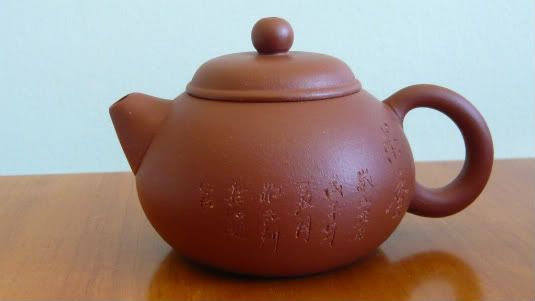
pictures of some popular Factory #1 teapots


More pictures are here.

The pictures are rather small and are mainly for the purpose of style identification. These pictures could be found in quite a few Chinese tea websites and teapot websites. So far there is no copyright concern. I guess some non-Chinese yixing lovers would be interested in these pictures as well, and therefore put them in the above public album.

I have a few other series of Factory #1 teapots pictures and will put them together in a folder soon.

These are not inclusive of all Factory #1 teapot styles, but cover most of the commonly seen styles. There were large amount of custom order teapots that were not included in Factory #1 catalog as those in the pictures showed here. In the market, the "cataloged ones" are usually more expensive than the uncatalogued ones, when qualities are similar in all aspects. This is largely for identity reasons, as it's easier to identify and authenticate the cataloged teapots. I'm not sure if it would still be the case in the long run, as some of the cataloged styles were made in much greater amount than some of the uncatalogued styles.

For people who are interested in more detailed and artistic documentation of some Factory #1 yixing styles, I would recommend this book: 钰壶雅集 Yu Hu Ya Ji

Some pictures of this book can be find on this page of Wu-Shing Books. This is one of the three "bibles of yixing teapots" named by some Chinese yixing lovers (another one of three is the Gu Jingzhou book).

As far as I know, this book is still being sold in Taiwan for about $60-80.

And here again is the question, if you have $100, would you spend it on a good but not fabulous teapot, or a picture book of splendid teapots? 

Mar 30, 2014

blog sale - some tea wares

Similar to the previous blog sales - 

If interested, please contact me at gingkoheight @ g m ail . com before April 11, 2014.  I will try to get all packages prepared before April 14.

Shipping is included for US addressees (with a $5 shipping refund if one buys two items), shipping to be estimated for other countries.

Shipping could be combined with Life in Teacup orders. 

All prices are lower than market prices and not correlated with our web store prices. Some of the items may be offered in Life in Teacup web store in the future, and the prices will be higher.


1. Small special shape red clay shui ping by Qian Hongfen, made in Yixing Factory #1 in 1990s for export. $. There are 5 available for this blog sale. There will be some more available in future in our web store.

More photos are available here


It's made of red clay. The volume is about 60ml. This was a mass-export products made by Yixing Factory #1 in 1990s. Qian Hongfen is a very well known Factory #1 worker. In my impression, her works, even the commercial level ones like this teapot, are relatively well made. The craftsmanship of this teapot is not great, but generally better than mass-export products of that time. The lid fit isn't perfect, but generally not bad. And I would select the relatively better ones from the batch for sale.


A drawback of this style is that this type of stainless steel strainer would be too big to put on this teapot. This wouldn't be a problem if one prefers single hole strainer. I personally don't. If it has to be a single hole, probably large leaves are better for it, as the leaves tend to leave some space for the water flow through the single hole, so to avoid plumbing work while drinking tea. There are DIY strainer ideas that could work for this little teapot. If you do want to DIY a strainer (it's actually not that hard), this and this are some ideas (the above two aren't the right size and just serve as reference). For a slightly more complicated DIY strainer, you could refer to this webpage (probably translation is not necessary as the pictures say it quite well).


2. Special shape purple clay shui ping. Author unknown. Made for Taiwan market to mimic an earlier style (in terms of shape and stamp). $. There are 3 available for this blog sale. There will be some more available in future in our web store.


More photos are available here.


This is a purple clay teapot, about 100-110ml. Rumors are this was a 1980s customized order. To be conservative, let's just think of it as a 1990s order. I think this is a very impressive little teapot. I currently don't have the information about who made it, but it was definitely somebody who did good work. The clay quality matches the very high quality found in pre-1990s teapots. The craftsmanship is great. The lid fit is perfect or near perfect. The shape and the square stamp are cute (I think).


3. Jingdezhen porcelain gaiwan. $18. There is one available.

More photos are available here.


The usable volume (not filled to the rim, but filled to the level of the lid rim) is about 110ml. The diameter of the bowl is 9cm (3.5 inch). For my hand size, it would be a bit large for gongfu brewing - after seeing a lot of discussions on how to use gaiwan for gongfu brewing without burning your finger, my final conclusion is, the number 1 tip is that the gaiwan is small enough relative to your palm size, and everything else is easy to handle :-p

However, I would feel comfortable using it for green tea brewing like this (this style is suitable for males too!).

The pattern is not hand painted but mimics hand painting. The painting is quite nice and the color is good. It takes a very close look to tell it's not hand painted. 


4. A xishi teapot with a broken lid, or may we call it a fairy pitcher. $24. There is one.


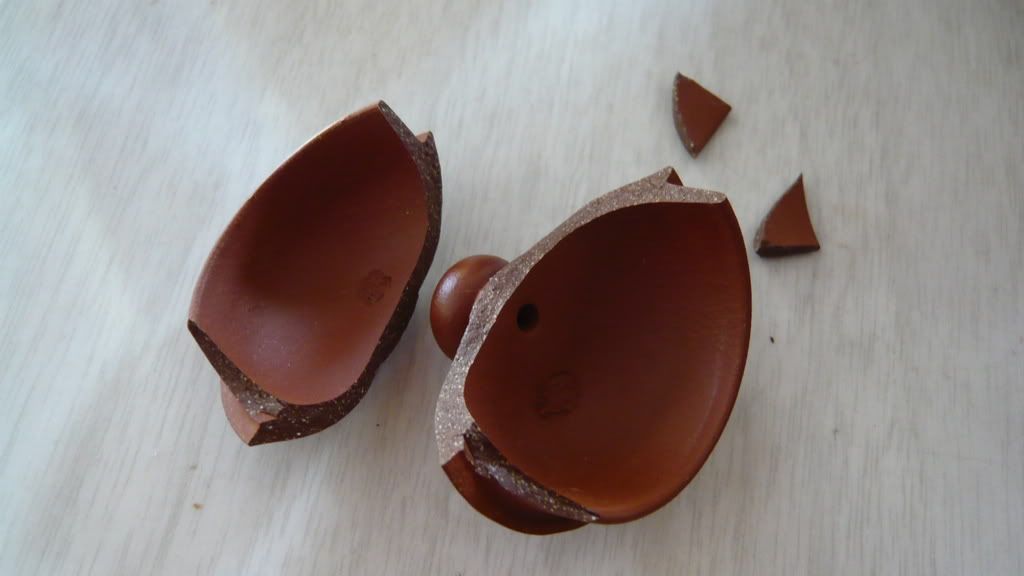
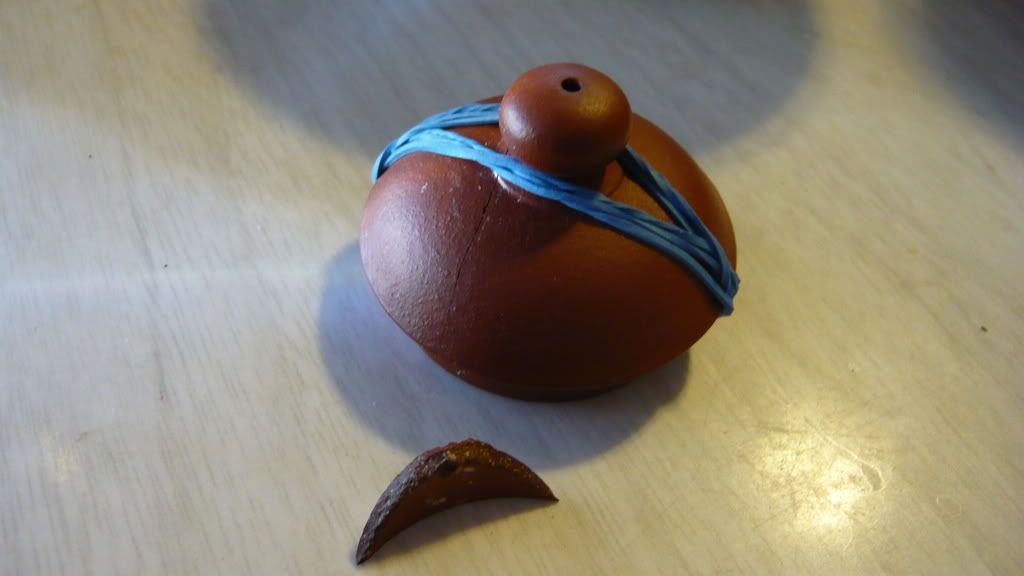
This poor little thing was one of our beloved 100ml di cao qing xi shi. The knob was very unfortunately broken off. It could still serve as a fairy pitcher though, if you just need one. I would send along the lid and the knob piece as well, in case you would like to do some repairing work. It's possible to stick the knob piece on with rice soup, and it could be very sturdy as long as you don't use the teapot for tea brewing (water or steam dissolves the rice "glue"). This way, you may use the teapot for tea storage. I personally use some teapots for storage of puerh and roasted oolong, with their spouts and knob holes plugged with tissue paper. It's an odd view, but works well! If you really want to glue the knob back on and use the teapot for normal brewing, you will need to be very careful about whether the glue is safe enough.


Free stuff:

1. Assorted yixing cups.
2. Small porcelain cups (about 30ml) of the similar painting style of the above gaiwan.
3. 2014 Frosty Spring Yunnan Roasted Green 7g sample.
4. 10-25g packs of 2013 green tea
1400m Huang Shan Mao Feng
750m semi wild Huang Shan Mao Feng
Jiang Xi Tribute Tea
Frosty Spring Yunnan Roasted Green
etc.

Feb 8, 2014

preparing a new yixing teapot (1)

This teapot has a cute nickname, "little dumb"
This includes preparing a new teapot or a newly obtained vintage teapot, whether is new vintage (some people use the term "vintage virgin") or used vintage.

Here are some methods that I could think of at this moment, including some methods that I'm reluctant to use but being used by a lot of experienced yixing collectors.

All the methods mentioned here are for legitimate yixing teapots. They are not useful to detect any harmful chemicals in the teapot or "cure" the teapot from any permanent harmful contents. Some of the methods may help to reveal the clay quality to some degree, but this is not a practical aim of preparing teapots. Whatever flaw that could be reflected in these method, could be detected in other observations before hand.

As usual, I know I will be too wordy to control the reasonable length of the post. So I would divide the contents in 2 posts. Part one is about the routine and popular methods. And part two discusses some more controversial method and some "queer" methods. 

1. To judge if a yixing teapot is ready to use.

To judge whether a newly obtained yixing teapot is ready to be used for tea brewing, other people may have more decent ways, but to me, there is a very important test, which doesn't sound very decent ;-) This very important test to me is... Sniff Test! Basically I would sniff a teapot around to decide whether it's ready to be used for tea brewing or it would need more "preparing" work.

The purpose of the sniff test is to see if there are dust residues hidden in the pores of the clay texture. This is not a test for any additive harmful chemicals, though, because many harmful chemicals are odorless.

The key to the sniff test is to sniff the teapot when it's moist but not holding water or having a lot of water on the clay surface. When the clay is moist, the dust odor is most prominent, if there is any. But when the teapot holds water, a lot of the odor is dissolved by water and can't be detected as easily. For a new pot, it's almost ready if it still has some hint of pleasant, aromatic odor of clay (shouldn't be strong though). It wouldn't be good if the odor is heavily soil-ish (need more rinsing, or the the teapot didn't have enough firing in the kiln).


2. Simple rinses may work sometimes.

In the most ideal situation, "preparing" work is minimum to none. For some high quality, high fire modern teapots of certain clay textures, the only thing needed in preparation work is to rinse it for a few rounds with tap water and then with boiling water. It takes 1 minute and the teapot is ready. Some vintage teapots could be ready with some simple rinse too, but considering the time the teapot might have spent in a dusted warehouse or an unknown place, probably more preparation work is necessary.

If the user would like to have some fun to go through more tedious preparing work, as described in this blog post, it is fine. But it's not always necessary.

In my experience, a lot of zhu ni teapots, ben shan green clay teapots and red clay teapots would get ready with such simple rinses. High-fired purple clay and duan ni teapots with relatively smooth surface may belong to this category as well. Usually, after simple rinses, if I don't see tiny piles of clay dusts inside the teapot, and if the teapot passes sniff test, then I would start using it if I'm very eager to start using it.


3. Rinsing with boiling water.

For most of my new teapots, I would rinse them with boiling water for many times. I don't spend extra time rinsing a new pot, but just rinse it when drinking tea. The teapot is filled with boiling water, and then rinsed some time later, and filled with boiling water again, and rinsed again. This could last for a few dozen rounds and a few weeks. I would give the teapot a "sniff test" from time to time, to judge how ready it is. But usually the rinsing time is more than the teapot needs to get cleaned. The rinsing helps to season the teapot anyway, although it's just plain water. So I wouldn't mind over do it.

I like this method much better than boiling a teapot in a pot of water, which is also a popular method of preparing the teapot. This method takes longer time, but it's fun anyway, and for many of you who've already got more than enough teapots (admit it!), you are not in a hurry to get a new teapot ready anyway.

Some new teapots has small piles of clay inside the pot, semi powder and semi clay, but removable. Many high end teapot makers would be careful enough not to leave such small piles, or remove them in the quality control step - that's partially why teapots from high end makers are often very easy to prepare and method #2 would be enough. But having left over clay powder in the teapot doesn't necessarily mean the teapot is low quality. Sometimes a relatively careless potter is even more skillful than a relatively careful potter. For teapots with left over clay, I think multiple rinsing would work much better than boiling the teapot, because it takes both hot water and repetitive rinsing to get rid of the left over clay.

Many commercial grade factory-made teapots in 1990s and before would have tiny piles of dust and clays inside when they are new. Many higher grade of factory-made teapots in 190s and before would have piles of white, fine sands or even aluminum powders (both used to file the teapot opening) inside when they are new. In these cases, repetitive rinsing with hot water would work more effectively to remove the dusts and powders than boiling the teapot just once.  

Sometimes, I would put some spent tea leaves in a teapot with water, and let it sit over night. This is because tea leaves are very absorptive, and could help to remove dusts hidden in the pores of the clay. I would prefer spent tea leaves to unused tea leaves, because the purpose is to use the absorptive feature of the tea leaves, and not to let the tea leaves "scent" the teapot - such scenting may disguise any residual dust odor and interfere with "sniff test".


4. Boiling the teapot in water.

Compared with method 3, boiling the teapot in water may get a teapot ready sooner (sometimes repetitive boiling and rinsing are probably necessary). It could work well on most new teapots (although many of the teapots don't need it), as long as carried out with caution. There are a few things that help to keep the teapot safe while being boiled:
a. Put the teapot in cold water before boiling starts;

b. Let all parts of the teapot completely submerged in water;

c. Leave lid off the teapot;

d. Use one or two towels to cushion the teapot in the boiling pot;

e. Use low heat when boiling;

f. After the heat is turned off, let the pot of water naturally cool down before taking out the teapot;

g Boiling the teapot for 30 minutes and 3 hours may do just the same work on the teapot, while 3-hour boiling induces more risk;

h. Some yixing teapots are waxed on the outside surface. Boiling (combined with scrubbing afterwards) could remove the wax relatively efficiently (compared with rinsing with hot water). But in such cases, you may need to spend extra time cleaning your boiling pot afterwards to get rid of any residual wax. If you are not sure whether the unusual shine on a yixing is caused by wax, you could try to scratch the teapot surface with fingernail and see if there is white wax accumulated.

When boiling a teapot, besides taking all above cautions, one should also be ready to take risk and, sometimes, take the consequences in following situations:

i. A high quality, well made zhu ni teapot may still have one or two  tiny crackles (sometimes invisible by naked eyes or hidden in some invisible corner inside the teapot) that could be extended into severe damages by boiling

ii. Some older teapots could have tiny crackles or other tears-and-wears that could be extended into severe damages by boiling.

iii. Very often, boiling would remove a lot of (although not all) the "patina" on  an older teapot. If your goal is to thoroughly remove all patina, boiling is not enough (harsher methods will be introduced in Part 2). On the other hand, if you don't want to lose a lot of the patina (given that it's known to be clean patina), then hot water rinsing would be better than boiling.

Chances of damage of the above two types could be minimized by taking cautious, but can't be completely avoided.


In part two, I will discuss:

4. rinsing cloth, luffa scrubb and tooth brush

5. tough detergent - bleach, hydrogen peroxide and other commonly used detergent for... toilet bowl...

6. relatively friendly detergent

Jan 5, 2014

another teapot

Last time on the "most hated teapots", Emmett of Cha & Kung Fu said, "is there an opposite version (to the breast teapot)?" And I recalled seeing a teapot with "combination of male and female spirit." Last night, when sorting out my book shelf, I randomly glanced through some books and saw this picture again. So here you go, Emmett :-D


It's called Fu Xi. Fu Xi (male) and Nv Wa (female) were the parents of all humans in ancient Chinese myths. So they were supposed to be "source of life" :-D This teapot was made by Lv Yaochen, one of the few living gurus of yixing arts. It's included on many yixing picture books. This picture is from a book called Palace Museum Collection: The 200 Pieces of Yixing Works that You Should Know of (《故宫收藏•你应该知道的200件宜兴紫砂》), and this Fu Xi teapot was collected by Palace Museum (although the main purpose of the museum is to curate antiques from the Ming and Qing emperors living in the Forbidden City, it also collects small amount of contemporary arts). 

I think this this Fu Xi teapot is more bearable than the very much "naturalism" "life of source" teapot that I hated. But I can't help wondering if it was only made in one copy, and whether anybody tries to brew tea with it ;-)

The above-mentioned book, by the way, is a pretty good one. It's mainly composed of pictures of yixing arts, so there won't be much of language barrier for anybody. Compared with numerous other yixing picture, this book is unique in a way that all the pieces presented are from the royal palace, so the overall styles are quite different from private collections that dominate most yixing picture books.

This book was published in 2007, by Forbidden City Publishing House, which specializes in Palace Museum pictures and literature. This publisher is one of those that have the highest publication quality in China, in terms of paper, printing, photography and literature of antiques. Even now, this book is sold at amazon.cn for ¥60. That is so cheap!

Jan 1, 2014

blog sale - yixing teapots and some tea

Similar to the previous blog sales - 

If interested, please contact me at gingkoheight @ g m ail . com before January 14, 2014.  I will try to get all packages prepared before Jan. 20.

Shipping is $4 (tea only) or $7 (teapots) flat for US, shipping to be estimated for other countries.

Shipping could be combined with Life in Teacup orders. 

All prices are lower than market prices and not correlated with our web store prices. Some of the items may be offered in Life in Teacup web store in the future, and the prices will be higher.


1. Purple clay teapot, made by Yixing Factory #1, in 1992 or 1993, by Chen Huifen. $. There are 5 available for this blog sale. There will be some more available in future in our web store.

The volume is 80-85ml. It has single-hole strainer. The shape of spout is a type of fast and fluent pouring. In early 1990s, oolong was trendy in Korea (and puerh started getting trendy). So I would guess that's how this teapot shape was selected for the Ceramic Arts Festival.

I don't remember seeing this style in the Factory #1 catalogs (I only have a few incomplete versions that I plan to show in future blogs). It's probably modified from some gourd style teapots. I've been calling these teapot "mantou 馒头 (bun)" style, unofficially, but it does share some similarities with some mantou style teapots in history :-D


These teapots were custom order by some Korean tea merchant for the third Yixing Ceramic Arts Festival (which took place in 1993 1992 correction: it's 1992, not 1993). The clay and firing are great. Craftsmanship is pretty good - better than the average level of craftsmanship for regular styles (such as shui ping) in Factory #1 at that period, I think. Water seal is not good. Lid fit looks fine from the appearance. I've selected all these teapots that have relatively good lid fit and don't have major flaws.

I've found these teapots interesting because I think their current price is pretty good (and I believe they are more affordable now than future). Besides, I sort of like teapots made for special events. The bottom seal says "The Third Ceramic Arts Festival Souvenir" and there is a lovely Korean character. It seems one of the characters in Korean word "teapot" (not sure of it, I just did a google translation).

More pictures are available here. The stainless steel strainer showed in the Please doesn't come with each teapot. Please let me know if you need one and I will manage to send one along with the teapot. But if you are in a big city, it's possible to get better strainers than this one.


2. Black clay teapot. Same shape as the previous one, by the same author, from Yixing Factory #1 during the same period. There is one available, with some minor appearance flaws, no function flaws. $.

Volume is 100ml. Single-hole strainer. 

More photos can be seen here

The surface flaws include a little dent on the surface (could be seen in the above photo right in the front) due to "sand explosion" - a sand grain was melted and "exploded", leaving behind a tiny dent. Besides, there is some uneven color of the clay (especially on the lid, but overall not very obvious). This could be seen in other photos. The white color on the lid is not dust, but uneven color. Both flaws happen mostly when the clay is authentic and firing temperature is high (both are features of Factory #1). But after all they are flaws. We all prefer good clay and good firing, without flaws.

I wouldn't mind keeping this one for myself. Please let me know if you would prefer to get a relatively perfect teapot from the same batch, as I'm getting some more of these teapots.

I've found this teapot interesting because it's a "brother" of the previous teapot. This one was also made for export, but not specifically for the Ceramic Arts Festival. The bottom seal is the author's name "Huifeng studio".


It looks like the above #1 and #2 are made with the same shaper (the semi-manual yixing teapots have a type of iron shapers for the craftswoman to sculpt the teapot body and spout). Their shapes overall look highly similar. The purple clay teapot (#1) is slightly smaller than the black clay teapot (#2) in volume. But interestingly, their weights are almost exactly the same. So it seems the volume difference is due to the varied degrees of shrinkage of their clays.


3. Yixing "shibo" set. There is one available. $.


Volume is 120ml (usable volume, not volume to the rim). It's the best for large leaf tea (oolong, puerh with whole leaves, etc.), as small debris could escape under the lid.


More pictures are available here.


The clay texture is very good and very similar to this and this.


This type of tea set seems more and more popular in China these days. This one is my favorite of all "yixing shibos" that I've seen. I like it very much, but I'm not sure if it could get popular in America. In China, few tea drinkers saw shiboridashi before, hence this style looks very novel and unique. But many American tea drinkers have already owned shibos from Japan and Europe. I very much enjoy using shibo-ish and hobin-ish tea ware for various types of Chinese teas, such as this, this and this. As much as I like this set, it didn't hit me as a "novel" style.


What I like about this specific one is that it reflects a sense of humor from its creator. The bottom seal is "China, Yixing" made very similar to the seals on those Facotry #1 teapot. And there is a number stamped under the lid. As many of you know, some Factory #1 shui ping teapots have a number stamped under the lid (said to be the number of each QC worker), usually a single-digit number. However, the number stamped under the lid of this "shibo" is 88, same number on every teapot this person made and not a QC number. I didn't have to ask her why - 88 is a very good number in China, often seen as a number of fortune.


4. Yan cha set, 15g 2013 Shui Xian and 15g 2013 Rou Gui. There are 5 sets available for this blog sale. $ each set of 30g.

Since dry tea of most yan cha look similar, I will be lazy and omit taking pictures.

Both tea are high mountain tea from central Wuyi region (zheng yan 正岩). The Shui Xian is from trees planted in early 1970s. Both are the relatively heavy roast type, but not the "tasting like fire" kind of heavy roast.


 5. Liu Bao produced by Guang Wu 广梧 (this is the same company that produced Guang Ya 广雅 puerh tea). There are 5 packs available for this blog sale. $ each pack of 15g.

This is mainly for people who are curious about Liu Bao (and probably those who are interested in examining it under microscope). I don't think everybody will like it, although the tea looks really pretty for a fermented tea. "Pretty" including "golden flowers" on the tea leaves, so it may not even be pretty in everybody's eyes. The tea leaves have rudimentary tiny golden flowers (smaller than those found in fu brick and not as many, not sure if it's exactly the same species, very possibly it is).

The tea offered here is one of the three promotion products that Guang Wu issued this year, as this is the first year that Guang Wu Liu Bao has been in the market. All three promotion products are quite inexpensive (especially compared with other Guang Wu products and products of Guang Ya), yet they look very nice (I haven't drunk a lot of them yet, so most judgment so far is based on appearance). The tea offered here is #1 and 1st tier in the promotion series. I think these are truly promotion products as they are really good deals. This #1 was out of stock in most places in no time. For selfish reasons, I almost wish liu bao doesn't get too popular too soon, so that they will offer more promotion products like these ones in future years :-p

It looks like this picture. The photo is from one of the sales agents, and is on the #3 of the promotion series. The tea offered in the blog sale is #1 of the promotion series, with more refined leaves and more golden buds. But the overall style is similar. It's not a "sheng" liu bao like this one. It's not the commonly seen style of Liu Bao either. Instead, it's a light-fermented liu bao with relatively whole leaves. The producer claims the tea is made with the traditional "double steam" technique. But since this technique almost disappeared in the last several decades, many tea drinkers feel there isn't enough knowledge base to judge it. But it's an interesting tea anyway. (That being said, the tea still has a basement-like smell and ideally should be aired out for a while before use.)


Free stuff:


* Small porcelain cup (40-45ml)


* Yixing teacups of red clay, di cao qing or jiang po ni, limited to 1 cup per person. There are few cups of each type. Please let me know your preferred type. The di cao qing and jiang po ni are made of same clay type as used for some teapots at Life in Teacup web store (the firing outcome will be slightly different each time, due to the size and shape).


* tea ware wrapper, similar to this one:


* Yixing red tea - if you are interested in tasting the red tea from the hometown of teapots. This is the most popular "teapot-seasoning" tea in yixing.

Oct 15, 2013

ordinary teapots and ordinary potters

As you know, my tea motto is, tea drinking is a luxury of time, and not necessarily a luxury of money. We all know that yixing prices are higher and higher nowadays. Not necessarily a luxury of money? Well, it's all relative what "luxury" means. But overall, I believe yixing purchase just demonstrates that spending time is more important than spending money. I'm sure money could help one have a lot of fun. But having a lot of money isn't the only way to have a lot of fun.

This little teapot showed above is one of the least expensive yixing teapots I have. I bought it several years ago from Yunnan Sourcing for about $25. I bought it partially because it was a good deal (Yunnan Sourcing has a lot of good deals!) and partially because it was an interesting phenomenon that *many* people from teachat back then bought this same teapot from Yunnan Sourcing. It was pretty much a group effect. I remember seeing numerous tea-show photos from various people on teachat with this teapot. When I bought it, I took a look at the author's name - Zhou Huaqiang - and didn't think much of it. There are hundreds of thousand yixing potters in China. It's not always possible to tell who is better than whom.

I use this teapot very often. It's probably not one of my top 10 (or top 20) favorite teapots. But it's just so easy to use and so pleasant. As mentioned before, it's one of my favorite travel teapots. This is very similar to the phenomenon in shoes (I mean women's shoes, not necessarily men's shoes). I have about 60-80 pairs of shoes, but probably fewer than 15 pairs of them are in constant use, and my favorite and prettiest shoes are not all within these 15 pairs. (And there are several pairs that I have never worn yet since purchase.)

Later, a tea friend of mine in China mentioned to me that he got an inexpensive teapot that worked very well. And the name of the potter is Zhou Huaqiang. I was happy that we share teapots from the same rather unknown potter. What a coincidence (because there are hundreds of thousands of yixing potters)! And this helped me remember the name of Zhou Huaqiang better.

In the past a few years, I talked with more yixing professionals and learned from them several key points to aim at if one wants to make shui ping teapot "the Factory No. 1 style", including the shape of the tip of the spout, the connection lines at various locations, and angles of different sections. Then, I realized that this summarizes very well why some shui ping teapots look nice and are easy to use. At that point, when I looked back to Zhou Huaqiang's little shui ping teapot, I could see that it indeed hits all the key points. The teapot is made of regular grade of red clay mixed with sands - nothing fancy, but regular and good clay. It's a semi-manually made pot - hand made facilitated by shaping tools (this method would qualify as completely hand made in most other fields of pottery, but is classified as semi-manual in yixing, in contrast to the fully hand made method). Overall it's not an upscale teapot. It's just an ordinary teapot made by an ordinary young potter. But when I gained more understanding about the shui ping style, I've come to appreciate this teapot more, and know that it's a sincerely made piece.

I usually don't have much idea about how much each specific yixing potter is "worth". But recently in an occasional market observation, I noticed that these days Zhou Huaqiang mainly focuses on fully hand made teapots (a sign of "doing well" for a yixing potter) and all his teapots are sold for a lot higher prices than $25 (this is also because they are fully hand made, of course). This by no means indicate that the little shui ping I have and my peer tea drinkers have are worth a lot of money now :-p And that's not my concern anyway. But it's nice to know that Zhou Huaqiang is doing better and better in merely several years. And I was not surprised. The man who put sincere work into a regular piece of work that didn't make much money for him, is a sincere artist. And he deserves success. I'm sure it takes much more than hard work and good work ethics to succeed, and there are talented and hardworking artists who don't make it to the very top of the food chain. But I'm glad to see this guy is doing well, and I believe being sincere to the work is one of the basic and essential quality of an artist. 

Another teapot I used to like very much is this one. And probably you could tell I really enjoyed it from my 2-week report.
 
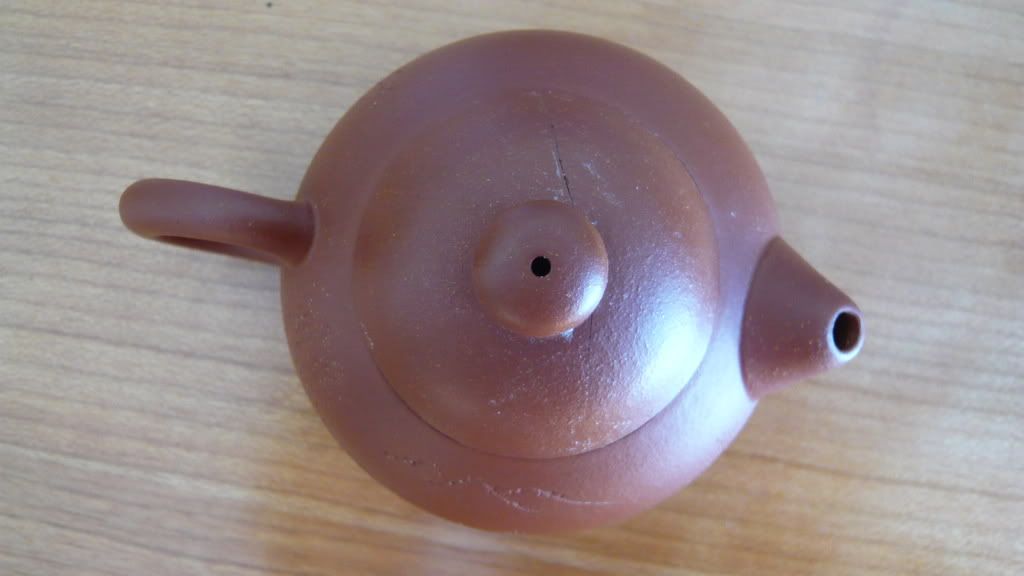
Since I bought it myself from China, and since back then USD to CNY was still 1:8.3 (yeah good old days!), this one cost even less than $25. And it's such a cute pot! I said I *used to* like it very much, because very unfortunately I broke the lid shortly after the 2-week report :-(


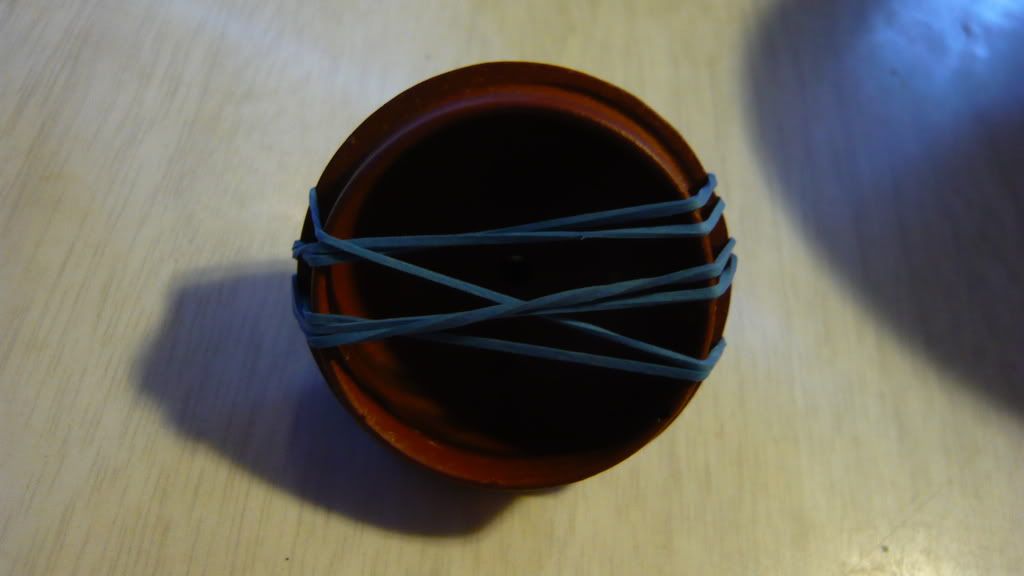
I managed to "glue" the shattered pieces with rice soup - not a water-proof glue, of course...


The teapot holds as one piece very well (rice soup is miraculous) as long as it doesn't touch water.

So I barely ever use this teapot anymore. But I still use it as a sharing pitcher from time to time. And occasionally, I put the lid of the aforementioned Zhou Huaqiang shui ping on top of this teapot and it fits quite well. Funny thing these two made a good match!

This teapot was made by Ji Weicheng - and of course he was only one of the hundreds of thousands of yixing potters and I didn't have much idea how much he was "worth". But overall I was impressed how well made it was for its price level. When I saw the name of Ji Weicheng earlier this year, he was listed as a well respected yixing artist and he mainly focuses on fully hand made teapots nowadays. Obviously he is doing well, after merely several years. His teapots aren't yet among the most expensive ones, but obviously he is at a whole new level now. And I was not surprised. I only regretted that I didn't wrote to him to beg for a new lid when his teapots were much cheaper :-p

Not all the unknown potters are as good. Around the same time I bought the Ji Weicheng teapot, I bought another inexpensive teapot made by another unknown young potter (whose name shall not be mentioned here...). At the beginning, it had great difficulty just pouring water out of it. After a quick examination, I found that 3 of the 7 strainer holes were clogged by clay, and another few of them were half-way clogged. It was the first time I had ever done something like this. But I found a big pin, straightened it, and used it to dredge the 7 strainer holes. I did it successfully and it took me 10 minutes. I felt both upset and amused. I understood that it was an inexpensive teapot, with regular clay and regular level of craftsmanship. But I did expect a teapot to pour smoothly. Besides, it doesn't take that much work to do some quick quality control or quick fix (it took me 10 minutes). The potter who made this teapot, as far as I know, is by far not as successful as the above-mentioned two. Probably he could still make a good living in the billion-people market of China. But I believe he is at a completely different level than the other two.

When reading my own 2-week report of the Ji Weicheng teapot, I saw that back then I said I was quite satisfied with these well made inexpensive teapots and wouldn't plan to buy any expensive teapots anytime soon. The funny thing is, I still feel this way now. In today's market, maybe $25 yixing teapots aren't that common, and even twice or triple the price would be seen as inexpensive. But within the relative price ranges, I've come to see many more well made inexpensive (well, relatively inexpensive) teapots made by unknown young potters. I didn't become much richer than several years ago (although I wish for the other way). Besides, I break things rather stupidly (as witnessed by the Ji Weicheng teapot...) and probably I should be banned from using expensive and fragile things :-p That being said, if I had a lot of money, I will surely buy more beautiful yixing teapots and spend more money on them (when I said this, someone in the house is scared...). But meantime, I always believe ordinary and sincerely made teapots deserve our appreciation too.

Aug 17, 2013

pictures of "most hated" yixing teapots...

This is inspired by a teachat discussion earlier this year at
http://www.teachat.com/viewtopic.php?f=36&t=18536

By strict definition, most, or all of the teapots showed in that discussion are not yixing teapots - they are not made of the authentic yixing clay.

But there are many authentic yixing teapots that are hate-able. And in my eyes, some authentic yixing teapots made by famous yixing artists are also hate-able. This last kind, because of the "halo" on them, I hate them even more than hating straightly bad teapots. And of course me hating them doesn't mean any final evaluation on them. I'm an art illiterate and hate many contemporary art works - I love many of them too, but some of them really strike my nerves.

Here are a few examples. All from the famous yixing book written by Han Qilou. By the way, this is one of the best yixing books in the least expensive price range. It has pictures of hundreds of yixing teapots, both antique and contemporary, all made by famous artists. Some of the contemporaries are beautiful. Some, I hate.


This is one of the most hated by me. The title of this teapot is "source of life".

It's not that I dislike breast shape teapots. I like the traditional xishi style very well.
This is one I like:


This is another one that I like:


This is yet another one that I like:


And I like wendan, a relative of xishi style in the breast-shaped family:


But... "source of life"... really??? It's a well-made teapot and I have biased taste. I just hate it.


Another two that I hate. The one on top (left) is "cheetah". I admire the author's effort to make a yixing teapot that barely looks like of yixing texture. But I just hate it.


The one on bottom (right) is "2008 Olympics". There is a world map on the lid, Olympic logos all over the teapot, and some traditional cloud pattern on the spout and handle. This is one of the busiest teapots I've ever seen, considering how many symbols it has to carry on itself. I admire the author's effort of trying to be "inclusive", be timely and be politically correct. But I just hate it.


None of them is "bad" teapot. But they rank high on my "most hated" yixing teapots list.

Aug 7, 2013

blog sale - no green tea this time :-( Part 1

Unlike the blog sales in previous years, this time, no green tea... well, maybe one or two. I have plenty of green tea to drink, but not much "exotic" to share in a blog sale :-p

Similar to the previous blog sales - 

If interested, please contact me at gingkoheight @ g m ail . com before August 24, 2013. 

Shipping is $4 flat for US, $7 flat for Canada, shipping to be estimated for other countries.

Shipping could be combined with Life in Teacup orders. 

All prices are lower than market prices and not correlated with our web store prices. 


All pictures can be clicked to enlarge.


This blog sale will be updated over the week and weekend with more items. Things in plan include some hei cha, some se zhong oolong, a few yixing teacups and some free stuff. Generally things not commonly seen, not even routinely seen at Life in Teacup ;-)

Since I'm wordy and have to give all the blah blah blah along the sale, this post is going to be long! So the latter part of the sale will be put on a later blog post. 


1. A couple of tea posters available to United States addressees only (due to the bulky shape). All other items are internationally available.

There are two types. Three copies are available for each type. The posters are all 60cm x 90cm (about 2' x 3'). The rims of the posters are slightly creased in previous shipping but there is no obvious damage and generally doesn't affect the outlook.

$ each poster and $ for two posters shipped together. The price includes shipping by priority mail (because they supply the long tube boxes suitable for the poster).

These are some samples I ordered when planning to carry some "tea education" stuff in Life in Teacup. But I've decided not to deal with them as they are too bulky to handle if you don't want to fold them. 

The posters are not as educative as some of the great tea books. But they are nice to display, and interesting to watch from time to time. The printing is not to an artistic level, and is about the regular poster quality.

The first poster is a collection of historically famous puerh products, wrappers, inner tickets and cake/brick tickets.

Poster A: puerh poster

Taiwan Wu-Shing Books (the publisher of the magazine, The Art of Tea, which is the English version of Puerh and Teapot magazine) once issued a similar poster which I put below my two posters. Wu-Shing Books' poster is of higher quality and is more educative (and more expensive, as their other nice stuff). It has captions to explain the displays and group the images based on their backgrounds. This above-displayed poster looks more casual and has prettier image structure, in my opinion. I use it as a fancy display and think it looks nice.

Generally I'm not enthusiastic at learning about old puerh from either posters or books. It's pretty much like what Chinese say about "the skill of killing a dragon" - you could learn the skill, and then you will barely find any dragon for you to kill :-p So overall I like the poster and keep one for myself to display. But my suggestion is don't take it too seriously and just see it as a fancy display. If anybody has Wu-Shing version and no longer want it, I'm interested in buying it, Chinese version preferred but English version would be fine too :-)

The second poster is a yixing teapot poster. There are 100 yixing teapots. I would have been more educative if they are 100 most popular traditional styles, but I guess it would be hard to collect photos of all those historically important teapots (so far the only one who did it successfully was Gu Jingzhou in his yixing teapot book, which was put up in a previous blog sale and will put up for this blog sale in a few days). The teapots on this poster are all from modern famous yixing artists (including some dead ones and some living ones). Many of them are of traditional style or resemble traditional styles with some modern themes.

Poster B: yixing teapot poster


Below is the previously mentioned Wu-Shing Books posters. They are NOT mine and NOT those for sale.


End of item #1


2. Yixing teapot poker cards. $6 each. Three sets are available.

If you like yixing teapot images and don't want a poster, this poker set is another option. It includes images of teapots both from modern time and from the old time. The print quality is very mediocre. It's the regular poker image quality.

It's of regular poker size. This poker set was published by China Poker Museum in 2012 (yeah I didn't know either there was a *poker* museum...)


End of item #2.


3. Yixing picture book edited by Gu Jingzhou (you could call him the Godfather of yixing...). $, US media mail shipping included. The cake in the picture served as a paper weight and is not included in the sale :-p

The book is the same book as introduced in a previous blog sale. You can see the other post for introduction and why I think this book is probably the best yixing book ever. This time, the book is from the third print in Hong Kong in 1996. The previously introduced Taiwan first print was sold on my blog and Life in Teacup (and some copies were sold on ebay). Its price was raised later due to the increased supplying price. The books sold here (Hong Kong third print, I have two copies) are what I obtained this year. I got them for lower price because usually earlier prints of art books are more expensive than later prints. If putting the two books side by side, I somewhat think the Taiwan first print looks better than this Hong Kong third print. But the difference is rather small and I don't know if it's a "placebo effect" due to the price tag :-p The two books are all the same except for the cover and publisher page. I'm not optimistic for getting either print for the same price in future years.


End of item #3


4. Zhu Ni yixing picture book - The World of Zhu Ni. $110, US media mail shipping included. This book is new. The rims of the hard shell might be dented a bit, but not severely. The side may bear some dust (but not obviously dirty). It may have some storage smell (but not as strong as that of Hong Kong humid storage puerh). It looks like this book slept in some basement warehouse for months when nobody wanted it. And now suddenly many people want it. Similar fate to that of the Gu Jingzhou yixing book.

This is one of the best Zhu Ni books and is named as one of the three "must-reads" by quite a few famous yixing collectors (I will introduce the other two books in future blog posts but I only have this one for sale). Its page size is smaller than the Gu Jingzhou yixing book. It's mostly composed of pictures too, so is nice for collectors from various language backgrounds. It has images of about 200 historically famous Zhu Ni teapots, including clear images of their seals.

The book was published by Taiwan Hu Zhong Tian Di (壺中天地)Publishing and Malaysia Purple Cane Enterprise (紫藤集團), which are two of the most famous tea culture organizations in Asia. This book is the third edition published in 2011. The price at publication was NT. 1200 or RM. 150, roughly $45. Its current price in Asian market is around $80-100, depending on book conditions. And the earlier editions (first and second) are much more expensive.

Most of the pages with text are already showed in photos below. All the rest of the 180 or so pages are mostly pictures as showed in the fourth photo.


End of item #4.


5. Yixing teacup, Di Cao Qing clay. Approximately 80ml. $22 each.

Height is 45mm, and diameter is 70mm. Each cup weighs about 6 oz. It's made by Xu Peng, whose Di Cao Qing teapots and other teapots are available at Life in Teacup. The clay used in the teacup is pretty much the same as that used for the teapots (color tone could be different due to variation of kilns and the shape and thickness of each vessel that respond slightly differently to kiln conditions; texture is generally the same).

The shape mimics a bamboo section and is very nice to grab. It's my favorite size to match with a small teapot so that a sharing pitcher can be omitted in gongfu style drinking.


End of item #5.

Free stuff:

Small Korean teacup (about 40-45ml):


Small porcelain teacup (about 40-45ml):


Tea pack clips:


Teapot brush (no photo, it looks very much like a painting brush).

Puerh knife or needle (various types but generally all similar)

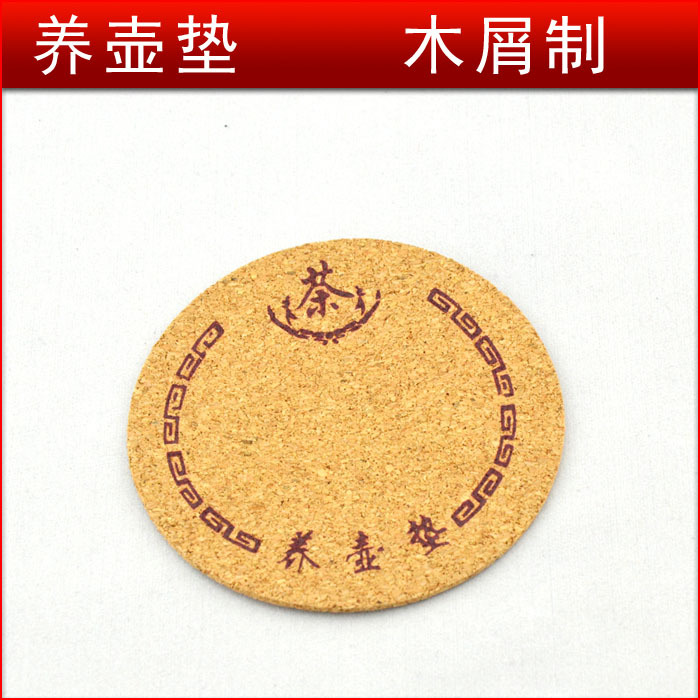
Teapot coaster - this is cheap stuff made of wood debris, similar to this one:

Starting from this year, suddenly everybody gave me a lot of these. They don't seem sturdy but could be useful to protect your yixing if you use a medal, stone or clay tea tray that could potentially hurt the bottom of yixing teapot.


To be continued.