Showing posts with label Brewing Method. Show all posts

May 8, 2012

brewing green teas with Petr Novák shibo set

Well, I guess shiboridashi was meant to be for green tea to begin with! But for a long time I forgot about this fact, as I enjoy using Petr's shibos for oolong and puerh - they have the perfect size and hand-grab feeling. The little "teeth" at the spout does a great job filtrating liquor out of brewed tea leaves. And, they don't get your fingers burnt! I never feel 100% comfortable using gaiwan for gongfu tea, and used to take teapots as much as possible. But suddenly, Petr's shibo became my new "gaiwan" :-D

Last time when we got a bunch of Petr's hand made tea ware (tea bowls, shibos, teapots...) for the web store, I selfishly grabbed this cute red shibo set for myself before showing it to anybody :-p Then in this spring, when new green teas arrive, I suddenly realize this is a perfect set for green tea! Oh well I guess I'm the last one to realize this :-p But I mean, many people use shibos for Japanese greens, and they are actually perfect as well for Chinese greens. And this specific set has everything I love as a green tea set!

For green tea that requires a lower temperature, the shiboridashi with lid removed serves as a perfect water cooler, and the small tea bowl that comes with it can be used as a brewing and drinking vessel. It's quite small, but perfect for tea that you've got to be thrifty on.

Cooling water:

Pouring water in the little tea bowl and throw in some Bi Luo Chun:

Bi Luo Chun "germinates" at the bottom of the bowl!


An Ji Bai Cha brewed in a similar way:


Tea that can tolerate hot water well can be brewed in the shibo directly, such as this Huang Shan Mao Feng:

Somehow I feel the color of the red glaze matches spring green very well! And the white inside is perfect for appreciation of green tea leaves.

Brewing Yong Xi Huo Qing is as easy as throwing tea grains into a bowl of hot water.


Then the tea grains would "germinate" in water.

 Then it takes a couple of minutes for the leaves to get fully expand.

 The monkey seems as thrilled as I am!

Teas like Bi Luo Chun and Yong Xi Huo Qing stay put at the bottom of the vessel and don't usually get into the way of your drinking. For some other teas whose leaves would go up and down in the water, or float around, the lid could be useful.

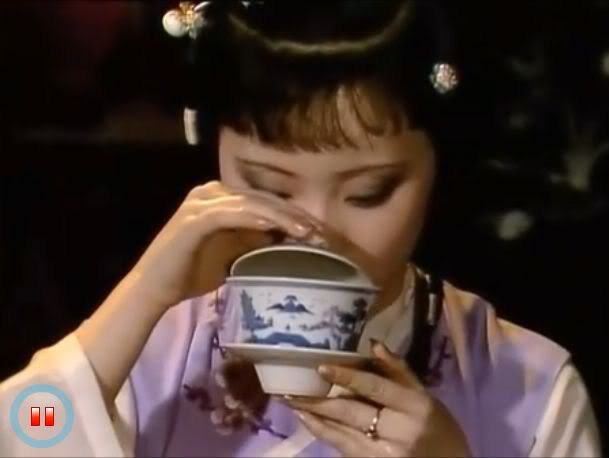
This is how people use the lid of a traditional gaiwan to wave away tea leaves when drinking green tea. You can do pretty much the same with the lid of a shibo :-)
(This is my favorite actress in my favorite Chinese TV version of my favorite book, The Story of the Stone.)
For most Chinese green teas, I would use hottest boiling water, or water temperature very close to boiling point. Hot water could be very helpful for green tea leaves to open their cells and release flavors. Then a tea bowl with wide opening is really handy. It allows hot steam to escape fast so the water wouldn't stay too hot to get the leaves "cooked". Meantime, the thick wall prevents water from cooling down too fast. I didn't analyze all this before using this shibo. But once I started, I found myself using it most of the time since the green teas arrived a few week ago. Then I came up with all these guess-analysis about why it seems so great for green teas!

Sep 15, 2011

tea (and tea ware) away from home

What tea and tea ware to bring on a trip away from home? This is a question tea drinkers frequently ask themselves.

For me, here are a few considerations:
1. Whether or not to bring any - on some trips, especially backpacking trips, I don't bring any. Too lazy to put up with the chores and worries (of breaking tea ware). I've seen several online discussions about tea for camping trips. So far none of them has convinced me to bring tea to camping trips myself, partially because I am one of the clumsiest campers, and partially because I don't feel like to have any tea when there is no daily shower and the restroom has no roof.

2. On most trips that I do bring tea, I bring barely any tea ware. On most trips, I have to carry my own stuff, and I stay in very modest lodges. So again, too lazy to put up with the chores and worries. Besides, I want the amount I carry to be proportional to the time I will be able to spend with tea. On many trips there are a lot of things to see and to do, especially because I am the compulsive, running-around type of traveler. When we were traveling in Mexico, my partner could spend half a day sleeping in the hostel, and another half day drinking and singing with others on the porch. I was like, "No! I didn't spend $500 air fare and travel 1000 miles here to sleep in the hostel!" I ran around and visited places all day long, every day! So, there was not much time for tea. I knew it before the trip, and therefore would pack very little tea stuff for the trip. When I take with me minimum to none tea ware and very small amount of tea, I usually have teas that are easy to brew in cold water, as well as black and/or green teas that are sealed in home-made teabags. Although I say black and/or green, one oolong I've found very convenient is Oriental Beauty, as I tested it with mug brewing and found it wonderful brewed in this way. Oriental Beauty is my favorite aeroplane tea. It brews well even in the not so hot water provided on board. Its aroma makes people jealous! Besides, ever since more and more airline started charging people for food and beverage on board, I've enjoyed bringing with me nice snacks, fruits and teas that will make the airline offerings look totally miserable, haha!

3. If I am on a short trip and can stay in a decent place with boiling water supplies, I would usually bring my gaiwan travel set. This is partially because of the obvious convenience and versatility of gaiwan, and partially because the gaiwan travel set is usually quite cheap and easy to obtain. I would rather not take along any nice tea ware if I have to worry about them being accidentally broken.

4. If I am on a multiple-week trip and can stay in a decent place (such as the Toronto vacation I have from time to time, or the 1.5 months I spent in Boston in the past summer), I would bring a few more pieces of tea ware and quite a few different teas with a few "anchorage teas" and a bunch of sample size teas. When selecting which pieces of tea ware to bring, I will use following criteria:

a. It's relatively sturdy. I won't pack the most fragile into luggage and let them see the ups and downs of the "outside" world.

b. Each piece of tea ware should serve multiple functions for multiple teas. A lazy person always wants every moment of her labor worth it!

c. After packing in one small teapot and one large teacup for one-person session, if there is more space, I would manage to pack in a few small teacups. Most of the times I drink tea alone. But I want to be ready if some other people could join me in tea sessions. When there are more people, one teapot may do its job well, but multiple teacups are necessary.

What are your tea-on-the-road routines and tips?

Aug 14, 2011

to avoid over-brewing & under-brewing Chinese green tea (1)

Most tea drinkers have very good ideas about what can cause over-brewing of a green tea. What I want to discuss here is a series of factors that may cause over-brewing, in a sequence of their significance as far as I can see.

1. Steaming
2. Volume of water
3. Temperature
4. Infusion time
5. Leaf/water ratio

This discussion is out of the thought that some factors are more likely to cause over-brewing, but are often neglected (for example, steaming factor). On the other hands, some other factors are not as likely to cause over-brewing, but are sometimes over-emphasized (for example, temperature factor).

Before I start, I would like to stress that tea brewing is a very personal matter, and there can always be a lot of variations in methods and brewing parameters. Eventually what works is the best, and different ways may work for different people. Sometimes we break some rules, not to prove these rules are wrong, but to demonstrate it's wrong to rule out other possibilities.   

Brewing tea is a process of extracting good flavors out of tea leaves into the tea liquor. Here I will define "over brewing" as brewing that causes unpleasant flavors to be extracted or generated - this is what people say a tea is "cooked". "Under brewing", in my understanding, is brewing that fails to extract most good flavors from tea leaves.

1. Steaming
I usually suggest people to use un-lidded vessels for green tea. Traditionally, gaiwan was a very popular vessel for green tea. But when gaiwan was used to brew green tea with young and tender leaves, the lid was either not placed or only used to cover the cup half way.

People with cooking experience may have noticed this. When you saute some green vegetables in a pan on the stove top, as long as you carefully control the process, you can make the sauteed veggies juicy, tender and crisp, with their nice green color. But if you leave the freshly sauteed vegetable in a sealed container or covered dish for several minutes, it can get pale and soft, losing half of the flavors. What "kills" the veggie dish is also what sometimes "kills" the green tea - steaming, not high temperature.

Why were teapots used in the traditional society for green tea then? I guess, it's because teapots (especially yixing) are good at retaining temperature. This could be important in the traditional society when the rooms were not well-heated in winter. When using teapots in the traditional society, people were struggling with cold environment, and were not worried about over-brewing due to hot environment. This is also why gaiwan is a versatile tea ware. By placing the lid, placing it half way or removing it, you can adjust the brewing environment in the cup.

It's not that a lidded vessel is less good for Chinese green tea. And I personally have a favorite yixing reserved for green tea. A tea drinker can adjust the temperature, leaf/water ratio and infusion time to make a lidded vessel serve very well. Naturally, when a lidded vessel is used, water temperature should be lower, in order to avoid the "steaming" effect. But then the "catch" is, when lower water temperature is used, there is the risk of "under brewing", which will be elaborated in the third section about Temperature.


2. Volume of water
When you use a small gaiwan (4 oz. of less) for Chinese green tea, as long as it's not fully lidded and steamed, feel free to use the hottest water, and the leaves will not be over-brewed. Of course, by adjusting the temperature a little bit, we can get better result. But when the volume is small, the danger of significant over-brewing is tiny or none. The wide opening of the gaiwan cup will allow steam to escape fast and temperature drop fast. This is just an experiment. I am not suggesting everybody to use a vessel as small as 4 oz. for green tea. (Besides, it could be hard for people with big hands!) A "small vessel" is probably something smaller than 180 ml (6oz.). But with a vessel up to 300ml (10 oz.) and with care, the vessel can release steam and lose heat fast, so that the tea will not be over-brewed.

Temperature and Heat are two different concepts. Think of the flame of match stick (temperature around 400 F) and a liter of hot water (temperature: 200 F). The flame has higher temperature, but with its small mass, it has by far less heat than the big pot of hot water. In tea brewing, it is the extra heat, not temperature, that over-brews a tea.

Some people may say, how inconvenient it is to use a tiny small vessel for tea! What if I want more! Well, first of all, I think we should be aware that in modern days, all our vessels, whether for tea, coffee, or many other things, have grown amazingly big. Many of them are so much bigger than what they used to be just a few decades ago. What's small to many of us today, was just normal size in the past. Believe it or not, when you have your tea, snack or other things in a small portion, it tastes better :-D Besides, you can always have multiple cups, with each cup carefully prepared and delicious. When large volume is used, then there should be caution about over-brewing, and other brewing parameters may need to be adjusted accordingly.

Aug 6, 2011

a red tea infuser turned into a Tai Ping Hou Kui glass

It's quite hard to find good Tai Ping Hou Kui, in   my impression, much harder than finding good Long Jing. That makes me a little stingy in drinking it.

Authentic TPHK has its leaves manually shaped one by one. Such kind of tedious labor often makes me feel guilty drinking the tea. Is it really worth it to make a tea in such a time-consuming and painstaking way? I don't dare to say it's not worth it. But I neither want to be the one processing the leaves nor the one paying big money to buy it :-p And if the tea is too expensive, I turn to other teas.

The TPHK I've got this year is pretty good, thanks to the cold spring weather. The leaves, in my eyes, are quite nice. But these are not the most beautiful leaves of Hou Kui. The top grade Hou Kui has all the leaves almost of the same length which would make me feel terribly guilty both for the labor it costs and for my own money :-p Again there is the question "is it worth it?" as there is no evidence that TPHK with even-length leaves taste better than that with shorter and longer leaves. But some people may think it's worth it, because the leaves can be so handsome and is one of the most beautiful tea scenes. As for me, I chose this one with modest leaves, which is still manually pressed one leaf after another one and, to me, is still quite expensive. So I was looking for a very small glass for Hou Kui. 


Before I found a real glass that's small, I got a gift of red tea infuser. It's pretty much like a stout graduated cylinder with a cover and an infuser inlet. The infuser arrived broken but the cylinder and cap are fine. I didn't plan to use it for red tea anyway, but was glad to find it a nice vessel for Hou Kui.

Now this is my official Hou Kui glass (although I use it and its cap for white tea too). I use a small yixing of about 130ml as the water decanter. Hou Kui is a high mountain tea from Anhui and steeps well in very hot water. Unlike Zhejiang tea drinker, many Anhui tea drinkers never have the habit of cooling water before tea brewing. Very few Anhui green teas can be hurt by the hottest boiling water (when brewed in a small vessel, no cap, no steaming...). But I prefer to let the boiling water take a side step through the yixing before pouring it to the glass a short while later.

Hou Kui is a very volume-y tea. What's in the glass is very little by weight. This "red tea infuser" is small and tall, exactly what I had wanted for Hou Kui!


Tea is not a luxury of money. That's what I believe. If there weren't some strange-minded person ever inventing such a strange-looking tea this hard to make, then even the richest person wouldn't have a chance of this drinking experience. As far as I know, none of the emperors in Chinese history had the opportunity to enjoy the luxury of Hou Kui. 

Jun 1, 2011

ATB Blog Carnival - Milk Tea... Tea Milk...

This blog entry is part of ATB Blog Carnival hosted by Gongfu Girl. A full index of blog arnival entries can be found here

The topic of this blog carnival is: about how to brew a specific type of tea. 
This blog post was written a year ago. I pulled it out since it fits the topic. I also added a few notes on it.

Before I ever tried adding tea to my milk (I haven't tried adding milk to tea yet), I had Milk Tea (it should be more precisely called Tea Milk, in fact) with my Tibetan buddy, Laja.

The milk tea Laja makes is easy. He just throws tea leaves into boiling milk. I read it somewhere that tea made in this way is called "Sweet Tea" or "Lasah Sweet Tea". But Laja just calls it Milk Tea. I asked what tea he used, and he had no idea. He only knew it was The Tea. Based on what I heard, what I read, and what I saw from tea products, Tibetan tea is a Hei Cha (what Asian would call Black Tea, which is different from the Black Tea in western sense), which is somewhat similar to Shu Puerh. However, this guy has no idea whether his tea is a Hei Cha or not. I guess if you drink it every day (scientifically speaking the milk tea is physiologically essential in traditional Tibetan diet), it's part of your life, it's The Tea, and the genre and category don't matter at all. These days I see Laja about once a year, and every time I had his tea but forgot to ask him to show me the package of dry tea leaves. So I haven't yet figured out what he uses for his milk tea. He told me that any black tea can be used. From time to time, he has tea sent from his hometown in Qinghai. But when he first came to America and didn't have any tea in hands, he even used the regular type of Lipton teabag. Now I think, if Lipton teabag can be used, then pretty much any tea can be used for it.

(Later, after a few phone conversations, Laja and I guessed that very likely his hometown "black tea" is some sort of Hei Cha from Hunnan, possibly Black Brick Tea. But I also have the impression that the tea leaves somehow looked like some Sichuan Hei Cha. Anyway, Laja's tea seems a Hei Cha. Puerh is also commonly consumed in certain regions of Tibet. - May 2011)

I don't often feel a need for milk tea. But out of curiosity, I tried making it for a few times, mimicking what Laja did, with some modifications. A modification I've had is packing tea in a bag. Laja would throw tea leaves in the milk and eat the tea leaves eventually. I would rather not eat the leaves. To save a filtration step, I seal the leaves in a small teabag.

At the first, I tried using the last bit debris of a 2004 Xia Guan Tuo.

I planned to make only a small bowl of milk tea, so I packed up only small amount of the tea debris. In my impression, Xia Guan Tuo is very strong and that much in a small bowl would be enough.


However, the milk tea turned out rather weak. I boil the milk in a small pot. When steam started to rise, I threw in the tea pack. Then after the milk was fully boiled, I let the electronic stove adjustment lever stay at about "11 o'clock" position with very weak heat for about 5 minutes. Then I squeezed the teabag and threw it away. To my surprise, the strength of Xia Guan Tuo seemed to be entirely shaded by the milk. Besides, since this is a sheng puerh, it doesn't change much of the milk color, which was very unexciting to me. So the second time, I used a 2009 Bulang Stamp Tea, Shu.

This is the Bulang Stamp Tea by itself:


This is probably one of my favorite Shu so far. But I've never really got super excited about Shu, most of which tastes hollow to me. What I like about this tea is, it's relatively lightly fermented, compared with most Shu. After each sip, there is actually some "kick", a little bit similar to the aftertaste of Sheng. But after all, I don't treasure Shu that much and wouldn't hesitate to throw it into some experiment. So I made a teabag with this tea. And this time, I used a lot more tea, probably twice as much as last time.


Boiled in milk, the tea changed the milk to a pink color.


This time, the tea taste was much more explicit. And I think it tasted more like Laja's tea. But still, I feel I could have used even more tea. With either Sheng or Shu boiled in the tea, the tea elicits some special "fat" flavor from the milk. The flavor is unique to lamb or beef. I used to dislike such flavor. But in recent years, frequently fed lamb by Robert (I sometimes joke that he must have been a Muslin in his last life), I've started to like such "nomad" flavor more and more, especially when it's not too strong.

It seems to me that the milk tea can make me go a long way. When I had a bowl of milk tea after a meal, by the time of the next meal, I didn't feel very hungry at all. Does this mean the milk tea can possibly be developed into some slimming tea? :-p

I would also like to try red tea, especially Darjeeling and Kenya black tea, in milk too. Darjeeling boiled in milk makes Nepal milk tea. Actually, in most milk tea recipes, concentrated tea is made first, and then it's mixed with a lot of milk and some sugar. But our milk, even whole milk, is not as rich as the "original milk", and I usually only have 2% fat milk at home. So boiling tea directly in milk is the easiest and produces rich milk tea.

(As I started drinking more and more milk tea, eventually I found it more convenient for me to make darker tea first and mix it with whole milk.  - May 2011) 

Some people believe British custom of adding milk to tea originated from Tibet. According to that theory, Tibetans influenced Nepali in making milk tea; then this drinking custom was brought to India, including Assam Province; and British people learned of adding milk to tea from Assam tribes. I don't know where this story is from, but it sounds very possible.


May 2011 -

In the past year, especially during the winter time, I made milk tea frequently with Fu Zhuan, a favorite Hei Cha of mine. The tea and milk are perfect match! I also "milked" some Black Brick Tea, Tibetan Ya Xi Hei Cha, Thousand Liang Tea/Qian Liang Cha, and a few other Hunnan Hei Cha and Sichuan Hei Cha. They are all pretty good! So, if you are a hard-core tea lover and not fond of the idea of adding milk to tea, I urge you to consider the option of adding tea to milk, haha :-D

To me, a constant problem is, even when whole milk is used to make milk tea, the milk is somewhat diluted eventually. One solution I've learned from a Uyghur friend is adding "milk skin" to the milk tea. "Milk skin" is the top layer of boiled milk. The fresh version of it (if you scratch the bottom of the saucer that has just been used for boiling milk, you will know it!) is heavenly delicious. But I only got some dried milk skin, which is perfect for milk tea. It looks somewhat like this:
Some Mongolians and Uyghurs like putting broken pieces of it in milk tea. It add milk flavor to the tea, and the soaked pieces are quite tasty too.

My Uyghur friend said, at home, they sometimes also add rose petals to the milk tea. This sounds terribly luxurious to me! But it's a great idea if you have lots of roses growing out of your window. I don't have fresh roses to eat. But ever since I heard of the rose milk tea, I've been dreaming of getting some rose jam for my milk tea!

Jan 10, 2011

How do you brew your green tea?

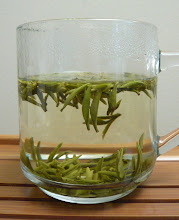
1. In a glass - you know that's my favorite vessel for green tea :-D It's easy and it has a view!


2. Sometimes a wine glass :-D I don't notice much difference between a wine glass and a glass mug. But a wine glass makes the tea session feel special!


3. Sometimes a very small glass. This 2 oz. double layer glass from Amazon is very cute. I use it for everything, tea, coffee, grand marneir... It's great for ball-shaped tea that's ready to sink to the bottom.


4. Sometimes a shot glass. Still looking for a tall shot glass for Tai Pin Hou Kui!


5. In a bowl - I like this way too and like holding a tea bowl, easy and comfortable...


6. In a gaiwan - I like it, but then I would need to use both of my hands, while glass/tea bowl requires only one hand :-D But I like gaiwan for Long Jing, which typically has leaves floated on the surface, and you can always use gaiwan lid to wave away the leaves.


7. In a yixing - I rarely used a yixing for green tea...

...until I got this cutest Duan Ni teapot. Its 180ml volume and narrow spout makes it insuitalbe for most of my oolong or sheng puerh. I am worried red tea would stain Duan Yi to a dirty color. As for shu puerh, I won't use any cute teapot for shu! It's very rare that I would change my drinking habit to fit a vessel. But that happens!


8. In a kyusu - I rarely use a kyusu for Chinese green tea, mainly because I love glass vessels. I would love to have a few more porcelain kyusu between 150ml and 250ml though. Currently I have a few above 300ml. I love them but seldom really use them.


9. In a water bottle - I do it a lot in summer, mostly with cold water, and sometimes warm water in a heat-tolerant bottle.


10. For few times when the tea should be drained after each infusion, without a gaiwan or teapot, I did this too... in a very clumsy way...


How about you? :-D

Dec 18, 2010

Wrestling of Dragon and Tiger 龍虎鬥

A tasting notes about this was logged on Steepster. Viewers’ discretion is necessary!

And later, I tried various versions of it!

“Wrestling of Dragon and Tiger” is a traditional way of tea drinking in some ethnic cultures of Yunnan. It’s not 100% puerh (and sometimes black tea is used instead). It’s a mixture of liquor and puerh. I’ve read about it in quite a few books but have never seen it’s practiced. So I did mine based on guestimation and imagination :-p

In my nutrition knowledge, it can be very unhealthy to take alcohol and caffeine together, when both are in large doses. But with large amount of one and small amount of the other, it seems ok. That’s why Irish coffee with Bailey is supposed to be ok, but nobody would put a shot of rum in a shot of espresso.
 
I thought of this exotic drink at a cold night. I have some ginger brandy as my "flu formula" and some other liquors for making cocktails. A shot of my cheap brandy always does miracle and makes my instantly warm. So at that cold night, I thought some brandy and some shu puerh may boost up some warmth. Indeed it worked perfectly! So the second time, instead of using some left over puerh leaves, I used some newly brewed puerh to get more taste of tea. And I tried a third time with Yunnan Golden Bud. Besides, I cut down the amount of alcohol. In the initial taste, I said, "When made a warm drink, everybody should cut off half of the amount of alcohol that she usually feels comfortable with." And later I thought, it should be cut down to 1/5 or less, since the alcohol rises with hot steam and gives you a light drunk-feeling very efficiently!

Here is my notes from the first drinking - The light drunk feeling came before the taste of tea. Besides, I did get peanuts and chocolates right next to me, in case I would feel the drink burning my stomach lining (luckily it didn’t). The steam of alcohol rushed through the throat as well as the nose. Then the taste of tea kicked in and lingered around. That’s the way to get both tea drunk and alcohol drunk with just one bowl :-D

Here is a record of what I did with Yunnan Golden Bud and rum.

First, I use the lid of the rum bottle to measure 1/2 to 3/4 lid-full of rum, and put it in my small chawan. According to the books, it's always crucial to add tea into alcohol, not the other way around. That's very reasonable, because alcohol is lighter than water. If alcohol is added on top of tea, it all floats on the surface and you are very likely to get drunk, as well as a big hit on the stomach.


Then, I used hottest possible water to brew some strong tea (ideally the tea should be brewed by boiling in water on fire). And then the tea was poured into the chawan. Then the drink is ready!

I like the name of this drink. It's exactly how it feels!

But it's NOT a daily drink. Don't let them fight each other too often, or the world will be upside down!

P.S. - Since I will be in Yucatan during the holiday, now I am considering the possibility of puerh-tequila as a New Year celebration drink :-D

Nov 29, 2010

a small teapot that changes it all

A few months ago, when Steepter's Select (which is not available now) had this cute little glass teapot from Samovar Tea on promotion, even I almost wanted to buy one. I said "even I" because I love yixing and porcelain teapots a lot more. But for a moment I was totally attracted by the little glass teapot. Small glass teapots are all cute! The teapot itself was not new to me. But I have to say, Samovar presented it in a very lovely way! It was on promotion with their Four Season oolong, which makes perfect match with the 4 oz. glass teapot.

Later, I was very grateful to see some tea drinkers mentioning that they used Samovar's 4 oz. glass teapot to brew some oolong from Life in Teacup, and enjoyed the tea much more than when they brewed the tea less gong fu style. I was very grateful, because I myself could never make such a positive influence. People were drawn to the cute teapot not just because of Samovar's reputation, but also because of their successful presentation of the product. When I went through the product web pages, I enjoyed watching the video clip which demonstrates using the cute teapot for gongfu brewing of oolong in a very beautiful and simple way. The 4 oz. little glass teapot is indeed a very good start point for people to use gong fu style. It's elegant but not as complicated as yixing teapots. Besides, its transparency provides a great view of tea leaves. The pairing up of Four Season and the glass teapot in the promotion was also very smart. As many other greener oolongs, Four Season yields much more in gong fu style than in other styles.

Thinking a teapot sometimes indeed gives us a whole new experience in tea drinking, I brought this Kamjove travel gong fu teapot to Life in Teacup. I don't expect it to make as large an influence comparable to that of the cute little glass teapot of Samovar. But maybe some people would find the Kamjove travel gong fu teapot very useful and handy.


I have always been a fan of Kamjove travel gong fu teapot. Kamjove was originally a manufacturer of electric pumps and compressors, which are still a big part of its production now. The company is located in Chaozhou, where everyone loves gong fu tea. The CEO of the company is an enthusiastic tea lover. His love of tea drove him to develop product lines of Kamjove tea devices, including several dozen various models of travel gong fu teapots and electric kettles. I've found it interesting that after becoming a large mechanic manufacturer and a millionaire, the guy isn't just satisfied with collecting some expensive traditional tea ware. Instead, he would like to make some modern, geeky tea ware himself. A typical engineer! And I think he is a savvy business man too. Their tea devices turned out more famous than their mechanic devices. After all, if 1 in every 10 tea drinkers in China uses a Kamjove teapot (and break one from time to time), their sales figure will be huge. I, as a tea drinker, have owned a few of them, and sent out several of them as gifts. I don't like using electric kettles. But I know many people using Kamjove kettles too. 

The one I previously used looks like this.

I've found its size (120ml infusion cage) perfect for gong fu style brewing. It strains water even faster than some faster-straining teapots. Besides, sometimes I would use its glass mug alone for green tea. I loved this teapot and once gave a same teapot to a friend who is a Chinese artist. Later he told me that at the beginning he didn't want to accept the gift at all (I was like, "what!?!") because it looked too geeky for a teapot. But he admitted that eventually he found it very convenient and lovely.

Later I switched to the one in the earlier photos. It's slightly larger (140ml) infusion cage). I like the smaller size and the slim look of the older one. But when I used the glass mug for green tea brewing, at the end of the brewing, I found it hard to reach the bottom of the slim mug to get spent leaves out. So I like the stout shape of the new one better. Besides, the new one has an infusion cage that can be interlocked with the glass mug, which makes it more convenient to carry the teapot around in one piece.

May 13, 2010

White Teas, names and more

White tea is lightly oxidized tea. It's made by directly drying (sun-drying or roast drying) and withering tea leaves, without killing the enzymes in the leaves. Since the enzymes in the leaves are not killed, oxidation happens to a small degree before the leaves are thoroughly dried. This is the case of traditional white tea only. I've had some Huang Shan (Yellow Mountain) white tea, made in colder climate zone, and therefore with almost zero degree of oxidation.

Bai Hao Yin Zhen (白毫銀針 Bai Hao Silver Needle) is probably the most precious white tea. After the tea leaves are harvested, only the leaf buds are used to make the final product, and the extra leaves will be used to make Gong Mei (Tribute Longevity Brow, 貢眉, whose lower grade is Shou Mei / Longevity Brow, or Sow Mee, 壽眉). When making Bai Hao Yin Zhen, all the imperfect buds, even those with tiny bug bites or smallest discoloration, will be removed -  this is the ideal standards and nowadays there are actually Bai Hao Yin Zheng products of various grades.

Compared with other tea categories, white tea category is smaller, with relatively fewer varieties. Besides the most famous Bai Hao Yin Zhen and Bai Mu Dan (White Peony), there are also Shou Mei (the lower grade of this tea is often seen as Sow Mee sold in Chinatown grocery stores as an inexpensive white tea), Gong Mei (貢眉Tribute Longevity Brow) as previously mentioned, and Fujian White Jade Bud (also called Fujian Green Snow Bud, as its leaf color greener than other Fujian traditional white teas). These are all the traditional white teas recorded in the tea books I've seen. Besides, Yunnan, Anhui and other provinces make white tea of various kinds, but large scale production has started only since recent years. Fujian province has started producing a New White Tea (新白茶) since 1968, mainly to supply Hong Kong and overseas markets. It's less expensive than traditional white tea. But sometimes Beijing Wu Yu Tai Teahouse carries a King Grade of this New White Tea, the annual production of which is said to be only about 100 pounds.

About White Tea, also worth mentioning is the Seattle White Peony Homemade by Brett of Black Dragon Tea Bar!

There are several names affiliated to white tea that are quite confusing and therefore worth some scrutinizing.

1. Silver Needle is not necessarily a white tea. For example, Jun Shan Silver Needle (Jun Shan Yin Zhen, 君山銀針), one of the ten most famous Chinese teas (there are various versions of the "top ten", but Jun Shan Yin Zhen seems to show up in most of those versions), is a yellow tea. Besides, Gui Lin Yin Zhen is a green tea from Gui Lin region.

2. If a tea's name include "white tea", it may or may not be a white tea. For example, An Ji White Tea (An Ji Bai Cha, 安吉白茶) is a famous green tea from Anji, Zhejiang province. White Monkey (Bai Mao Hou, 白毛猴) of Fujian province is mostly said to be a Green Tea. But White Monkey is an odd case. Most people say it's a semi-oxidized Green Tea. But theoretically if a tea is semi-oxidized, it's not a Green Tea. White Monkey is also called White Green Tea in Fujian. So I guess you can categorized this tea in whatever way you like. The confusion is understandable though. After all, when people started to invent a tea, nobody would think, "Today we are going to invent a white/green/red/yellow tea." The tea just came out in whatever way it could be.

3. If a tea's name include Bai Hao (or "silver tip", 白毫), it may or may not be a white tea. For example, Yun Hai Bai Hao is a green tea from Yunnan.

4. Recently, I read about the most confusing white tea names ever. It's in 品茶圖鑒 by 陳宗懋 Chen Zongmao et al. (2009). Traditionally, Bai Hao Silver Needle comes from Fuding (tea is roast dried there) and Zhenghe (tea is sun dried there) of Fujian province. White teas from these two regions use slightly different techniques, but the final products are quite similar. In all the other sources I've seen, white tea from these two regions is consistently called either Bai Hao Silver Needle or Silver Needle Bai Hao, which are treated as the same name. But in this book, the authors claim that the white tea from Zhenghe is called Zhenghe Bai Hao Silver Needle, while the white tea from Fuding is called Silver Needle Bai Hao. That's to say, Bai Hao Silver Needle and Silver Needle Bai Hao are two different names. On the one hand, the first author of this book is an Academician of Chinese Academy of Engineering. So I think I should take him seriously. On the other hand, I feel the authors didn't give thorough explanation on the two names. I have yet to see if there are other people who share this view.

Besides the name confusion, the discrepancy of various versions of white tea brewing methods is larger than in many other teas. My understanding of white tea is, it was very gently processed, without rolling or squeezing, and its cells are better maintained than cells in other teas. Therefore, it takes higher temperature (newly boiled water) and longer infusion time (5 minutes or longer) for water to infuse into the cells of white tea, especially for Bai Hao Silver Needle, whose leaves are nice and complete. Initially, it actually surprised me to see some sources suggest using lower temperature (180 F or lower). But after all, there are no fixed rules about tea brewing. Higher and lower temperatures may work for different people. I've seen people who were somewhat intimidated by the temperature restriction and thought that using very hot water for white tea was not "right". Therefore I sometimes just can't help urging people to give boiling water at least one chance. It may or may not work for each person, but it does no harm to try it at least once.

In Chinese medical theories, white tea is deemed as one of the teas with strongest cooling power. It's a great beverage when the body is annoyed by cold sores, dry throats or dry eyes. It's also a great relaxing drink when one feels anxious or worried. For people whose "inner heat" is weak (for example, if hands and feet easily feel cold in winter days - I sometimes feel that way), white tea may not be a daily drink, but can still be an occasional enjoyment, especially in days when the air is warm and dry.

Recently, there was breaking news about White Tea. Last year (2009) in Xi'an, intact tea leaves of White Tea was discovered in a newly explored Song Dynasty (about 1000 years ago) tomb! Initial analysis indicates that the leaves are Bai Hao Silver Needle, same tea as what we drink today!

From the following photo (from Tea Time magazine), the tea leaves look pretty much drinkable!


Personal declaration: Please do not put entries of this blog on Unsnobtea. I have no affiliation with Unsnobtea or any of their products.

I am sorry to have put it in this way, but so far I haven't found any contact information of Unsnobtea to talk with them about their using other people's blogs to endorse their own commercial website.

Other forms of discussion and sharing of information are always welcome, given proper communication.

May 10, 2010

Ban Na Sunset

Oh! What a cheesy name! But that's what I can think of so far to name this tea.

I heard of the idea from a friend - it's a popular way of drinking tea among Yunnan people (which part of Yunnan, he doesn't know though. Yunnan is so large and diverse!).

Step 1, brew Yunnan green as usual. This time I used a Yunnan roast green (the one that was made on January 1, 2010). The original version is using Yunnan sun-dried green though. I don't have any of it, but puerh young sheng is basically the same thing, just it's hard to get a young sheng with beautiful leaves. Next time I will try using the Guan Zi Zai Yi Wu, which has the most beautiful leaves I've seen from a puerh cake.

This is the amount of leaves I used, and later it turned out a bit too much. Or, my mug is too small.


Step 2, enjoy the first 3 infusions as usual. But for this, I refilled the mug every time when the tea liquor was about half of the cup volume. This is partially because I wanted to keep the strength of the tea, partially because I did use too much leaves. Yunnan green is strong!


Step 3, at the end of the 3rd infusion, when there is about 1/4 volume of the liquor left (I assumed 1/4 was better than 1/3 because the more newly added hot water, the better the tea would be infused), add in Yunnan red (black) tea.


Step 4, refill the mug with hot water.


That is it. Then you can re-infuse on and on. This lasted a whole afternoon for me. Eventually the leaves expanded a lot and there is relatively small space for accessible tea liquor. I guess, this is a tea enjoyed by people who drink a lot of tea and don't have much time to take care of their tea brewing. In other words, this is a tea for real workers to gulp, not for Gongfu drinkers to take sip after sip. So for such a purpose, this mug is too small. 


The first infusion after adding red tea was a bit astringent. But I didn't mind at all. Yunnan people would say if a tea is "bitter without biting your mouth and astringent without sticking to your tongue", then it's a good tea. I kind of agree. The astringency instantly became sweet aftertaste. Then later in the many infusions, the tea became smooth and remained flavorful.

Supposedly, Yunnan sun-dried green (such as a young sheng) is even stronger than roast green. So next time when I have a whole day of work, I will start the day with some Yi Wu leaves in a big mug and add in some Yunnan red tea later on. It can be a good companion without much attention required.

P.S. I brewed it again in my travel tea bottle for a road trip. It's a very convenient way to have tea during a trip, and I infused the same leaves over and over during the whole afternoon trip.