Showing posts with label yellow tea. Show all posts

Mar 11, 2011

updated Tea Harvest Calendar

Recently I did some updating on a Tea Harvest Calendar I made a few years ago. From time to time, people send me questions about harvest times of teas. In fact, I am not sure how to make a harvest calendar that's easy to read and inclusive of important tea information. Still, I am afraid I get stuck in between - the current harvest calendar is not easy to read, and it seems forever impossible to be inclusive. But this is the best I can do so far.

In addition, I am not exactly sure why people would like to see a harvest schedule (but indeed many people would like to). Most teas we can't get within the few weeks after harvest. And most teas are not in the best state within weeks after harvest - even for fresh-tasting green teas like Long Jing, old tea farmers would say, the tea starts to taste the best after 1-3 months of careful storage. But as a curious person myself, I can surely understand people's curiosity about tea harvest schedule. Besides, during those winter months, it's always nice to have a harvest schedule so that you would feel there are things to look forward to, especially if you are a green tea lover :D

Another potential challenge of a tea harvest schedule is, up to now, the accessible varieties of Chinese green teas in foreign market are still quite limited (many famous green teas have very small annual production and are of limited amount even in Chinese market) - what's the point including teas that most people cannot get access to? Some of those teas are still on my wish list, and some of them I don't get hold of every year. But I guess one reason to include them on the harvest schedule is, so that we have something to dream of :D The great diversity of today's US specialty tea market may not be something one could dream of 10 years ago. In the years to come, there will surely be more and more varieties and products of quality.

So here is the tea harvest schedule. The image can be clicked to enlarge. A web version is posted here:
http://www.lifeinteacup.com/harvest-calendar

I am sure there is a lot of negligence. I will keep working on it. Feedback and critiques will be highly appreciated.

___________________________________________


Introduction
Throughout the year, the relative positions of the sun and the earth can be expressed by 24 solar terms. Dates marking these 24 solar terms stay almost the same year by year on the international calendar. The 24 solar term marks directed a lot of agricultural activities in traditional society of China, including tea cultivation. On this Tea Harvest Calendar, the harvest dates of various teas are sorted in temporal order based on the solar terms they belong to.
More information about the 24 solar terms can be found on this webpage of Hong Kong government:
(Name translations of the solar terms are slightly different between this Tea Harvest Calendar and above webpage.)
Tea harvest dates vary slightly from year to year. The system of solar terms helps us understand how tea harvest is connected to climatic patterns.
This Tea Harvest Calendar includes names of the 24 solar terms in English and Chinese, their dates on the international calendar, and harvest times of some well-known Chinese teas. Additional notes are made about climatic changes and traditional agricultural events of some solar terms.


Part 1.
Part 2.


Part 3.

Sources of information:
1.     Tea farmers, who are, of course, the best sources of anything pertaining to tea.
2.     中国茶谱 - Wan Xiaochun et al. (2007) The Book of Chinese Tea. China Forestry Publishing House, Beijing.
3.     中国茶经 - Chen Zongmao et al. (1992) The Tea Classic of China. Shanghai Cultural Publishing House, Shanghai.
4.     中国茶叶大辞典 - Chen Zongmao et al. (2000) The Encyclopedia of Chinese Tea. China Light Industries Publishing House, Beijing.
5.     中国名茶图谱 - Shi Haigen et al. (2007) The Atlas of Chinese Famous Teas. Shanghai Cultural Publishing House, Shanghai.
6.     品茶图鉴 - Chen Zongmao, Yu Yongming, Liang Guobiao & Zhou Zhixiu (2009) An Atlas for Tea Tasting. Yellow Mountain Press, Hefei.
7.     中国乌龙茶 - Gong Zhi (2004) China Oolong Tea. Zhejiang Photography Press, Hangzhou.
8.     中国红茶 - Gong Zhi (2005) China Red Tea. Zhejiang Photography Press, Hangzhou.
9.     茶文化学 - Liu Qinjin et al. (2000) Studies on Tea Culture. China Agriculture Publishing House, Beijing.


Oct 21, 2010

Huo Shan Huang Ya (霍山黃芽)

Huo Shan Huang Ya (Yellow Bud) is one of the teas that have longest history but changed a lot throughout history. The name of this tea was recorded in history of Tang Dynasty as one of the tribute teas. But the tea people drank in Tang Dynasty was dramatically different from what we have today. In Ming Dyansty and Qing Dynasty, this tea won national popularity. Most loose leaf green and yellow teas we have today follow the processing methods developed in late Ming to Qing Dynasty.

Production of Huo Shan Huang Ya was discontinued between early 1950s and early 1970s. The production started again in 1971, when there were still a few tea farmers in their 70s or 80s who knew how to make this tea. Since the discontinuity of production was only 20 years and the resumed production was under direction of people who had the expertise, we can assume the tea we have today is quite similar to what this tea was like in Ming Dynasty. However, it's also worth noticing that the processing method of this tea was adjusted in mid-1980s to make it more similar to a green tea. This was due to market demand, according to the book 中国茶谱. In some sense, making a yellow tea greener can be called a betrayal of the tradition, because yellow tea is very unique and doesn't have to be made greener to be valuable. But as we know, such betrayal of tradition happens from time to time with a market incentive. In recent years, yellow tea has received more and more attention and in a process of revival. In America, I've heard more and more tea drinkers talking about yellow tea too. Currently, market demand on yellow tea is increasing. Both Meng Ding Yellow Bud and Huo Shan Yellow Bud, although still often made greener than they should be, start to have more and more traditional style yellow tea products, again, with a market incentive. Sometimes, in tea or other fields, it's easy for us to blame producers for chasing market profits and giving up traditional values of their products. But in fact, without consumers caring about traditions and without intellectuals advocating for traditions, how can we account producers for all the loss of traditions.

This is the first time I've had this tea. I got it, again, from my group shopping organized by a tea lovers' group in China. This product is a "greener version" of this yellow tea. Currently in market, greener version of this tea is still more commonly seen than the traditional yellow version. But this year some friends of mine got some yellow version this year, which makes me feel hopeful to get some in future years.


Although a green version, this tea has a honey hint flavor unique to yellow tea. The liquor is less green or bright than that of a typical green tea.


Unlike green tea, yellow tea is an oxidized tea. Unlike oxidation in red tea or oolong, the oxidation of yellow tea is driven by hot and humid environment after its enzyme loses activity. Oxidation in red tea and oolong is mainly driven by the enzymes in tea leaves. The unique oxidation in yellow tea causes its unique flavor.

Like many other great things, yellow tea was very possibly created by accidents. After the "kill green" step in green tea making (when enzymes are killed), if the tea is not cooled and dried soon enough, tea leaves will be oxidized to certain degree and become yellow (similar phenomenon can be seen if cooked vegetable/beans are kept humid and hot in a sealed container for a while). Once this happened and gave the tea enjoyable flavor, people started to intentionally let it happen to make yellow tea.

An alternative hypothesis is that yellow tea was created before green tea. And later one, some people improved the processing procedure and eliminated any delay that may cause oxidation. Hence green tea, an un-oxidized tea was created.

So there is no final conclusion yet whether yellow tea appeared in history before or after green tea. But this makes me think that traditions of tea making are complicated. With small adjustment in the procedure, a yellow tea can be made greener, and a green tea can be made yellower. Then it's really hard to say which way is THE tradition, the original tradition or the newer tradition, the most classical procedure or the reformed/refined procedure.

Apr 26, 2010

Meng Ding Snow Bud (Xue Ya) (蒙頂雪芽)

Let me say first that I do love this tea very much. I will describe all the great features of this tea first, and then tell a little about my mixed feelings about this tea.

Mount Meng is one of the most famous tea mountain in China with probably the longest culture history. In ancient time, people believed "brewing Meng Ding (top of Mt. Meng) tea with water from the center of Yangzi River" is the highest level of tea enjoyment. The harvest standard of Snow Bud on top of Mt. Meng is, when there are only 5% of the tea bushes start budding. It takes about 80,000 tea leaf buds to make roughly 500g of the final tea product. A skillful tea harvest worker may well spend half a day to get just enough tea leaf buds to make 100g final tea product.

Dry tea leaves - they should actually be called tea buds!


I've just realized that I had been anal about NOT using a scale. Although I use a scale to weigh tea all the time for other people, I never knew the exact amount of tea I used in each cup! So today I thought I would just use a scale, at least once :-D It turned out I used 2.5g leaves. It's about just right amount for me. So I think up to 3g tea in a mug will be ok. More than 3g will make the mug too crowded with tea leaves.

I used the middle-throw method (中投法)as described in the post about Long Jing.


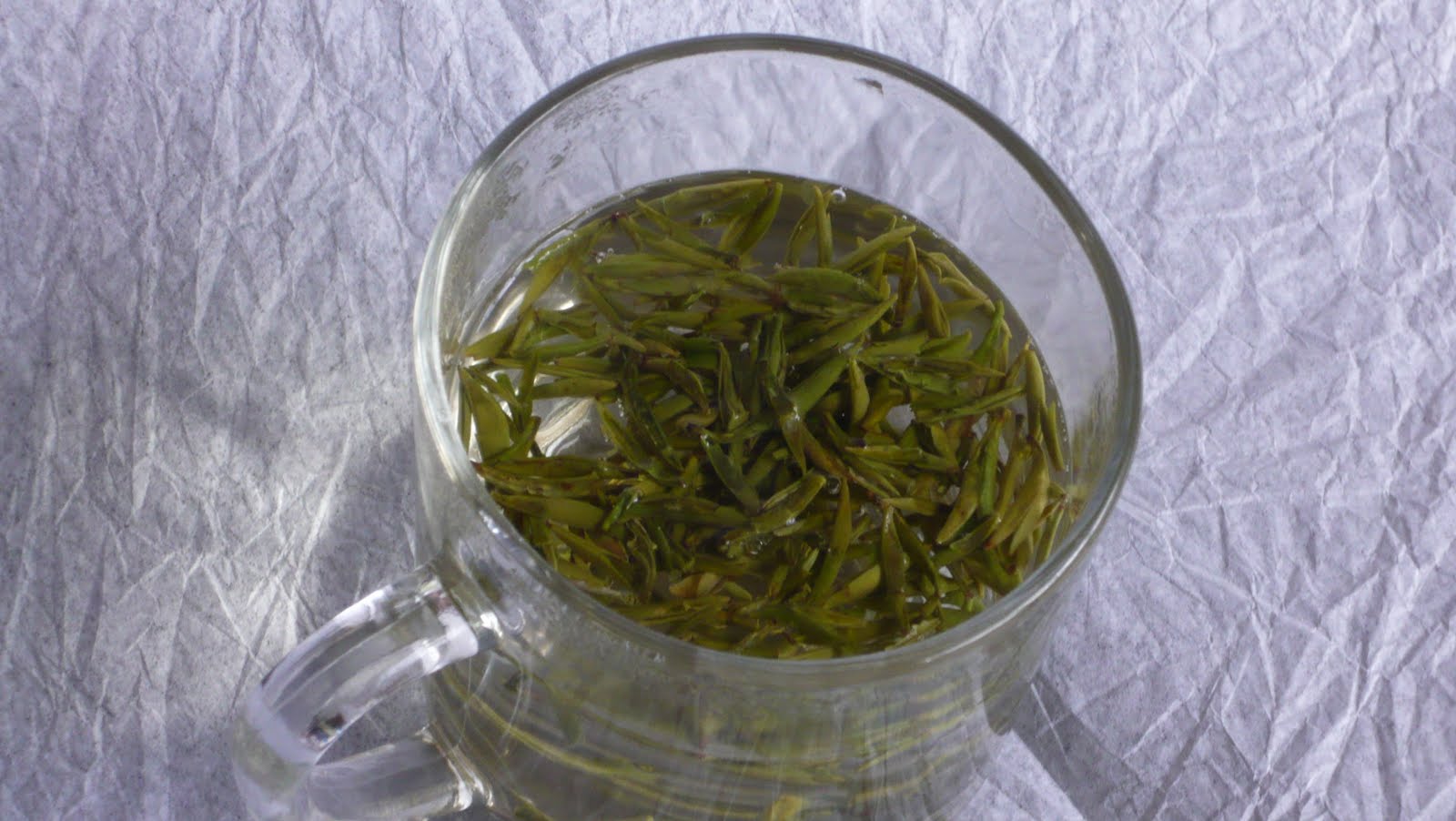
I am obsessive about the view of tea leaves in water!


I think I said just a few days ago that Huang Shan Mao Feng has the most beautiful leaves. But these guys are actually as good, or even prettier!


The leaves dance in water, up and down, up and down...


Then finally most of them sink to the bottom. I love the way how they stand up straight all the time.


The taste: light vegetal, with sweet aftertaste. It feels clean and moist in mouth, and the tea radiates some cool feeling even in hot water.

This is first yellow tea we've ever carried. Yellow tea was developed from green tea technique. After the tea is heated (in this case, pan-fried) to have the enzymes killed), the tea is allowed further oxidation with optimal temperature and humidity. Therefore, oxidation in yellow tea is different from oxidation in black tea or oolong. In yellow tea, the oxidation is not catalyzed by the tea's own enzymes, but triggered by outside environment factors such as temperature and humidity.

Here comes my mixed feelings.

Oxidation of this tea is very light. If we compare this tea and another Meng Ding Snow Bud I had last year, the differences are big, although both teas are great. The other tea has larger buds, and deeper oxidation, and therefore more typical sweet taste of a yellow tea.

Currently in China, Green Tea still dominates. A direct outcome is, many other teas are green-tea-ized. The most popular Tie Guan Yin is made to be very green. And many yellow tea products is made very green.

Recently I discussed with a friend who has dealt with yellow tea for many years. In his opinion, it's not possible to make Meng Ding Snow Bud into typical yellow tea with deeper oxidation, because the buds are so young and tender. On the other hand, the other Meng Ding Snow Bud I had last year (which I loved very much), in his opinion, is more typical yellow tea, but should be called Meng Ding Yellow Bud (Huang Ya) instead of Snow Bud, because the buds are larger than the standards of Snow Bud. So here is the trade-off, you may choose the precious Snow Bud, but it can't have the typical oxidation level of a yellow tea. On the other hand, the bonus is, if we forget about the yellow tea, and compare this tea with a green tea, the price of this tea is much more friendly than a first-harvest green tea with comparable youth and tenderness.

I hesitate to call this tea yellow tea, because, as you can see, from leaves to liquor, it's all green! I hesitate to call it green tea either, because it does intend to be a yellow tea, and it does have some nice sweet aftertaste of yellow tea. I guess it's not my own dilemma and it's shared by many tea people.

Jan 27, 2009

First tea party of this year & a gift

Who is that lucky one in the poll to have one tea party every week OR MORE? :D

I had only 2 tea parties last year - not many tea drinkers around, people are busy, tea drinkers are mostly somewhat introvert... I guess these are why. But will try to have more tea gathering this year. Just because we are somewhat introvert, we should try harder reaching out for each other :D In fact, preparing a tea party is so much easier than other kinds of parties, and the food/drink is generally healthier.

And I got this nice gift from a friend. It's Meng Ding Snow Bud (or Meng Ding Yellow Bud, 蒙頂雪芽)! The tea leaves are so adorable, as its flavor. I could stare at the leaves for a long, long time! It's quite green for a yellow tea, but I guess, that's the trend in recent years.