Showing posts with label white tea. Show all posts

May 28, 2012

silver needle - new and 1 year old

Because of my own physical conditions (I think I'm the slightly "cold" type according to Chinese medicine theories), I have been interested in aged white tea. In Chinese medical theories, white tea has great cooling power and could be too "cold" for people who are the "cold" type (e.g. feeling cold easily in winter, having cold feet or cold back sometimes...). However, with time being in aging, white tea will become "warmer and warmer".

There is a saying that some traditional tea stores in Guangdong would only sell white tea aged for 3 years or so. But I haven't got it confirmed by more than few people. Part of my family is from Guangdong, while I myself am from Beijing. I know many Cantonese would be reluctant to drink any tea that doesn't look dark red, and meantime, I know some Northerners grown up with green tea would be reluctant to drink tea with a hint of red color. I think this has a lot to do with not only cultural aesthetics, but also regional climates and diets.

I drink new white tea from time to time, but not very often. Since I've tried some aged white tea that pleased me a lot, I have been drinking a lot more white tea that has been aged for 1-5 years than the new white tea. The aged white tea I've collected are all White Peony (Bai Mu Dan) and Shou Mei (Longevity Brow). Somehow I don't feel Silver Needle, which is composed of tea buds only, is good for aging. But I don't have much experience in aged white tea. I would like to see more people's review on aged silver needle and other aged white tea. Besides, if some day you dig out some accidentally aged white tea from a corner of your home, definitely try it and let the rest of us know!

I've written about a 2005 Bai Mu Dan here. I've also tea logged a 2009 Shou Mei on steepster. SororiTea Sisters reviewed the same 2009 Shou Mei. And this tea has recently been reviewed on RateTea.com by creator of the website Alex Zorach.

This time, my focus is comparing a 2012 silver needle and a 2011 silver needle. I haven't intentionally aged silver needle or obtained any aged silver needle. Since there is a little left from last year, I thought it would be convenient to do a quick comparison.

2012 silver needle:
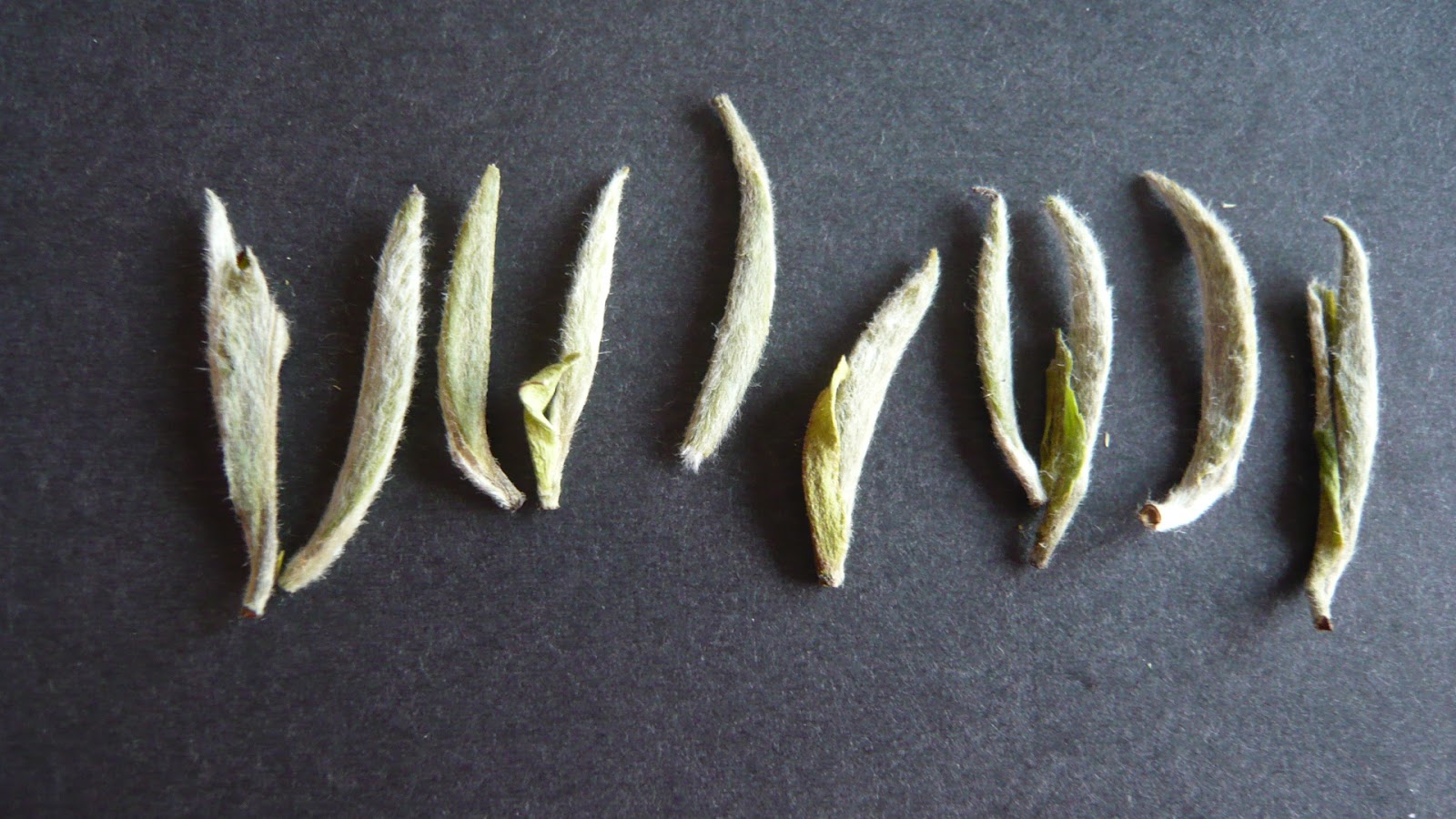
(I feel I generally like White Peony more than Silver Needle. So this year I wasn't even sure if I would still get some Silver Needle. But then I saw this Silver Needle that looks absolutely adorable. So I thought I would get some, if not for anything else, just for collecting some good-looking Silver Needle! Then after I tasted this tea, I was really glad that I had got it.)

If you are interested in doing some geeky reading, here is an article on Alex Zorach's blog about definition of white tea. Here is an article on RateTea.com on oxidation of tea, again by Alex Zorach. Here is a blog I wrote about white tea. As you could see from each of these writings, white tea is a tea whose oxidation enzyme is not dis-activated. And therefore white tea is a tea more ready to change than most other teas.

2011 Silver Needle on the left, and 2012 Silver Needle on the right. The new tea look significantly greener than the older tea.


2011 tea:


2012 tea:


 2011 on the left and 2012 on the right.

2011 on the left and 2012 on the right.

2011 on the left and 2012 on the right. 


2011. Notice the multiple red spots. 

2012. Few or none of the red spots.

I used 1.4g of each tea in each gaiwan. The useable volume of the gaiwan is about 80-90ml. I poured in boiling water, covered the gaiwan and let the tea steep for about 3-4 minutes.

The flavors of the two are very different. They don't taste like the same tea! The new Silver Needle has a brighter and more floral flavor. The older one has a deeper tone, somewhat woody and herbal taste. Starting from the fourth infusion, it seems to me that the 2011 tea taste smoother, with less woody and more honey flavor. Meantime, the 2012 tea's floral note is not as uprising, but tuned down a bit with a brighter honey taste. Both tea can go for quite a few infusions, that is if you use hot, hot water ;-)

Overall, the 2012 Silver Needle is my favorite new white tea in all these years. But the lovely floral note in its flavor may not be the flavor to remain if the tea is to be aged for years. I guess I will be drinking more new white tea this year! The 2011 Silver Needle doesn't taste as complex as the previously mentioned 2009 Shou Mei. Maybe it's because of age. Maybe it's because bud tea doesn't age as well as leaf tea. Overall, my favorite aged white tea so far is still the previously mentioned 2005 Bai Mu Dan. It's from this guy, who now has got a "real" job and no longer sells tea.

(I would like to include samples of 2012 silver needle, 2011 silver needle and 2009 Shou Mei in a small sample set in the next blog sale. Probably 4g 2011 Silver Needle [since I have little left], 8g 2012 Silver Needle and 8g 2009 Shou Mei. If you have some left over older white tea that you can barely consume by yourself, I urge you to run a blog sale or swap!)

_________________________________________

Appendix:

The 2009 Shou Mei (photos taken about a year ago)


Mar 11, 2011

updated Tea Harvest Calendar

Recently I did some updating on a Tea Harvest Calendar I made a few years ago. From time to time, people send me questions about harvest times of teas. In fact, I am not sure how to make a harvest calendar that's easy to read and inclusive of important tea information. Still, I am afraid I get stuck in between - the current harvest calendar is not easy to read, and it seems forever impossible to be inclusive. But this is the best I can do so far.

In addition, I am not exactly sure why people would like to see a harvest schedule (but indeed many people would like to). Most teas we can't get within the few weeks after harvest. And most teas are not in the best state within weeks after harvest - even for fresh-tasting green teas like Long Jing, old tea farmers would say, the tea starts to taste the best after 1-3 months of careful storage. But as a curious person myself, I can surely understand people's curiosity about tea harvest schedule. Besides, during those winter months, it's always nice to have a harvest schedule so that you would feel there are things to look forward to, especially if you are a green tea lover :D

Another potential challenge of a tea harvest schedule is, up to now, the accessible varieties of Chinese green teas in foreign market are still quite limited (many famous green teas have very small annual production and are of limited amount even in Chinese market) - what's the point including teas that most people cannot get access to? Some of those teas are still on my wish list, and some of them I don't get hold of every year. But I guess one reason to include them on the harvest schedule is, so that we have something to dream of :D The great diversity of today's US specialty tea market may not be something one could dream of 10 years ago. In the years to come, there will surely be more and more varieties and products of quality.

So here is the tea harvest schedule. The image can be clicked to enlarge. A web version is posted here:
http://www.lifeinteacup.com/harvest-calendar

I am sure there is a lot of negligence. I will keep working on it. Feedback and critiques will be highly appreciated.

___________________________________________


Introduction
Throughout the year, the relative positions of the sun and the earth can be expressed by 24 solar terms. Dates marking these 24 solar terms stay almost the same year by year on the international calendar. The 24 solar term marks directed a lot of agricultural activities in traditional society of China, including tea cultivation. On this Tea Harvest Calendar, the harvest dates of various teas are sorted in temporal order based on the solar terms they belong to.
More information about the 24 solar terms can be found on this webpage of Hong Kong government:
(Name translations of the solar terms are slightly different between this Tea Harvest Calendar and above webpage.)
Tea harvest dates vary slightly from year to year. The system of solar terms helps us understand how tea harvest is connected to climatic patterns.
This Tea Harvest Calendar includes names of the 24 solar terms in English and Chinese, their dates on the international calendar, and harvest times of some well-known Chinese teas. Additional notes are made about climatic changes and traditional agricultural events of some solar terms.


Part 1.
Part 2.


Part 3.

Sources of information:
1.     Tea farmers, who are, of course, the best sources of anything pertaining to tea.
2.     中国茶谱 Wan Xiaochun et al. (2007) The Book of Chinese Tea. China Forestry Publishing House, Beijing.
3.     中国茶经 Chen Zongmao et al. (1992) The Tea Classic of China. Shanghai Cultural Publishing House, Shanghai.
4.     中国茶叶大辞典 Chen Zongmao et al. (2000) The Encyclopedia of Chinese Tea. China Light Industries Publishing House, Beijing.
5.     中国名茶图谱 Shi Haigen et al. (2007) The Atlas of Chinese Famous Teas. Shanghai Cultural Publishing House, Shanghai.
6.     品茶图鉴 Chen Zongmao, Yu Yongming, Liang Guobiao & Zhou Zhixiu (2009) An Atlas for Tea Tasting. Yellow Mountain Press, Hefei.
7.     中国乌龙茶 Gong Zhi (2004) China Oolong Tea. Zhejiang Photography Press, Hangzhou.
8.     中国红茶 Gong Zhi (2005) China Red Tea. Zhejiang Photography Press, Hangzhou.
9.     茶文化学 Liu Qinjin et al. (2000) Studies on Tea Culture. China Agriculture Publishing House, Beijing.


Dec 9, 2010

2005 Bai Mu Dan (White Peony, 白牡丹)

Can white tea be aged as what they do with puerh? I don't know. I am generally very conservative about it. There are historical records of keeping white tea (as well as oolong) for years and use the tea for medical purposes. But I've never seen historical records of keeping white tea for connoisseur appreciation. But then, no record doesn't necessarily mean non-existence. Luckily I got this 2005 Bai Mu Dan sample from a supplier, and of course I wanted to try it.

Dry leaves: very lovely. Color is overall darker than new Bai Mu Dan. I added two photos of new Bai Mu Dan at the end of this post for comparison purpose.


I put this much in a glass mug. Later it turned out a bit too much for mug brewing. But the flavor was fine and didn't seem over-brewed.

I brewed the tea in a glass mug and put a gaiwan lid on top of it to conserve the heat. I like to have a lot of heat in white tea brewing.
 

The leaves are beautiful. Due to the processing method of white tea, the cells are well preserved in the tea leaves, which enables the tea leaves to last a long time without degrading.

Overall I love the taste of this tea. It has much "darker" taste than newer white tea. The flavor remotely resembles Oriental Beauty, Moonlight White and a non-smoked lapsang souchong I recently had. It has a unique chocolaty taste that I've never found in another white tea. I enjoy drinking it very much and will stop worrying about any of my white tea that can't be consumed in a few years.

About long-term aging of white tea, I've seen opposite opinions. The advocates say that white tea has cells more intact than any other tea (which is true) and therefore the leaf contents are in better conditions to age and develop favorable flavors (which I don't know). The opponents say that few other teas have the biochemical basis of Yunnan large-leaf varietals, and therefore can't develop complex flavors through aging (this sounds plausible too). But one thing that's pretty much for sure is, white tea can possibly have much longer shelf life than some other teas, due to its intact cell conditions. From this tea, I've seen that white tea can possible develop some unique, darker flavor through aging. But when would be a peak time for such flavor and will the good flavor fade within several years, only time can tell and only those who care enough to experiment can discover. Personally I wouldn't invest time and tea to experiment on it. But who knows, maybe some of my white tea will accidentally end up in the closet for years and give me some new knowledge :D 
 
_________________________________

These are photos of a new Bai Mu Dan taken last year. However, this tea is of a lower grade than the above 2005 tea.

Dry leaves are more colorful, with a lot greener leaves. The 2005 tea mainly has black leaves and white buds.

Tea liquor is of lighter color than the 2005 Bai Mu Dan.

Nov 4, 2010

Moonlight and Beauty

About Moonlight White and/or Moonlight Beauty, there are many versions of the story about how it is [they are] made. Some people say they are the same tea and some people say they are not. Most of the time, I don't like mysteries of tea, because many of them are not intrinsic mysteries of tea, but rather man-made. Some tea producers seem to be determined to confuse people about what a tea is.

This version of story about this Moonlight White is a relatively simple one. According to the producer, leaves were harvested at night under moonlight (hence the name of the tea) and were laid on the floor of a room in a single layer (no overlapping of tea leaves) to be dried completely in dark in several days. That's all. I am not sure if the moonlight harvest is just a "romantic" factor here. But I guess the key here is the tea was harvested and dried in dark.


According to the producer, it's crucial to have the leaves dry in a room without any exposure to light, and without leaves overlapping with one another. Otherwise the tea would not have black leaves and white (silver-tipped) buds, but a mixture of green leaves, red leaves and white buds instead. I did see Moonlight White with green leaves and white buds before and I guess it used a different way of processing. A quick hypothesis I can think of to explain the difference is, when dried in sunlight, the leaves dry faster and therefore oxidation level is lower. When dried in dark, the leaves take longer time to dry, hence longer time to oxidize, and hence darker leaf color. But I am not sure if the "absolutely no light exposure" and "absolutely no leaf overlapping" policy is just another "romantic" factor. Compared to all other white teas I had had, this Moonlight White has the highest oxidation level. The taste even remotely resemble that of a red tea. I can see why some people would compare this tea to Taiwan Oriental Beauty (Bai Hao Oolong), which is a highly oxidized tea too.

2nd infusion.

7th infusion.


What makes this tea special is that the leaves were harvested from big tree (乔木) of Jing Mai (景迈) which are also used to make high quality puerh. The producer says because of the inner quality of the leaves, this tea can last 20 infusions or more, much more long lasting than regular white teas. My tea session didn't go as much as 20 infusions. But it did last a good 9 infusion or so. I didn't use many dry leaves from the beginning, and the spent leaves only filled 1/3 of the gaiwan. The tea can tolerate long infusion very well and is generally very smooth. So I guess if you fill the gaiwan with a lot of leaves, it can indeed give you many infusions. But so far I prefer to use less amount of dry leaves, because to me this tea is not about power and dramas, but about mellowness and sweetness.


From time to time, I hear stories of some people selling Moonlight White as fake Bai Hao Oolong. Actually, I don't think it's possible. Moonlight White is as great a tea as Bai Hao Oolong. If a tea is used as fake Bai Hao, it can't be an authentic Moonlight White either. The real Moonlight White is from big trees of Yunnan, and many of these trees, such as all of them in Jing Mai, are from elevation of above 1000m (3000 ft.). You can almost always tell from the beautiful leaves.

(I categorize this post in both "white tea" and "puerh" only because Moonlight White sometimes is referred to as a type of puerh. But I personally don't think it fits in the definition of puerh.)

May 13, 2010

White Teas, names and more

White tea is lightly oxidized tea. It's made by directly drying (sun-drying or roast drying) and withering tea leaves, without killing the enzymes in the leaves. Since the enzymes in the leaves are not killed, oxidation happens to a small degree before the leaves are thoroughly dried. This is the case of traditional white tea only. I've had some Huang Shan (Yellow Mountain) white tea, made in colder climate zone, and therefore with almost zero degree of oxidation.

Bai Hao Yin Zhen (白毫銀針 Bai Hao Silver Needle) is probably the most precious white tea. After the tea leaves are harvested, only the leaf buds are used to make the final product, and the extra leaves will be used to make Gong Mei (Tribute Longevity Brow, 貢眉, whose lower grade is Shou Mei / Longevity Brow, or Sow Mee, 壽眉). When making Bai Hao Yin Zhen, all the imperfect buds, even those with tiny bug bites or smallest discoloration, will be removed -  this is the ideal standards and nowadays there are actually Bai Hao Yin Zheng products of various grades.

Compared with other tea categories, white tea category is smaller, with relatively fewer varieties. Besides the most famous Bai Hao Yin Zhen and Bai Mu Dan (White Peony), there are also Shou Mei (the lower grade of this tea is often seen as Sow Mee sold in Chinatown grocery stores as an inexpensive white tea), Gong Mei (貢眉Tribute Longevity Brow) as previously mentioned, and Fujian White Jade Bud (also called Fujian Green Snow Bud, as its leaf color greener than other Fujian traditional white teas). These are all the traditional white teas recorded in the tea books I've seen. Besides, Yunnan, Anhui and other provinces make white tea of various kinds, but large scale production has started only since recent years. Fujian province has started producing a New White Tea (新白茶) since 1968, mainly to supply Hong Kong and overseas markets. It's less expensive than traditional white tea. But sometimes Beijing Wu Yu Tai Teahouse carries a King Grade of this New White Tea, the annual production of which is said to be only about 100 pounds.

About White Tea, also worth mentioning is the Seattle White Peony Homemade by Brett of Black Dragon Tea Bar!

There are several names affiliated to white tea that are quite confusing and therefore worth some scrutinizing.

1. Silver Needle is not necessarily a white tea. For example, Jun Shan Silver Needle (Jun Shan Yin Zhen, 君山銀針), one of the ten most famous Chinese teas (there are various versions of the "top ten", but Jun Shan Yin Zhen seems to show up in most of those versions), is a yellow tea. Besides, Gui Lin Yin Zhen is a green tea from Gui Lin region.

2. If a tea's name include "white tea", it may or may not be a white tea. For example, An Ji White Tea (An Ji Bai Cha, 安吉白茶) is a famous green tea from Anji, Zhejiang province. White Monkey (Bai Mao Hou, 白毛猴) of Fujian province is mostly said to be a Green Tea. But White Monkey is an odd case. Most people say it's a semi-oxidized Green Tea. But theoretically if a tea is semi-oxidized, it's not a Green Tea. White Monkey is also called White Green Tea in Fujian. So I guess you can categorized this tea in whatever way you like. The confusion is understandable though. After all, when people started to invent a tea, nobody would think, "Today we are going to invent a white/green/red/yellow tea." The tea just came out in whatever way it could be.

3. If a tea's name include Bai Hao (or "silver tip", 白毫), it may or may not be a white tea. For example, Yun Hai Bai Hao is a green tea from Yunnan.

4. Recently, I read about the most confusing white tea names ever. It's in 品茶圖鑒 by 陳宗懋 Chen Zongmao et al. (2009). Traditionally, Bai Hao Silver Needle comes from Fuding (tea is roast dried there) and Zhenghe (tea is sun dried there) of Fujian province. White teas from these two regions use slightly different techniques, but the final products are quite similar. In all the other sources I've seen, white tea from these two regions is consistently called either Bai Hao Silver Needle or Silver Needle Bai Hao, which are treated as the same name. But in this book, the authors claim that the white tea from Zhenghe is called Zhenghe Bai Hao Silver Needle, while the white tea from Fuding is called Silver Needle Bai Hao. That's to say, Bai Hao Silver Needle and Silver Needle Bai Hao are two different names. On the one hand, the first author of this book is an Academician of Chinese Academy of Engineering. So I think I should take him seriously. On the other hand, I feel the authors didn't give thorough explanation on the two names. I have yet to see if there are other people who share this view.

Besides the name confusion, the discrepancy of various versions of white tea brewing methods is larger than in many other teas. My understanding of white tea is, it was very gently processed, without rolling or squeezing, and its cells are better maintained than cells in other teas. Therefore, it takes higher temperature (newly boiled water) and longer infusion time (5 minutes or longer) for water to infuse into the cells of white tea, especially for Bai Hao Silver Needle, whose leaves are nice and complete. Initially, it actually surprised me to see some sources suggest using lower temperature (180 F or lower). But after all, there are no fixed rules about tea brewing. Higher and lower temperatures may work for different people. I've seen people who were somewhat intimidated by the temperature restriction and thought that using very hot water for white tea was not "right". Therefore I sometimes just can't help urging people to give boiling water at least one chance. It may or may not work for each person, but it does no harm to try it at least once.

In Chinese medical theories, white tea is deemed as one of the teas with strongest cooling power. It's a great beverage when the body is annoyed by cold sores, dry throats or dry eyes. It's also a great relaxing drink when one feels anxious or worried. For people whose "inner heat" is weak (for example, if hands and feet easily feel cold in winter days - I sometimes feel that way), white tea may not be a daily drink, but can still be an occasional enjoyment, especially in days when the air is warm and dry.

Recently, there was breaking news about White Tea. Last year (2009) in Xi'an, intact tea leaves of White Tea was discovered in a newly explored Song Dynasty (about 1000 years ago) tomb! Initial analysis indicates that the leaves are Bai Hao Silver Needle, same tea as what we drink today!

From the following photo (from Tea Time magazine), the tea leaves look pretty much drinkable!


Personal declaration: Please do not put entries of this blog on Unsnobtea. I have no affiliation with Unsnobtea or any of their products.

I am sorry to have put it in this way, but so far I haven't found any contact information of Unsnobtea to talk with them about their using other people's blogs to endorse their own commercial website.

Other forms of discussion and sharing of information are always welcome, given proper communication.