Jun 27, 2012

some random thoughts about "shoulds"

This post was inspired by Alex Zorach's blog post There is no Should. I started writing this right after reading Alex's blog post, but somehow didn't manage to finish it earlier :-)

This is not exactly about tea, but I've thought of it in the context of tea.

If we leave moral questions aside and just focus on technical questions in tea drinking, What does a "should" mean in tea drinking? (Here by "Should", I mean "Shall" or "Ought to" meaning of the word "Should".) I guess there are different answers depending on what the specific tea topic is. But generally I feel most "shoulds" are more or less meaningless. Tea appreciation is a very personal activity. If we believe there aren't that many "shoulds" in water drinking, rice steaming and apple eating, then why would there be more "shoulds" in tea drinking? Of course one can always improve techniques even on apple eating, and he may receive friendly suggestions on a better way to peel his apple, but that's not something somebody else tells him he "should" do, right?

I can understand that when we love tea so much, sometimes it's heart breaking to see other people "mess up" with good tea leaves. But when somebody else drinks his tea, it's about him, not about us. Besides, suggestions can always be given in a gentle, subtle way instead of with an arbitrary "should". After all, tea is only one aspect of life, and we have to admit, everybody messes up with something, and sometimes, one person's messing up is another person's celestial enjoyment. I not only mess up with tea occasionally, I think I constantly mess up with other things such as wine. In fact, I'm afraid I've been butchering wine and liquor culture :-p

I know nearly nothing about wine, and mainly drink red wine for its warming effect (health benefits?). I know if I drink good wine, I will be wasting it. So usually I just buy cheap wine. My typical conversation with a local liquor store owner was like this:

(I was wondering around examining the wine bottles...)
Owner: How can I help you? What kind of wine are you looking for?
Me: Some kind of Merlot or Cabernet with screw-on lid, so that I won't need a cork tool...

Then the store owner quickly recommended an Australian Cabernet around $10, which turned out pretty good for me. And I appreciated his help. After reading some conversations on tea forums, I suspect my wine choice would drive some wine lovers crazy :-p But that was really all I wanted and all I needed from a red wine.

I also consume about 1 bottle of vodka every year, drinking it with grapefruit juice and using it for homemade fragrance, like the one mentioned in #5 of this post. By the way, my aromatherapy book says vodka and tequila are perfect as base fluid for homemade fragrance because they have the right amount of alcohol content and they don't have strong odors themselves :-D

Last time when I went to a local liquor store to buy vodka, I saw more than a dozen varieties. Learning that I was looking for a vodka, the store owner asked, "How do you drink your vodka?" I told him I'd drink it with grapefruit juice (and holding back from telling him about my homemade vodka fragrance). He thought for a moment, and picked up for me a big bottle for less than $10. I appreciated his quick and non-intrusive help. He didn't tell me "no self-respecting vodka drinker would mix juice with vodka" (but I heard comments of this style from tea drinkers...), and he didn't try to talk me into "improving" my vodka appreciation by stepping up to more expensive products (you know this kind of sales pitch happens in all kinds of stores, including some tea stores).

I also keep a bottle of ginger brandy per my good neighbor's recommendation. He swears it's the best flu medicine, and I believe him :-) I don't even enjoy drinking brandy. This bottle is totally for its health benefits :-) And I wonder if there are among brandy connoisseurs the counterpart of anti-flavored-products people among tea connoisseur :-p

Besides buying cheap alcohol and mess up with them, I also occasionally mix alcohol and tea. Remember seeing some tea drinker saying this in horror? "What?? They mixed tea with that stuff?!"

I wonder if there are some rum enthusiast out there saying this in horror - "What?? She mixed rum with tea?!" But so far I haven't got anybody saying it to me yet :-p

Even though I have poor tastes on alcohols, sometimes small suggestions help. For example, when our local liquor seller handed me my wine in the screw-on lid, he also told me that airing it for 15 minutes upon opening the bottle would improve the taste. I appreciate the advice, not only because it's something effective and easy to do, but also because I appreciate the liquor seller cared to give me some tips on a bottle of rather cheap wine.

Who knows? Although there is no sign of it yet, maybe someday I will want to become more intelligent on wine drinking, especially when I meet with wine drinkers who are cool, friendly and not snobbish. And if I decide to stay where I am now and drink alcohols mainly for their "health benefits" and as alcoholic juice, I would appreciate it if serious alcohol connoisseurs would allow me to do whatever I want with my drink, and I would appreciate friendly suggestions and simple tips.

When it comes to tea, I have to admit that there are teas and tea brewing methods that just strike my nerve and don't appeal to me. And there are times when my mind is dominated by all kinds of "shoulds". But I would try to remember how I would like to be treated as an alcohol drinker, and what I would like or dislike to hear from other drinkers about wines and liquors :-D

Jun 17, 2012

three major styles of Tie Guan Yin (1)

I once wrote about the three styles very briefly here. At this moment I realized it was 2.5 years ago (OMG!). I had always thought of further elaborating the topic and didn't realize my procrastination was so bad :-p

It would take many pages to thoroughly explain the styles of Tie Guan Yin, so I tend to get lazy and over-simplify them :-p

I made a few pictures and a chart about the styles a few years ago and somehow didn't feel like to get into the geeky details. So I will try to make this short and brief :-)

The picture can be clicked to enlarge.

Here, only the 3 major styles are listed. However, the styles of Tie Guan Yin spans through a spectrum instead of being a few distinct categories. For example, the modern green style could be made closer to traditional green style and is hence called Zheng Wei (orthodox green style, 正味). The modern green style could also be made very "green" (Xiao Qing, 消青) or made into a fresh sour style (Xiao Suan, 消酸). And there could be many smaller categories in between the above mentioned styles.

Here I would like to emphasize the three major styles because each has its own significance. They are different in quite a few ways. But I would try to summarize their differences very briefly as following:

* Traditional Charcoal Roast: medium oxidation, significant roasting that ranges from medium light to medium high. (The heavy roasting of Tie Guan Yin is generally lighter than the heavy roasting of Wuyi Yan Cha.)

*  Traditional Light Roast (or I would also call it Traditional Greener Style): medium oxidation, relatively brief roasting to induce aromas.

* Modern Green Style: light oxidation, roasting to dry, and no more roasting once the tea leaves are dry.

Next I will explain why I think each of them is significant in Tie Guan Yin family.

1. Modern Green Style.
Many people love it. Many people dislike it. Many people blame it for the shrinking market of traditional style TGY.

a. Why many people love it?
I think this has to do with the cultural context of tea drinking. Modern Green Style of TGY was developed under great influence of Taiwan High Mountain Oolong. Many TGY factories in Anxi and other counties of Fujian have invited Taiwan tea professionals to direct their production, and the modern TGY techniques are largely from techniques of High Mountain Oolong.

The development of Taiwan High Mountain Oolong deserves a separate full discussion. But in short, with modern green technique (in contrast to traditional Taiwan oolong technique), people found the superior fresh taste of tea leaves from high mountain ranges could be expressed to the greatest degree. Such fresh floral, vegetal, buttery (and much more...) tastes were rarely found in either green tea or other oolongs. The heavenly tastes of High Mountain Oolong also helped Taiwan Oolong win its international fame. The international acknowledgement started from Japan. This was not surprising, because Japan is a big tea country, and a big green tea country. I believe their appreciation of Taiwan High Mountain Oolong had a lot to do with the context of green tea culture.

Then, both the wonderful tastes and its market success made Taiwan High Mountain Oolong very influential to tea farmers in Fujian. In my impression, among all Chinese sub-cultural groups, Fujian people (or Hokkinese, as sometimes referred to in English) are some of the most creative, adventurous and business-savvy. They are good at riding the trends of the era and grab opportunities to create their own trends. It took Fujian farmers just several years to create Modern Green Style TGY based on learning from Taiwan tea professionals.

The reasons why people like Modern Green Style TGY are somewhat similar to the reasons why people love Taiwan High Mountain Oolong (but there might be a bunch of other reasons too... green TGY lovers please feel free to share your reasons...) And the reason why green TGY succeeded in China was somewhat similar to why Taiwan High Mountain Oolong succeeded in Japan - it faced a market dominated by green tea lovers.

The success of Modern Green Style TGY in China was quite amazing. The business talents of Fujian people were also fully embodied in this process. Besides, Fujian government (which I think is one of the most efficient local governments in China) was actively involved in commercial promotion of TGY, with all its lobbying power and political network.

b. Why many people dislike it?
I personally like traditional style of TGY much more than the modern green style - but I'm an omnivore :-)

I can somewhat understand why traditional style lovers dislike the modern green style. Some of them would feel green style tastes like putting perfume in your mouth - however fragrant, it's not pleasant.

Besides, many people, traditional style lovers and modern green style lovers all included, feel modern green style is less friendly to the stomach than the traditional style.

It might be a little too subjective to say traditional style TGY potentially has more complex and soul-touching flavors than modern green style TGY. But an interesting phenomenon I've observed over years (not backed up by true data analysis though) is, many modern style TGY lovers would gradually move toward a preference of traditional style TGY, but the opposite rarely happens.

One thing to clarify is, both people disliking traditional style TGY and people disliking modern green style TGY may consider the possibility that they happened to have tasted the poor representatives of the disliked style.

A common critique on modern green style TGY is that sometimes it could taste "stinky grassy" (臭青味). This unpleasant grassy flavor is not the same as the pleasant type of grassy flavor found in some green teas and greener style oolongs. This "stinky grassiness" is more likely a problem of improper tea processing rather than a problem of modern green style TGY. It could be caused by improper oxidation or not enough drying in tea production which is very similar to a problem in green tea that was discussed in another post. But this shouldn't be a problem in a well made modern green style TGY. On the other hand, indeed, modern green style TGY, with its low oxidation level, is more prone to this problem than other oolongs.

c. Why many people blame it?
With the national success (and later on, international success) of modern green TGY, market selection causes more and more farmers to produce modern green style. Therefore, there has been less and less traditional style seen in the market, and good traditional TGY has been in rarity. Many people believe it's the uprising of modern green style TGY that directly causes the shrinking production of traditional style TGY.

I don't think modern green TGY is the one to blame though. It's a choice of many buyers to favor modern green style TGY. And it's a choice of many producers to focus on the style most favored by the market. It's all people's choice. Modern green style TGY adds to the diversity of TGY family. It doesn't hurt to have one more style with distinctive characteristics.

I don't think either, that TGY farmers should be blamed for making a lot more modern green style TGY than traditional style. They follow the market trends, which are affected by tea drinkers, including you and me. If you and I are not buying tons of traditional style TGY while other people are buying tons of modern green style TGY, why blame the farmers for catering to stronger purchase powers?

d. Why I think Modern Green Style TGY is important?
I think Modern Green Style TGY is significant in tea history, because it created a trend that had never happened before - national popularity of a oolong. I believe this has not only converted more people into oolong fans, but somehow changed people's way of thinking.

In the past thousands of years, in China, green tea was the love of the nation. Even today, it's probably still the favorite tea in general. But it's no longer the sole dominant tea category in China. In the past, in most provinces in China (with exceptions of a few southern provinces such as Fujian and Guangdong), it was almost a common belief that "green tea is the best tea." People almost took it for granted without challenging the thought. But indeed it was the typical subjective, hierarchical way of thinking. Many people thought so only because they were drinking green tea all the time and weren't exposed to a lot of other types of teas. Only since 1990s, TGY, more specifically, Modern Green Style TGY has grabbed large portions of Chinese tea markets, and virtually changed people's way of thinking. If TGY hadn't done it, probably sooner or later, Wuyi Yan Cha, puerh, or some other tea, would challenge the green tea dominance. But TGY did it the first and the fastest.

Many people far away from oolong production regions, my mom included, thought they had experienced the finest teas (aka Long Jing, Bi Luo Chun, etc.) in their lives, but were suddenly wakened by TGY (at that point, Modern Green TGY) and realized there is actually a whole new world out of what their previous tea world. My family clan is mainly located in Beijing. My mom started drinking oolong in her 50s, so are many of my aunts and uncles, so are families of many of my friends from provinces across China. Once getting started by Modern Green TGY, these old new drinkers would soon fall in love with some or many other oolongs, reds and other teas they didn't think of exploring before.

Whether or not one likes this specific tea, Modern Green Style TGY just did it!
________________________________________

Oh well, I guess I just can't keep it short :-p  So I will take a break here and write more about traditional greener style and traditional charcoal roast later!

Jun 11, 2012

How about the slimming effect of tea?

"Why the slimming power of tea doesn't work on me? Why??"
Does tea have slimming effect? What kind of tea has slimming effect?

First, let me tell a story. It's a popular story in China. I have a vague impression that it's from an ancient story book whose name I can't recall.

------------Here is the story.--------------

Once upon a time, there was a wizard who was selling magic seals with a supernatural power to repel mosquitoes. You know, sometimes you just need something like that because mosquitoes can drive people crazy!

A man heard from his fellow villagers that the magic seal indeed worked well. So he came to the wizard to buy the magic seal. He saw the magic seal was just a thin piece of paper filled with strange characters and drawings. He asked, "Will such a piece of paper really keep mosquitoes away?"

The wizard said, "Of course. 100% guaranteed."

Hence the man bought the magic seal and posted it on his bedroom wall. The following night, he suffered no less from mosquito attack throughout the night. The man was outraged, "This damn magic seal has no magic at all!"

The next day, the man saw the wizard in the village and asked him angrily, "How come your magic seal didn't work at all?!"

The wizard said, "Impossible! It worked for everyone!"

At the moment, two villagers were passing by. The wizard stopped them and asked, "How is my magic seal working?"
"It works perfectly." The villagers said.
The wizard turned to the angry man, "See, it works! You must have misused it. Where did you post it?"
The man said, "I posted it on my bedroom wall."
The wizard and the two villagers all laughed. "That's why it didn't work for you. You didn't use it correctly! You are supposed to obtain a new mosquito net first. Then, you should sleep inside the mosquito net at night, and post the magic seal right on the mosquito net. It will work perfectly, as long as you follow the instructions." The wizard said, and the two villagers nodded along.

--------------------The End--------------------

Now back to our original topic. Does tea have slimming effect? What kind of tea has slimming effect? Well, I guess, the answer is, any kind of tea has perfect slimming effect, as long as you follow the instructions. Then what are the instructions? They are simple: Before and after drinking your tea, eat as little as possible, and work out as much as possible.

Did tea help me, a big tea lover lose weight? Unfortunately, no! (As much as I really need to lose weight!) Why? Because I didn't follow the instructions. I always have more than excellent appetite after drinking tea. I never "eat as little as possible". So I fully understand that it was because I didn't follow the instruction, not because the "magic" didn't work!

Now let me tell you a secret, a secret to be kept among readers of this blog only! Guess what! Bacon has slimming effect too! But to make it work for you, instructions must be followed: 1 piece of bacon every day at noon; Then eat as little as possible, and work out as much as possible every day.

If you use bacon in the right way (as described above), you will see its slimming effect very, very soon!

Ok, I guess you could tell I'm not being serious today :-D

"Well, I know why tea doesn't have a slimming effect on me..."

Jun 5, 2012

Blog Sale - green tea samples, and others

Similar to the one last year -

The teas for this blog sale are not sold at lifeinteacup.com (most of them are not sold else where either). Some of them I've obtained small amounts for personal tasting. With all of them piling up, the small amount of each tea is probably still too much for me to drink myself :-p

Some of the green teas are from the same group purchase mentioned in the blog sale of last year.

All prices are lower than market prices and not correlated with our web store prices. 

If interested, please contact me at gingkoheight @ g m ail . com before June 15, 2012. 

Shipping is $4 flat for US and Canada, $8 flat for Europe. 


Warning!! Most teas included in this blog sale are for tasting purposes only, and I don't have large supplies of them. If you fall in love with any of them, it's up to yourself to find more :-p Sometimes it's not hard to find them, and sometimes it could be quite a challenge.


1. Anhui Green Tea Sample Set. $7. Sold

There are 3 sets available. The sample set includes 4 teas, 6g of each, totally 24g. 

A. Huo Shan Huang Ya - a historical yellow tea made into green tea. Similar to this one


B. Zen Patriarch Tea - similar to this one.

C. Mountain West Green Orchid - a tea that shares similarity with Huang Shan Mao Feng and White Plum Flower Peak.

D. Yong Xi Green Pearl - a later harvest from the same tea bushes for Yong Xi Huo Qing

There are a few free samples coming with this sample set, including White Plum Flower Peak (4g), Yong Xi Huo Qing (4g, similar to this one, to compare with Yong Xi Green Pearl), Tong Cheng Small Orchid (4g, similar to this one) and Mother's Tea (6g, as described here, to compare with Zen Patriarch Tea).


2. Hubei Green Tea Sample Set. $4. Sold
There are 3 sets available. Each sample set has 6g of each of the three teas described here. Totally 18g.


3. Zhejiang Green Tea Sample Set. $8. Sold

There are 3 sets available. Each sample set has 3 teas, 6g each, totally 18g.

A. Jing Shan Tea - this is a grade lower than the Jing Shan Tea in last year's blog sale. But I've found it of more prominent flavor. Generally I feel the price of Jing Shan Tea is too steep compared with many other options. So probably I won't get it in large scale in near future. But I like this tea and it's nice to taste it from time to time.

This is 2012 Jing Shan Tea.

The tea won't get bitter at this level of leaf/water ratio. But still I would recommend lower leaf/water ratio. I just lost my mind and throw in to many leaves :-p


B. Bodhi Silver Tips - This is a newly developed variety. The processing is similar to the heavier pan-frying method used in Zhejiang for late season harvest green teas. But this tea uses early season harvest to combine the freshness from the tea and aroma induced by the pan-frying method.


C. White Da Fo Long Jing - This is a green tea from Xinchang, the hometown of Da Fo Long Jing. The tea cultivar is from Anji, hometown of An Ji Bai Cha. The tea is processed with Long Jing method. The flavor is closer to An Ji Bai Cha than Long Jing. I will write more later about a comparison of Anji Bai Cha and Anji White Long Jing. For a long time, I wasn't excited about the idea of using Long Jing method to process Anji white tea. But this year, I sort of fell in love with white Long Jing, and consider getting a lot of it next year. So I would love to hear from more people about their thoughts of white Long Jing.

There are two free samples coming with this sample set, including An Ji Bai Cha (4g, to compare with white Long Jing) and Meng Shan Cloud (4g). Meng Shan Cloud is actually from Sichuan and can serve as a "fuzzy" tea to compare with Bodhi Silver Tips.

These are photos taken on the Anji White Long Jing I got. It's from our Anji Bai Cha producer, not from Xinchang. But the Xinchang white Long Jing looks similar.


(4-6. Assorted Long Jing. These are all from the same group purchase mentioned in the blog sale of last year. And yes that's the group purchase that was sold out immediately after opening, as described in the April madness blog post. I've got quite a few Long Jing already, so would let these go if some people would like them. Each will be accompanied by a Long Jing sample from Life in Teacup or my own collection.)


4. Da Fo Long Jing (the blue can on the left of the folowing photo), $10 Sold.
This is from a different source than the Da Fo Long Jing carried by lifeinteacup.com. It has received excellent evaluation from the organizer of the group purchase.

If someone would like to take the whole can, then I won't break the seal. I estimate there is 25-30g Long Jing in it (or a little more). I heard, but can't see, that there is also a wild chrysanthemum sample in it. I bought some wild chrysanthemum from this seller and love it (I will write a blog post about these tiny little flowers).

Seller's web store address (on taobao) is at the bottom of the can. But they've probably sold out this version for this year.

The whole can will be $10. But please let me know if two people would like to split it.

 
5. Xi Hu Long Jing 10g sample in a can (the middle one in the above photo), $3. Sold.

This is not a very high grade Long Jing. But it's from the tea field of Hangzhou Tea Museum. It was harvested around Guyu (around April 19). This date is considered very late in Long Jing harvest and near the end of the harvest season. Late harvest Long Jing does have more prominent flavors than the earlier harvest.


6. Shi Feng Long Jing 4g sample, $5 each. Sold.
2-3 samples are available.
Considering there is only 4g, $5 is quite expensive. So this tea is mainly for people who are crazy about Long Jing. The price of this tea in China is a lot more than this and more than I would like to pay. But it's a very good tea and can generally be seen as a "benchmark" of authentic Shi Feng Long Jing. It's made of Long Jing Group cultivar and was harvested on April 6. Due to the weather conditions this year, April 6 of this year is comparable to April 2-3 in most other years, and is the best time for Long Jing harvest. (Our Long Jing Village tea from April 7 is a perfect harvest too. This is not advertising, as the Long Jing Village tea is already sold out. But just can't help mentioning it haha!) Perfect old tea bushes, perfect timing and perfect processing. Besides, this tea is from the small piece of tea field reserved for supplying to Diao Yu Tai (the Chinese version of White House).

The free sample coming with this tea will be another Shi Feng Long Jing. I do think the Shi Feng Long Jing I got from Long Jing Village is as good as this one. But this tea, due to its "royal blood", went through very strict sorting and has perfect leaf shapes. The Long Jing Village tea didn't go through as strict sorting as this one, and may contain some larger leaves. I'm interested in learning what others think of them. My personal stock of Long Jing Village tea is already at its very bottom. But I will try to include 4g sample with the purchase of this sample. If there isn't enough Long Jing Village tea, a sample of Weng Jia Shan Long Jing will be given instead.


7. White tea sample set, $8. Sold.

There are 3 sample sets available. Each sample set includes 4g 2011 Silver Needle, 8g 2012 Silver Needle, 8g 2011 Bai Mu Dan and 8g 2009 Shou Mei. Total of 28g. The silver needles were recently discussed here.


8. Red tea sample set, $5.
Each sample set include 5g of each of 4 red teas. Totally 20g.
The 4 teas are:
A. Superior grade lapsang souchong - charcoal roasted but no typical smokey flavor.

B. Traditional style lapsang souchong - Smokey and slightly sour. The leaves were intentionally chopped, which was a common practice in the traditional processing. This tea might not be smokey enough for people who love typical smokey lapsang souchong, and could be too smokey for people who love non-smokey lapsang souchong. But for people who just want something in between, this tea is good. And this is probably the closest to traditional style that one can get.

C. Red tea Tie Guan Yin - a red tea made from Tie Guan Yin cultivar.

D. Keemun Mao Feng - it was described in this post, and is so far my favorite style of Keemun red tea.


Buyers please feel free to claim some free stuff here:

1. Some Taiwan High Mountain Oolong samples I've got here and there. I didn't taste them and I'm not sure of the quality. There might be some very nice ones and some mediocre ones. Good for people who haven't try much of Taiwan oolong yet but would like to try.

2. Some modern greener style Tie Guan Yin samples I've got here and there.

3. Ba Ba Cha - similar to this one. It's not anything precious, just if you would like to try it.

4. Saki bottles - I used to use them as vases. But the house is so stuffed and I know I can't keep everything :-p

5. Long Jing debris as described here. It's not anything precious and mainly for people who are curious about it. I don't have much and will put it in 15g samples. 

6. If you wonder whether there is good mini sheng, I can send you a couple of mini's that I think are good. I think there are plenty of good mini sheng's out there, but not everybody can find them or care to look for them ;-) And of course, "good" is all relative :-) This is for tasting purposes only. I don't have large supplies of them.

Jun 1, 2012

3 green teas from Hubei Province

This map is from one of the most popular Chinese online tea forums. Somebody from Hubei made a Hubei Green Tea Map showing tea varieties and their origins: http://teabbs.zjol.com.cn/viewthread.php?tid=189006&extra=page\%3D3&page=1

In this map, each line connects the tea name to its production region (small triangles).


It's amazing. There are quite a few famous green teas that are from Hubei, but I had never realized there are so many green tea varieties produced in this province! Seen from this map, there are about 50 green teas and a few other types of teas. Obviously it would take me many years to taste most of them!

Fortunately, this year, I've got 3 Hubei green teas, En Shi Yu Lu (恩施玉露), Five Peak Fairy Dew (五峰仙露) and Cai Hua Silver Tip (采花毛尖).

1. En Shi Yu Lu. 

En Shi Yu Lu is one of the few steam-green (green tea using steaming as the method to dis-active its enzymes) teas in China.

It's said to be somewhat similar to gyokuro of Japan. To me, the similarity in taste is rather remote. But considering most other Chinese green teas are not steam-green tea, the connection between En Shi Yu Lu and gyokuro does somehow stand out.

The processing method of En Shi Yu Lu is said to be closest to some tea processing method of Tang Dynasty. Again, to me, the similarity is hard to imagine. Although a steam-green tea, the style of dry tea leaf reflects strong influence of Ming and Qing Dynasties. But indeed, compared to most other Chinese green teas, this tea is probably the closest to some ancient green tea.

En Shi Yu Lu dry tea leaves.


Considering it's a steam-green tea, I used the shibo as a water cooler.


2. Five Peak Fairy Dew.

This is a Hong Qing green tea (pan-fried to kill the enzyme and then roasted dry)


3. Cai Hua Silver Tip.

This is a Chao Qing green tea (pan-fry processed), but the processing method of this tea is unique and quite different from processing of most other Chao Qing green tea. The processing of this tea involves significant rolling and pressing of tea leaves to induce flavors out of the leaves. This processing method has been listed as a province level cultural heritage.


These three teas taste quite different but also share significant similarities, in spite of their very different processing methods!

Overall, I feel the flavor of En Shi Yu Lu is the most "outgoing". The flavor can be infused easily. That's probably why many people would use lower water temperature for this tea than for other Chinese green teas. It's probably the lowest water temperature I use for a Chinese green tea. (But notice "lower temperature" means different ranges for different people. To me, it means 75-85C, or 170-185F.) It has a nice, grassy sweetness that's often described as "sugarcane" flavor. When higher water temperature is used and when steeped for extended time, it releases a hint of bitterness which doesn't sustain but turns into some kind of sweetness very fast.

The other two seem more tolerate of higher temperature. But similar to En Shi Yu Lu, they are very ready to release flavors. So I used a "water cooler" and relatively low water temperature for them too. Similar to En Shi Yu Lu, they more or less have the "sugarcane" flavor. All the three teas have relatively green color in their tea liquor, compared with most other Chinese green teas. This, along with the explicit flavor, are probably due to the relatively "heavy" processing methods of all of them.

Since the three tea use very different processing methods, I guess their similarity reflects contribution of geological factors and regional taste preference. The three teas are from two Tujia counties adjacent to each other (Tujia is one of the 56 ethnic groups in China). Both are located in the same geological zone that's rich of selenium and zinc. This selenium zone extends through part of Hubei province and Guizhou province, and quite a few green teas produced in this zone are famous for their rich selenium contents. But I don't know how much selenium would contribute to the flavor of the tea.

In addition, I think the regional tea preference is correlated to the regional diet. Hubei green teas are generally of more explicit flavors than green teas from provinces like Jiangsu and Zhejiang. Unlike Zhejiang cuisine which is featured by delicate, light flavors, Hubei cuisine has various strong flavors. With a diet full of all kinds of heavy flavors, Hubei people probably would prefer tea of very prominent tastes.

I got only small amount of each of these three teas. But with the numerous green teas, I can't handle a lot of each tea anyway. I would like to include 3 sample sets of these teas in the next blog sale, for people who are interested in Hubei teas.

May 28, 2012

silver needle - new and 1 year old

Because of my own physical conditions (I think I'm the slightly "cold" type according to Chinese medicine theories), I have been interested in aged white tea. In Chinese medical theories, white tea has great cooling power and could be too "cold" for people who are the "cold" type (e.g. feeling cold easily in winter, having cold feet or cold back sometimes...). However, with time being in aging, white tea will become "warmer and warmer".

There is a saying that some traditional tea stores in Guangdong would only sell white tea aged for 3 years or so. But I haven't got it confirmed by more than few people. Part of my family is from Guangdong, while I myself am from Beijing. I know many Cantonese would be reluctant to drink any tea that doesn't look dark red, and meantime, I know some Northerners grown up with green tea would be reluctant to drink tea with a hint of red color. I think this has a lot to do with not only cultural aesthetics, but also regional climates and diets.

I drink new white tea from time to time, but not very often. Since I've tried some aged white tea that pleased me a lot, I have been drinking a lot more white tea that has been aged for 1-5 years than the new white tea. The aged white tea I've collected are all White Peony (Bai Mu Dan) and Shou Mei (Longevity Brow). Somehow I don't feel Silver Needle, which is composed of tea buds only, is good for aging. But I don't have much experience in aged white tea. I would like to see more people's review on aged silver needle and other aged white tea. Besides, if some day you dig out some accidentally aged white tea from a corner of your home, definitely try it and let the rest of us know!

I've written about a 2005 Bai Mu Dan here. I've also tea logged a 2009 Shou Mei on steepster. SororiTea Sisters reviewed the same 2009 Shou Mei. And this tea has recently been reviewed on RateTea.com by creator of the website Alex Zorach.

This time, my focus is comparing a 2012 silver needle and a 2011 silver needle. I haven't intentionally aged silver needle or obtained any aged silver needle. Since there is a little left from last year, I thought it would be convenient to do a quick comparison.

2012 silver needle:
(I feel I generally like White Peony more than Silver Needle. So this year I wasn't even sure if I would still get some Silver Needle. But then I saw this Silver Needle that looks absolutely adorable. So I thought I would get some, if not for anything else, just for collecting some good-looking Silver Needle! Then after I tasted this tea, I was really glad that I had got it.)


If you are interested in doing some geeky reading, here is an article on Alex Zorach's blog about definition of white tea. Here is an article on RateTea.com on oxidation of tea, again by Alex Zorach. Here is a blog I wrote about white tea. As you could see from each of these writings, white tea is a tea whose oxidation enzyme is not dis-activated. And therefore white tea is a tea more ready to change than most other teas.

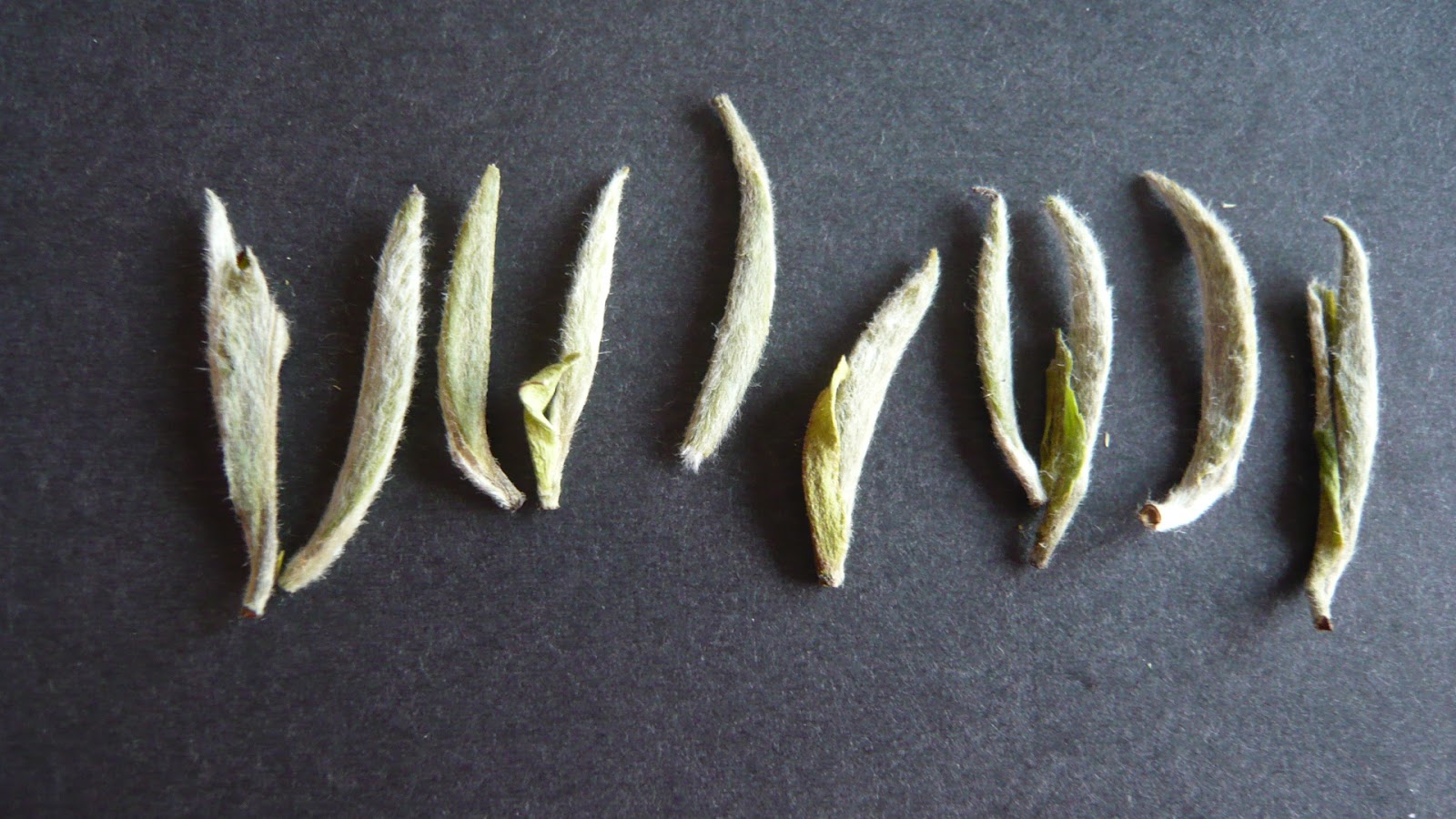
2011 Silver Needle on the left, and 2012 Silver Needle on the right. The new tea look significantly greener than the older tea.


2011 tea:


2012 tea:


 2011 on the left and 2012 on the right.

2011 on the left and 2012 on the right.

2011 on the left and 2012 on the right. 


2011. Notice the multiple red spots. 

2012. Few or none of the red spots.

I used 1.4g of each tea in each gaiwan. The useable volume of the gaiwan is about 80-90ml. I poured in boiling water, covered the gaiwan and let the tea steep for about 3-4 minutes.

The flavors of the two are very different. They don't taste like the same tea! The new Silver Needle has a brighter and more floral flavor. The older one has a deeper tone, somewhat woody and herbal taste. Starting from the fourth infusion, it seems to me that the 2011 tea taste smoother, with less woody and more honey flavor. Meantime, the 2012 tea's floral note is not as uprising, but tuned down a bit with a brighter honey taste. Both tea can go for quite a few infusions, that is if you use hot, hot water ;-)

Overall, the 2012 Silver Needle is my favorite new white tea in all these years. But the lovely floral note in its flavor may not be the flavor to remain if the tea is to be aged for years. I guess I will be drinking more new white tea this year! The 2011 Silver Needle doesn't taste as complex as the previously mentioned 2009 Shou Mei. Maybe it's because of age. Maybe it's because bud tea doesn't age as well as leaf tea. Overall, my favorite aged white tea so far is still the previously mentioned 2005 Bai Mu Dan. It's from this guy, who now has got a "real" job and no longer sells tea.

(I would like to include samples of 2012 silver needle, 2011 silver needle and 2009 Shou Mei in a small sample set in the next blog sale. Probably 4g 2011 Silver Needle [since I have little left], 8g 2012 Silver Needle and 8g 2009 Shou Mei. If you have some left over older white tea that you can barely consume by yourself, I urge you to run a blog sale or swap!)

_________________________________________

Appendix:

The 2009 Shou Mei (photos taken about a year ago)


May 22, 2012

mother's tea

This tea was not made for Mother's Day, since obviously they don't celebrate Mother's Day in rural Anhui :-D But it was a nice coincidence that the tea was made at the end of April, shortly before Mother's Day. The tea is casually named so, because it's made by a mother, and many people knew about this tea through her daughter.

I got this tea for a few reasons.

First, it's an excellent example of inexpensive manually processed tea. It's probably the least expensive manually processed tea I could ever get. This is mainly because the "mother" who makes this tea makes it for fun rather than as a job. The tea is made with a method similar to that of the Zen Patriarch Tea, which is a gem and many grades higher than this tea. The "mother" who makes this tea is one of the people who makes Zen Patriarch Tea. The leaves of this tea are from the same tea bushes for Zen Patriarch Tea, but these are much older leaves. Nowadays, most late-season tea leaves would be processed by machine, since they are relatively cheap and not always worth manual work. So I think we are lucky to have this old lady who enjoys manually processing this tea.

Secondly, in Chinese culture, there is great admiration of longevity and wisdom of senior people. Items passed on from senior people are often seen as auspicious. The mother who makes this tea is an ordinary woman who doesn't have a lot of money and didn't receive much education. But in her 60s, she is healthy and still working hard to take care of her mother in law, and sometimes her children and grand children as well. Being healthy, being able to enjoy working and surrounded by a nice family are some of the greatest fortune. In this sense, I think this lady is a person of fortune. This is also why we carry a small amount of her tea in our web store without a profit. I just hope to take a share of her senior fortune :-D

Thirdly, the daughter who sells this tea (who is by the way one of the several "amateur tea sellers" whom I'm going to write about) is one of my favorite green tea sources. The previously mentioned Zen Patriarch Tea, my favorite green tea from last year, and quite a few other green teas I enjoy are from her. I always love high end green teas. And because I use relatively expensive international shipping, in recent years, most of my green tea selection focuses on rare and high grade teas so that the shipping costs are more or less justified. But basically all my favorite producers have their focus on tea itself rather than grading or pricing of the tea. Getting incomes from tea is always important. But if a producer is crazy about tea, labeling or pricing never comes prior to tea itself. Many producers of the best green teas are capable of producing high quality inexpensive teas, and they would make inexpensive tea with the same sincerity they have on high grade teas.

The daughter who sells this tea is from a tea farmer family of rural western Anhui. Similar to the guy who is from a Huang Shan Mao Feng village, she has also settled down in Hefei, the capital city of Anhui. She often invite her mother to enjoy the big city and have some leisure time with her family in Hefei. Her mother stays with them from time to time, but always insists on going back home when the tea season comes. Even when sometimes the train and bus tickets of going home costs more than some late-season inexpensive tea could be sold for, the mother would go home to make tea anyway, because "you can't let the tea leaves get wasted!"

In the past a few years, the daughter has sold this tea through the internet, mostly to a bunch of acquainted tea drinkers and retailers. Once her mother learned of her tea was sold on the internet instead of on a "real" market, she said to her daughter, "You must be kidding! How can you possibly sell something to somebody you can't actually see while he can't actually see what you are selling!" Later, as described by the daughter, her mother was "completely in awe of modern technology!" I've found her mother's reaction interesting and cute :-D My own mom has never learned to use VHS (till the day it was thrown out), often misuses her cell phone and often messes up with her digital TV. But she is getting her coffee through internet now :-D Starbucks is very expensive in China and isn't nearly as good anyway. With our family's miserable history of coffee drinking, her current coffee is actually the first good coffee she has ever enjoyed, although I'm paying for it and she has no idea how somebody would ship the coffee without the buyer ever meeting him to hand over the money :-D

May 16, 2012

Concept Tea (11) - Orchid and sheep droppings...

(Concept Tea (10) is here.)

This is not about orchid. But, several years ago, I learned very nice tips about orchid fertilization from my roommate, who is from Taiwan and is so knowledgeable about gardening, especially anything tropical. He is a tropical fish lover too and kept a big fish tank. He never used commercial "plant food", but fertilized all his plants with the tank water (a.k.a. fish feces water). He often says, fish feces is wonderful! Indeed, when I was with him, my orchids enjoyed his fish feces and thrived.

This blog is not about orchid, but about tea and poops... A Tie Guan Yin with outstanding orchid aroma cultivated with sheep droppings.

My favorite Tie Guan Yin producer is a very young guy from a Tie Guan Yin family. He inherited a lot of traditional wisdom of tea cultivation and received higher education from a first-tier technology university in China. He is always keen to integrating modern science with the traditions of tea production. He is crazy at experimenting on things and likes to cooperate with other tea guys to do crazy things.

Once I asked him what was his "secret" of making delicious tea. I have to admit it was more of a compliment than a question, as I didn't expect him to explain to me in details. But, "goat droppings!" is his answer. He said, winter fertilization is key to tea cultivation, and goat droppings is heavenly winter food for Tie Guan Yin tea trees. I was a little surprised and said, "so, that's the most important thing in Tie Guan Yin cultivation, and you just told me the 'secret'?" Then he told me that it's nothing secret. Basically many tea farmers in Fujian know it, and goat droppings are still commonly in use, yet few people would do it perfectly, due to the intensive labor and high costs involved. Only crazy people would bring "goat droppings fertilization" to an ideal level.

This year, I got this tea from their factory. It's not a routine product. The leaf materials are from their partner organic farm run by another young man who has the financial security to do crazy things without restriction of budget or profit outcome. Besides organic cultivation and generous use of traditional fertilizers, what's interesting is a lot of their fertilization is from sheep droppings that are transported by cargo train from inner Mongolia - it's like transporting sheep droppings from Wisconsin to Florida.

Why from Mongolia? A very practical reason is, Fujian is a small and highly populated province, and you can hardly collect that much sheep droppings :-p Besides, with agricultural development and higher density of tea plantation and orchards, there is even less space for goats or other domestic animals. Most other southern provinces have the similar situation. In Inner Mongolia, livestock is a backbone industry, and sheep droppings are abundant. In addition, in the north, animals are bigger and fatter, and droppings are supposed to be more nutritious :-D But anyway, I see this sheep droppings fertilization as more of an exploration than some long-term operation. If sheep droppings can demonstrate great values in promoting quality of the tea, then this experiment may encourage people to open a lot of options of organic fertilizers.

This tea, in short, is my favorite modern green style oolong throughout the years.


I used a small porcelain teapot to brew it and this was proved to be a good idea! A porcelain teapot or a gaiwan makes it convenient to experience the "lid aroma", aroma from under the lid of the brewing vessel. The lid aroma of this tea is wonderful. The taste is rich of orchid aroma and the buttery protein kind of taste usually found in tea from environments abundant of natural nutrients. The liquor texture is smooth and soupy. And the extra soupy feature is something in common that I've noticed from quite a few organic oolong. This may have to do with the rich pectin contents resulting from carbon nutrients in organic fertilizers. Synthesized fertilizers simply don't have such outcome because they are rich of nitrogen but short of carbon nutrients. 


The leaves are not perfect. Due to the weather of the harvest period, this tea was harvested when leaves were slightly older than preferred. In spite of that, the tea is still my favorite modern green style oolong. And the imperfect leaf condition gives me hope that the tea could be even better in a future year with better weather conditions and better processing.


Although the leaves of this tea are not perfectly young and tender, the leaves look succulent and lively. Against the current trend of Tie Guan Yin leaf materials, these leaves are not from new bushes either.

In recent years, Tie Guan Yin lovers may have noticed that towns of Anxi County (where Tie Guan Yin originated) took turns to be the new "hot spot" of Tie Guan Yin. These towns, Gan De, Xiang Hua, Long Juan, Jian Dou... are old producing areas turning into new stars one after another. If you ever wonder why, here is an important fact behind this phenomenon: these towns, one following another, cultivated new bushes either by removing older bushes or by converting other agricultural fields into new tea plantations.

In modern green style Tie Guan Yin production, New Bush is a key word. Why is that? Because new bushes have the best-nutritious leaves to support the taste of freshness and orchid aroma emphasized in modern green style Tie Guan Yin. Then, what's wrong with old bushes? Why aren't their leaves as good? It's largely because the tea bushes don't receive the best nutrients over the years, and synthesized fertilizers can never do as well on them as the traditional organic fertilizers. Nowadays, many modern green style Tie Guan Yin are advertized as from "new bushes", or 2-3 years old bushes. But what are people going to do with them after they are no longer new? A tea bush is a plant. It shouldn't get "old" or "weak" after merely a few years. It's getting "old" and "weak" only because the original nutrients in the soil are exhausted and they are not taken care of properly.

So far, what has been happening is, after one "hot spot" has its tea bushes growing older, people's interests all go to the next "hot spot" with newly planted bushes. Then, what will happen to the "no longer new" bushes? Some tea bushes, as they get older and "weaker", would be used to make cheaper and cheaper teas. Some farmers would chop them down and make space for planting new bushes all over again. But then there are problems. The soil may have already been exhausted by the previous cultivation. How long will it take to recover? Besides, typically the new tea bushes will take in all the human labor without any yield in the first year. Then, at certain point, these factors, along with the ever increasing labor costs in China, would make some farmers think, is tea cultivation still worth it? Wouldn't fruit orchards and many other things be easier and more profitable?

The pursuit of "new bush" creates dead circles (I have to mention that it's not everybody's opinion, as many people, consumers, tea sellers, producers all included, are very enthusiastic about new bush Tie Guan Yin), because new bushes can't stay new forever, and all the endeavors on new bushes are only for short-term gain. But a different way to view the whole situation is: if soil and tea bushes are well fertilized, then old bushes are not inferior to new bushes, and then there is no need to run after new bushes. Instead of staying busy chopping down old bushes and growing new bushes, the money and efforts could be spent on maintaining good nutrients for the established plantations. There might be more input than profit in the initial years, and it may not bring in a lot of quick money, but the benefits seem long-term and sustainable. I've exchanged some conversations with quite a few Tie Guan Yin producers on this, and I think it's their vision of ecosystem and effective fertilization that convinced me this is a much better approach than the cycle of planting new bushes.

So the concept behind this tea is very simple - many other things are by far not as important or useful as, em... poops!

May 12, 2012

circa 1990 Menghai 8972 brick purely dry storage

In China, many aged puerh products are emphasized to be "purely" dry storage. The "purely" doesn't just stress how dry the storage is. Most purely dry storage puerh has been stored in drier regions in Yunnan, which are not very dry regions to begin with. Some humidity data are mentioned in this post about another of my beloved dry stored tea. In Chinese puerh industry, the "purely" in "purely dry storage" mainly emphasizes that the tea has been dry stored in its entire life, without intentional or accidental dampness. By this definition, not all Yunnan stored tea can be called "purely dry storage", because there is a rain season in many regions of Yunnan and "accidents" happen.

Besides, I can't say there isn't any emphasis of dryness in the word "purely", because it's mostly used in Yunnan stored puerh. It seems many merchants and collectors in Guangdong and Hong Kong would call their dry stored tea just "dry storage" and rarely use the term "purely dry storage". I don't have enough experience to compare the pros and cons of Yunnan dry storage and Guangdong dry storage. But a currently popular hypothesis is, tea ages more slowly in Yunnan, which is much drier than Guangdong, but the aroma is maintained better. Here, "better" depends on one's preference though, and an alternative is to say "the aroma is different from that results from Guangdong storage". But when people say the aroma is maintained better in Yunnan, my understanding is, the aroma referred to is the prominent honey and floral aroma. In this sense, I do believe the aroma is maintained better in drier Yunnan.

This 8972 brick, I would call it "circa 1990" because as many tea of its time, the production date is not labeled anywhere and the date document (sometimes found in a whole box of puerh bricks or cakes) is nowhere to find. 

This tea is sometimes referred to as "Cultural Revolutionary Version brick", as it's made following the formula of Menghai factory's famous "Cultural Revolution brick" issued during the Cultural Revolution era. The word "Version" should be emphasized because it's not a CR brick but rather a brick that's made after the CR era following its formula. The first batch of "CR Version brick" was made in 1989. These bricks that I've got are said to be the 1989 batch. But there isn't really a way to confirm it. Besides, it's a little too convenient to say it was made in 1989, as that's the earliest possible time. But then, with dry storage, the age of a tea is actually less confusing. There is basically no way to fake the age of a dry stored tea. Any faking method would ruin the aroma and/or the outlook of the leaves. So after tasting this tea, with its leaves and aroma typical of dry storage, I would guess, still guess, but with confidence, that this tea is very likely from 1989 or shortly after it. Hence I arbitrarily call it "circa 1990".

Upon opening this tea, my first impression is, it's so clean, even for a dry stored tea! "Clean" doesn't mean it won't have any stones, grain shells or hairs in it :-p So far I haven't seen any, but who knows! It feels clean mainly because its leaves look handsome and "unambiguous".

Then this impression of "cleanness" remained all the way in my drinking. At this point, the brick is tight enough to hold together but easy enough to break. So I manage to pry off leaves without many crumbs. The brick doesn't have "covering layer" (many big factory products have higher grade leaves on the covering layer and lower grade leaves inside), and the leaf material is consistent inside out.

I guess, being clean isn't really an important thing in aged puerh. But I myself like clean tea. I do drink "dirty" tea sometimes, but I like clean tea! And I deeply appreciate how clean this tea is - probably not as clean as a new green or oolong, but it's really clean! For this tea, I didn't even use a strainer between teapot and teacup, which I used a lot for most puerh.

The taste of this tea is where I made my guestimation that this tea is from "circa 1990", or as early as 1989. It tastes smoother than the "butterfly tuo", the liquor feels more soupy, yet the aroma is still prominent. I guess 20 something years is the only way for the tea to get all these characters.

Overall, I like this tea even better than the "butterfly tuo", which I already like a lot and of course it can still further "grow up". I almost wanted to include this brick as a "concept tea", but dropped the idea because the concepts in it are quite similar to the concepts in the "butterfly tuo", which I've already included in the "concept tea" series. But probably this tea is an even stronger representative of this type.

I will not repeat the thoughts that I included in the post about the butterfly tuo. But there are a few interesting things that I want to mention about this tea:

1. I think it's quite drinkable now and guess that's the peak or near the peak stage for this tea. This is just my guess and I don't really know it. The tea still has some light bitterness background in the taste, and is not as smooth as a lot of shu puerh. But the aroma is rich and pleasant. I somewhat believe you can't have all the great things all at once. I guess (without much confidence but still an "educated guess" haha...) with time being, both the bitterness and the aroma will get weaker. At certain point, when the bitterness almost disappears and aroma is still strong, that will be my favorite stage of the tea. And I think the tea is very close to that stage now. But I value aroma very much and it may not be the preference of everybody's. If somebody values mellowness more than aroma (and I know a lot of people do), then they may have quite different definition about the tea's peak stage. I've seen people saying it must take dry storage forever (or at least quite a few decades) to make a tea drinkable. I guess those people simply have very different flavor preferences from mine.

"When would a tea reach its peak", and "how old is old" is a very interesting topic and I would like to write a different post later to compare what some tea professionals think of it (I will only go over what they say because I don't have much to say on the topic but have great interests in learning about people's thoughts of it.)

2. Overall I like this tea better than the butterfly tuo. And this tea is more "mature" than the butterfly tuo. But currently this tea is not more expensive than the butterfly tuo, which is already less expensive than many other aged teas. I'm not the one who made the prices. But I think their prices do follow the market rules. This brick comes "naked", with a standard CNNP wrapping for a whole pack of 4 bricks, but without wrapping for each individual brick. "Clothing" matters, not just in social events :-p Besides, the butterfly tuo, although rare, does have some established market among people who know about it. And so far I've only seen one batch of it from 1996. In contrast, the 8972 brick was made in different years. Late 1990s ones are not naked anymore and have individual wraps. But overall, most of them don't bear production dates. If under the same dry storage, a late 1990 version can't taste anywhere similar to an early 1990 version. But I somewhat believe prices are often made far before the tasting takes place. I think the multiple batches are confusing enough to affect the price. For collectors who buy in bulks and expect to sell them in bulk after a number of years, this tea may not be a good investment choice.

3. It's pretty much unknown to me how various regions, harvest seasons, leaf grades and other factors contribute to the taste of a tea after years of aging. Interestingly, I've noticed some common flavors between this brick and the butterfly tuo. I have a 1996 Menghai tuo (which I will blog about later) that's from the same factory as this brick, and is in the same age period as the butterfly tuo. However, the 1996 Menghai tuo doesn't share much commonness with either is brick or the butterfly tuo. This seems just too complicated!

May 8, 2012

brewing green teas with Petr Novák shibo set

Well, I guess shiboridashi was meant to be for green tea to begin with! But for a long time I forgot about this fact, as I enjoy using Petr's shibos for oolong and puerh - they have the perfect size and hand-grab feeling. The little "teeth" at the spout does a great job filtrating liquor out of brewed tea leaves. And, they don't get your fingers burnt! I never feel 100% comfortable using gaiwan for gongfu tea, and used to take teapots as much as possible. But suddenly, Petr's shibo became my new "gaiwan" :-D

Last time when we got a bunch of Petr's hand made tea ware (tea bowls, shibos, teapots...) for the web store, I selfishly grabbed this cute red shibo set for myself before showing it to anybody :-p Then in this spring, when new green teas arrive, I suddenly realize this is a perfect set for green tea! Oh well I guess I'm the last one to realize this :-p But I mean, many people use shibos for Japanese greens, and they are actually perfect as well for Chinese greens. And this specific set has everything I love as a green tea set!

For green tea that requires a lower temperature, the shiboridashi with lid removed serves as a perfect water cooler, and the small tea bowl that comes with it can be used as a brewing and drinking vessel. It's quite small, but perfect for tea that you've got to be thrifty on.

Cooling water:

Pouring water in the little tea bowl and throw in some Bi Luo Chun:

Bi Luo Chun "germinates" at the bottom of the bowl!


An Ji Bai Cha brewed in a similar way:


Tea that can tolerate hot water well can be brewed in the shibo directly, such as this Huang Shan Mao Feng:

Somehow I feel the color of the red glaze matches spring green very well! And the white inside is perfect for appreciation of green tea leaves.

Brewing Yong Xi Huo Qing is as easy as throwing tea grains into a bowl of hot water.


Then the tea grains would "germinate" in water.

 Then it takes a couple of minutes for the leaves to get fully expand.

 The monkey seems as thrilled as I am!

Teas like Bi Luo Chun and Yong Xi Huo Qing stay put at the bottom of the vessel and don't usually get into the way of your drinking. For some other teas whose leaves would go up and down in the water, or float around, the lid could be useful.

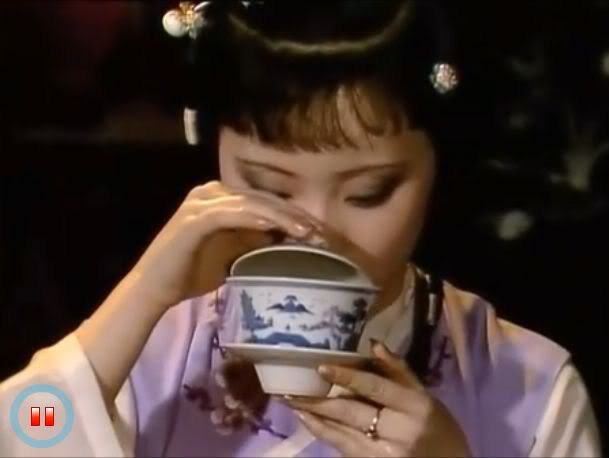
This is how people use the lid of a traditional gaiwan to wave away tea leaves when drinking green tea. You can do pretty much the same with the lid of a shibo :-)
(This is my favorite actress in my favorite Chinese TV version of my favorite book, The Story of the Stone.)
For most Chinese green teas, I would use hottest boiling water, or water temperature very close to boiling point. Hot water could be very helpful for green tea leaves to open their cells and release flavors. Then a tea bowl with wide opening is really handy. It allows hot steam to escape fast so the water wouldn't stay too hot to get the leaves "cooked". Meantime, the thick wall prevents water from cooling down too fast. I didn't analyze all this before using this shibo. But once I started, I found myself using it most of the time since the green teas arrived a few week ago. Then I came up with all these guess-analysis about why it seems so great for green teas!