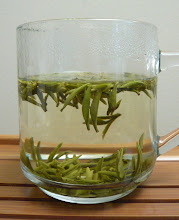
Jul 23, 2011

Discussion on Long Jing (6) - QingMing vs. GuYu

Discussion on Long Jing (5b) is here.

Qing Ming (around April 4) and Gu Yu (around April 19) are two important landmark days of solar terms in the traditional calendar system of some eastern Asian and southeastern Asian cultures. Solar terms document movement of the sun throughout the year, and is very important in directing agricultural activities of east Asia. Many of the solar terms can also apply to other parts of the world, especially regions in temporal zone of the northern hemisphere. Therefore I can constantly observe solar terms such as Qing Ming (marking the start of spring), Small Snow (marking approximate start point of winter snow) and Jing Zhe (marking the "awakening" of mosquitoes and bugs) in New England. Equinox days and Solstice days are also included in the solar term system.

Here is a tea harvest calendar based on the solar terms. By the way, the Major Heat (a landmark point of solar terms whose meaning is reflected by the name) of this year happens between yesterday and today (July 23, 2011). If you are in the Northeast of America, probably you already experienced it in a very deep sense.    

I used the same brewing method as in discussion 5b to brew a pre-Qingming and a pre-Guyu Shi Feng Long Jing. Both are made from Jiu Keng Group cultivar, by the same family in Long Jing Village. Within a small clique of fans, people often call product series of this family by the family address, 2xx Long Jing Village. 

The pre-Qingming one was produced on April 3, and the pre-Guyu one was produced 5 days later, on April 8. In warm spring weather, 5 days makes a big difference on the tea harvest. On the other hand, the difference between this two teas is not as prominent as, for example, a pre-Qingming from April 1 and a pre-Guyu from April 18. So, after all, pre-Qingming and pre-Guyu are only approximate concepts. Sometimes, the harvest date is more informative than labels of Qingming or Guyu.

The two teas are made by the same family. However, they were not processed in exactly the same way. The pre-Qingming one was completely manually processed, as pre-Qingming Long Jing production is very small and deserves the best attention. Most families in traditional Xi Hu Long Jing regions process their pre-Qingming tea manually. The pre-Guyu one used semi-manual processing, as it's usually of much larger production and there can't be enough tea workers to do the complete manual processing.

In all the pairing photos here, pre-Qingming is on the left and pre-Guyu is on the right.

Dry tea leaves


Dry tea leaves of pre-Qingming


Dry tea leaves of pre-Guyu


2nd infusion:

Pre-Qingming:

Pre-Guyu:

As seen in the cups, pre-Qingming Long Jing has a lot more buds than leaves. Pre-Guyu Long Jing has fewer buds and larger leaves.

Spent leaves:

Pre-Qingming:

Pre-Guyu:

Overall, the taste differences between these two teas is obvious when you taste them side by side, but the difference is rather small when you are not tasting them side by side. Their harvests are only 5 days apart, but there was surely a lot of growth going on in these 5 days. That's why Long Jing, as many other prestigious green teas, has its harvest time documented not by season or month, but by date. When tasted side by side, the pre-Qingming displays more prominent "aroma of spring" - green, floral and uprising. The pre-Guyu has less of this green, floral aroma and its aroma doesn't last as long as that in pre-Qingming. On the other hand, the pre-Guyu has slightly heavier taste and stronger "throat feeling" (I mean, more prominent flavor sensed near the throat region). But again, the difference is small. The price difference, however, is big. The price difference, I think, is not just based on their taste difference, but largely because of the time-line labels they bear.

The difference between pre-Qingming and pre-Guyu is probably even smaller this year, as the harvest of the traditional cultivar (Jiu Keng Group) was quite late in this past cold spring. In a few pieces of field in Mei Jia Wu, there was no pre-Qingming harvest at all. In some other years, when the harvest is overall earlier, pre-Guyu may taste significantly "older" than pre-Qingming.

When I was a child, as I remember, most pre-Qingming served as precious gift (in the gifting culture in China, it's important to use the best as gift and keep the modest grade products for oneself), treat for important guests and for grandparents. For daily drink, most of us Northerners were happy enough to have pre-Guyu. In some years there was no pre-Qingming harvest (this didn't happen often, but was not super rare either), then people would think pre-Guyu was as good as pre-Qingming, as it was harvested in similar climate as pre-Qingming of other years. That was a time before market-economics and modernization.

In the past decade, I don't remember ever hearing there wasn't a pre-Qingming harvest in a year. I suspect most people would harvest the tea as early as possible (and it must be pre-Qingming to be early enough), instead of let the nature determine when start harvesting. Sometimes people value the pre-Qingming label so much and neglect other important parameters such as cultivar, producing region and, sometimes, even the taste itself. Therefore in recent years, very oddly, even in Hangzhou, the capital of Long Jing, some lower quality tea of earlier harvest date is sold for much higher price than higher quality tea harvested only several days later.

Well, I am not trying to bring us back to the days of government planned economics. Nowadays we do enjoy a lot more convenience in tea drinking. Today, getting pre-Qingming Long Jing shipped to North America is so much easier than getting it shipped to Northern China in the 1980s.

As precious as pre-Qingming is, it's not necessarily the best tea for everybody. In China, some old-fashioned tea sellers would often remind their customers that many old-fashioned tea drinkers would even prefer the pre-Guyu to pre-Qingming, because they would think pre-Guyu is more flavorful and has more "kick". I call them "old-fashioned" because the "new fashion" seems to be "the more expensive, the better" :-p In my own shopping experience, for tea or other things, I like it when sellers give reasonable recommendations on less expensive options. Sometimes I like the most expensive item the best and love to splurge on it. Sometimes I like a less expensive item the best. When I don't have to pay the highest price to get my favorite stuff, I think, the happiness doubles :-D

Jul 17, 2011

my personal history of coffee drinking

What?! Coffee?!

Well, first of all, maybe coffee counts as some sort of "herbal" "tea"? :-D

Secondly, I do like coffee. And it's something quite unique that I've adopted in my adult life. I can't recall my early history of tea drinking, since it was too much of daily life and all memories were blurred. I can't recall my early history of alcohol drinking either, because, as you may know, Chinese kids can start drinking alcohol from whatever age. Up till today, I've never been a frequent alcohol drinker. But my first glass of wine was too early to remember :-p So for me to review some personal history of beverage, what's left is coffee.

My earliest coffee experience was at the age of 10 or so. Back then, coffee was not commonly seen in China. One day, we got an "expensive and fancy gift" - instant coffee by Nestle Cafe :-D On a Sunday afternoon, during our usual tea time, we made some instant coffee. Nobody managed to finish the third sip and everybody was deeply puzzled how come this dark brown, bitter and sour thing was said to be a very popular drink in the Western Hemisphere :-p  So we put away the coffee and barely had it again. Later, probably in another gift set that we received, we "discovered" coffee mate, and found coffee more "bearable" with coffee mate added. For a few times, we received ground coffee as gifts. We thought of it as more complicated to handle and less "bearable" than instant coffee.

In the old days in China, milk usually arrived (or was purchased) every morning, and was immediately boiled and taken as part of the breakfast. There was almost never cold milk stored in the fridge. So it was only years later that I "discovered" milk for coffee.

By the time we made coffee more "bearable" with coffee mate, all of us basically lost interest for coffee and thought it could only be enjoyed by some people for mysterious reasons. So we seldom had coffee again, and re-gifted all our coffee to other people. Back then, coffee was a trendy gift. But I suspect some friends who received our re-gifted coffee didn't enjoy it more than we did :-p

In 2000, the second year I got my driver's license, I took a road trip to the southwest and drove for more than 3000 miles in 10 days, all by myself. That was when I felt a need for caffeine and found some coffee didn't taste bad at all (I mean those cups of coffee I had in rural restaurants...) So when I came back home, I started drinking coffee in the morning, Nestle or Maxwell instant coffee...

All those years I had been in the States, I didn't pay much attention to Starbucks, not even curious about it, as I was not yet a coffee drinker. Then, in the summer of 2001, I "discovered" Starbucks, in Beijing - because, back then, all cool kids in Beijing were supposed to have Starbucks experience. So I found out Starbucks ice Mocha was my favorite, huh, desert beverage! Back in the States, I did notice ice Mocha here is a lot sweeter, too sweet for me to handle. But I enjoyed my Starbucks experience and stopped by from time to time.

At about the same time, I lived with a nice couple who shared with me their coffee made from a filter drip coffee maker. They had very high quality coffee and rotated flavors from time to time. Soon I happily found that I lost tolerance of instant coffee. Meantime, I started to realize Starbucks seemed quite expensive, considering the cost and quality of home brewed coffee.

In 2003, I had another roommate who kindly shared with me her coffee made from a stove-up Moka pot. That just blew me away! From then one, I became a loyal fan of Moka pot. Then I got a coffee grinder and started buying coffee beans. In 2006, after I moved to an area within the territory of Trader Joe's, I started buying organic, fair trade beans from them. I appreciate it very much that they offer such a broad range of coffee. In recent years, I buy most of my coffee beans from a Guatemala plantation. It's not certified organic. My husband once spotted the plantation on his bicycle and decided to take a tour in it. According to him, the environment and operation of the plantation are quite convincing, so whether or not it's certified organic doesn't make a big difference. Also it's not Fair Trade certified, but for us, it's direct trade anyway. 

This is my personal history of coffee drinking. I am glad I "discovered" coffee and fell in love with it. I am also very glad that I wasn't eternally cast away from coffee after my first few painful tastings. Finally I am glad I didn't stop at instant coffee. Overall I am just an ordinary coffee drinker, not an "aficionada". I don't actively look for new types of coffee, and feel satisfied with my simple coffee ware. Till now I still feel lucky that I formed a bond with Moka pots, as none of my Moka pots ever costs more than $20. Even the one on my wishlist is under $50. So to me, coffee drinking is a lot less expensive than tea drinking :-D

What beverage do you like other than tea? Any other coffee+tea lovers out there?

Jul 12, 2011

gossip... gossip...

This is old news. But I've just found out about it, and think this is seriously juicy... :-p

Zhang Tianfu is like the Godfather of Fujian tea. He is one of the first generation biology professors of China, and has conducted tea research for more than 70 years.

Guess what! Zhang Tianfu got (re)married, last year, at the age of 100! In the wedding photo showed here, the bridegroom, Zhang Tianfu, was then 100 years old and now is 101 years old (actually 102 years old by Chinese way of counting). The bride was 58 years old by the time of the wedding.

I have to say, Zhang Tianfu looks very young for his age (his wife too!). I guess he has no problem to live above the age of "tea longevity" (108 years old). Those tea companies eager to sell tea by its health benefits, should just get him for their TV commercials :-D

By now, Zhang Tianfu has broken the record of Chinese celebrity wedding age set by C. N. Yang, the Chinese American Nobel-prize winner physicist who got (re) married at the age of 82 to a 28-year-old woman! When C. N. Yang got married, I was thinking, working on science and keeping the brain active must help a lot to retain one's youth and vitality! Now Zhang Tianfu must be a very convincing example how one can stay young with tea! Well, in fact, C. N. Yang is an enthusiastic tea drinker too. He spent a big chunk of his youth in Kunming during the war time, drinking tea and studying physics. (His story was mentioned in my earlier blog here.)

As gossipy as I am, I dig up a bit more... Zhang Tianfu's wife was an acrobat when she was younger. She was widow of a tea scholar who was son of Wu Juenong. And Wu Juenong (1897-1989, quite long-lived too!) was like the Godfather of Chinese tea. He was second to none in in the Chinese tea history of 20th Century, and was respected as the Contemporary Tea Saint by Chinese tea professionals of a few generations.

So much to gossip about tea romance and tea karma :-D

Jul 10, 2011

some suggestions for new puerh drinkers - shu

(I post this on Steepster a few months ago. This is pretty much the same as the steepster post, with a few points added at the end.)

First, I have to admit that I have very limited knowledge about puerh, and I am not learning fast. I think what makes me qualified to give new puerh drinkers advice is, I am not crazy about puerh - This may sound a little illogical. But what I mean is, just because I don't have a broad love of puerh (I don't like most shu and I don't like a lot of sheng), my advice might be useful to those who don't have a broad love of puerh either. Sometimes when I recommend a puerh to someone, I would say, even I love it - if I can enjoy it, probably you can too :D

I will start with shu, because most shu tastes stinky to me. Therefore, if a shu tastes good to me, chances are most people would like it.

1. Select a shu - most of the suggestions here only make sense when the products considered have clear information about production year and manufacturer. Such information is almost essential, but more than a few products in the market don't have such information. If a product is just named "puerh" without additional production information, then there is no way to give any general advice on it.

I select shu with very conservative criteria. I look forward to expanding my horizon (mostly by getting free or cheap samples instead of making bold purchases). But I suggest beginners to use very conservative criteria in choosing puerh. Here are some criteria:

1a. I would look for shu products of about 3-years in age, or older. It's not that all younger shu products are stinky. I've had one or two new shu that are not stinky at all (which left me happily puzzled). But we are talking about being conservative here. Many products need a year or two to shed off the stinky flavor from deep fermentation.

1b. Many people believe, when you look for a shu, don't even bother with small factories, go for the large factory products. I do believe there are some very good shu products from small factories. But I agree it's a safe way to go for the large factory products first. A most conservative list of large factories would include (and their products are widely available in western market):
            * Da Yi - probably the most popular factory for shu
            * Xia Guan
            * CNNP  - It's the factory for some classic products. Unlike Da Yi and Xia Gua, CNNP does contract out a lot of their products (but not for some classics such as 7581), which is bad. But there is still the quality control, and usually when a product is bad, it's bland tasting, not of worse problems.
            * This list can expand with a few more factories, but that's where debates may start. For people who have just started exploring shu, I think Da Yi products can already keep them busy for quite a while. 

1c. It's probably common sense now - you don't have to buy a whole cake or tuo to experience a product. Sampling is almost essential.

2. Brewing a shu - whether gongfu style or a big teapot is used, I think following tips may help:

2a. Rinse the tea generously. Rinse the tea with boiling water for 10-15 seconds, and discard the water. If rinsing once is not enough, then twice. Some shu doesn't require rigorous rinse, but even in that case, a thorough rinse will not exhaust its flavor. When you know a specific puerh better,  you will have more precise sense how much to rinse it. But at the beginning, rinsing the tea generously can reduce the off flavor of fermentation as much as possible, and therefore you can have a more pleasant first encounter with the tea. :D

2b. Start with low leaf:water ratio and increase it in future sessions if necessary. When using gongfu style, I would start with 3-4g tea in a 120ml vessel, and 5 seconds for each of the initial infusions. When using a large teapot, I would start with less amount of tea than what I would normally use for red tea, and add more boiling water whenever the teapot is less than 1/3 full. If the tea liquor looks like dark soy sauce, then probably less tea leaves or shorter infusions should have been used.

As much as I have said that I am not crazy about shu, there are indeed a few shu's that I love very much. To name just a few, there is the good old (and cheap, if home-aged) 7581. Also there is the good and popular 7262. Not only it's tasty, it also has intriguing characters in aging. According to Taiwan puerh professional Shi Kunmu, some 7262 aged in Malaysian dry storage developed into a stage resembling old sheng - I haven't experienced a shu of such characters yet, but think what he said about 7262 is quite plausible. A favorite of mine is the one in the photo of this blog, shu brick compressed with Y421, a high end loose shu produced by Kunming Factory. Y421 is a routine loose tea product, but for some reason I don't see a lot of bricks made of it in the market.

Obviously I haven't found all good shu, due to my lacking of enthusiasm in shu overall. If one is very interested in shu, I am sure there are numerous good choices. That's why I emphasize conservatism for people who newly explore shu. It's important not to be freaked out from the very beginning, and in fact there are lots of awfully freaky shu products out there.

If you by all means just dislike shu, I think that's fine. There are many other teas to enjoy anyway. One saying I somewhat disagree with (although I can understand where it's from) is, "Shu is an acquired taste." My thought is, don't bother to acquire the taste, but we can always keep ourselves open to it. If it's your cup of tea, eventually it will find its way to you. If it's not your cup of tea, then there is no obligation for you to like it, and it's ok to give it up.

Jul 5, 2011

my father's first encounter with Lipton

My father's experience is shared by quite a few, though not a lot of, people of his age. At the time, my father was more confused than anything else. But looking back now, we all think it's quite funny.

In 1980s, China's economy was just starting to open to the world, development was fast, and new things came out every day. My father was working in the first American-invested hotel in Beijing as the manager of restaurant department. It was a vacuum period for restaurants in many cities of China. Most of the best restaurants were in high end hotels. A typical high end hotel, such as the one my father worked in, could have up to seven, eight or more Chinese restaurants in it, plus one or two western style ones. So my father was in charge of restaurants in their hotel, and part of his job, is checking out good food in various places of China.

Once my father attended a banquet in Shanghai, exclusively for professional epicures like him. They had course after course of exquisite dishes. At the end, waiters brought green tea in large cups, for mouth washing. The tea was fresh Long Jing. Using tea for mouth washing was never a big trend in China. But my father and his colleagues swiftly followed the procedure, as every Chinese intellectual must have read the most influential book in Chinese literature, The Story of a Stone (also named A Dream of Red Buildings/Chambers, which, I think, is a bad English name for the book), in which the mandarin family uses tea for mouth washing after each meal. My father thought the mouth washing ritual was fine, but it was annoying to him that fresh Long Jing was abused in such a way. Any cheap, fresh green tea would have served the same function well. In his traditional value system, there is nothing bad about luxury, but purposeless wasting is a totally different story.

After the Long Jing mouth washing, they were served tea, this time, for drinking. The waiters brought beautiful and elegant bone china cups with matching saucers. In each artistically made cup, there was the (said to be) highest grade Lipton black teabag, the supposedly great tea to end their grand meal. My father is a green tea drinker in his entire life. So he took the Lipton tea as a "foreigner's tea"experience. That was his first encounter with Lipton, so was most of his colleagues. However strange it may sound today, back then, none of them was shocked by the Lipton teabag after a fine meal and Longjing mouth washing. They were only a bit confused.

That was in 1980s, when hotels and restaurants aimed at serving uprising elite class of China and foreign tourists. A lot of strange things came out with big price tags, simply because there were people willing to pay for them. It was also the time when the finest imported French white wine was mixed with Sprite (yeah, the Coca Cola company product) to serve in expensive restaurants.

Many of those strange things gradually disappeared when Chinese people saw more of the outside world, and when a lot of rich people were enlightened on better ways to spend their money. In recently years, my father's Lipton story comes up to my mind from time to time, because only in recent years, I've realized Lipton has always been such a big deal in China. Today, few Chinese would see teabags as high-ranking or fancy, but simply convenient way of tea drinking. But it shocked me, again and again, to hear some Chinese tea professionals talking about the admirable business achievements of Lipton. They say, With so much tea produced annually, why hasn't China ever had a company like Lipton? China needs its own Lipton! In addition, I've seen lengthy articles (written by tea professionals) about how Chinese tea industry needs to strengthen itself to realize its "Lipton dream"...

Really?!

Maybe I am not the only dumbfounded?

(The photo on the top is a scene from 1987 TV series version of The Story of a Stone, the ladies rinse their mouths with tea after a meal :-)

Jun 29, 2011

Taiwan "style" Oolongs (0) - why they caught my attention

Taiwan "style" Oolong, with the stress on "style", meaning these teas are not from Taiwan, but use the same cultivars and techniques as for Taiwan Oolong.

I have been interested in these Taiwan "style" oolongs for a few years, due to a series of facts that I've observed:

1. Taiwan style oolong is raised extensively in Asia - including Zhejiang, Fujian, Sichuan, Yunnan, and more provinces in China, also including Vietnam, Thailand, Myanmar, and probably more Asian countries. And now the oolong raised in New Zealand is a rising star!

2. Taiwan oolong is often more expensive in mainland China than in US - considering the transportation distances, this is quite odd. When I go back to China visiting family and friends, I often gift them with Taiwan oolong. The tea was purchased from Taiwan, shipped to US, and then carried by me to Beijing. Probably in future, Zealong will also travel across oceans like this. My friends in northern China often resent about how hard it is to get good, authentic Taiwan oolong, not because there is none in the market, but because the market is flooded with a lot more fakes. When they get some good, authentic ones, often the prices are shockingly high.

3. There is a lot of Taiwan style oolong produced in China. Oddly, this doesn't help bring down Taiwan oolong price in China, but cause authentic Taiwan oolong to be more expensive, as there is much less authentic than inauthentic. Quite a few of my Chinese friends say, you can't get authentic Taiwan oolong for a price lower than $$$ - but this doesn't make much sense to me, because buying a tea for a price three times higher than its price in Taiwan local market doesn't make it more likely an authentic Taiwan oolong. Some fake oolong products are packaged beautifully and have rather high prices, because there are people buying them.

4. In Fujian, including Anxi, home of Tie Guan Yin, there are quite a few plantations managed by Taiwan tea professionals. The cultivars, core staff and equipment are all from Taiwan. I heard such kind of plantations exist in Vietnam and Thailand too, and imagine they can produce very high quality tea. However it's hard to get their quality confirmed, as rarely one can find products plainly labeled as Taiwan style oolong made in Vietnam or Fujian. But with time being, I did find a few Taiwan style oolongs made in Sichuan and Yunnan and honestly labeled so.

5.  So far in China, many people are crazy about Taiwan oolong, but probably more people buy fake products than authentic ones. In spite of all the efforts of some producers in making high quality Taiwan style oolong, no such product has yet become very popular in the market. Ironically, low quality Taiwan style oolong with fake labels often sells better than high quality Taiwan style oolong with honest labels.

6. Supposedly there is some high quality Taiwan style oolong produced in Fujian. But so far I haven't seen one that catches my attention. A friend of mine, a Tie Guan Yin seller, once tried to source some "famous" (or "infamous") high quality Fujian "Taiwan style oolong" for his store. He failed to do so, because, as he told me, he couldn't afford buying Fujian produced Taiwan style oolong for almost the same price as authentic Taiwan oolong. According to him, the tea was almost as good as, and as expensive as, authentic Taiwan oolong. The price was not entirely based on production costs, but rather because the producer could easily sell it to other vendors as "authentic Taiwan oolong". My friend figured he wouldn't be able to sell it for a high price as Fujian oolong, since consumers wouldn't like to pay such a price for a Taiwan style oolong that's not made in Taiwan. He wouldn't want to label it as authentic Taiwan oolong either, because no matter how good it is, such kind of labeling is deceiving behavior.

7. There are a lot of fake Taiwan oolong in Taiwan market too. A Taiwan tea farmer I know once told me how disappointed he was to learn that a wholesaler he had known for a long time started to shift most business to "imported" oolong. I don't know how common this phenomenon is. But there is a tea I bought directly from a Taiwan wholesaler that I highly suspect is "imported".

8. So far I haven't learned of any reasonable way to distinguish an authentic Taiwan oolong from Taiwan style oolong made in other places. In reality, there are many ways to detect the physical appearance, processing style and flavors of the tea that are "typical of authentic Taiwan oolong" or "typical of fake products". But all these criteria evaluate the quality, but not source of the tea. Surely there is a much higher proportion of top quality tea among authentic Taiwan oolong, and Taiwan style oolong is more likely to be of lower quality, because Taiwan has the best natural and technical conditions for its oolong. But there is also low quality authentic Taiwan oolong and high quality Taiwan style oolong, and there are products of equally high quality and from very different sources. If a tea is from a Taiwan oolong cultivar, the plantation is managed by experienced Taiwan tea professionals, and the leaves are harvested and processed by skillful Taiwan tea workers (such tea is not rare out of Taiwan), then how can one tell if it's from Taiwan or elsewhere? I can't think of a way to tell. In recent years there are authentic Ali Shan Oolong with DNA certification. But as I've spent more than few years studying biology, I've found this DNA certification thing doesn't make biological sense. It sounds more like a mental comfort for people who see DNA as mysterious and ensuring. In another aspect, this DNA certification thing also reflects how much fake products have interfered with the market of authentic products, so much that people have to try every way possible to certify the authentic ones.

9. Considering all the energy and brain work it costs to make fake labeling, to market a fake tea as authentic and to produce the tea to begin with, I wonder why such energy and intelligence can't be used on making some tea of solid quality. Can't people make good money at all with honest labeling and price consistent to quality? I guess I am not the only one wondering so. On the other hand, I also wonder why fake tea sometimes sells better than honestly labeled Taiwan style oolong of higher quality. Is it because the label is even more important than the quality in eyes of many buyers?

10. I have been thinking of above issues for a long time but hadn't tried to sort out my thoughts. This writing is largely inspired by Zealong, the New Zealand Taiwan style oolong. I obtained the three products of Zealong last year but had been flooded by a lot of other tea samples since then and didn't get time to try these Zealongs. Then the recent interesting reviews and discussions on Zealong by Mattcha and Sir William reminded me of this tea and inspired me on thinking and writing a little more about Taiwan style oolong.

A tea professional I highly respect once said, There is no best tea. But authenticity is the basic and ultimate standard for tea. I appreciate the effort of some tea professionals in making high quality Taiwan style oolong and labeling it as what it truly is. I believe most of them have genuine interest in making tea, not just making money. So far, no such product has achieved huge market success yet, and the market sometimes even encourages fake labeling. But I guess people involved in fake labeling have limited professional future in tea making, and people who are truly interested in making good tea always have a chance to succeed in the market. Currently Zealong seems to have a bright future. I am curious to see if some other Taiwan style oolong will catch up with it.

So this is basically why Taiwan "style" oolong has caught my attention. I will go over a series of such products and here is the plan:

1a. Zealong Aroma - I've got to put it in the front because it's probably my favorite Taiwan style oolong so far.

1b. Zealong Dark & Zealong Pure.

2. Yunnan Ji Bian oolong - Qing Xin (Green Heart) Oolong cultivar from Taiwan, 2300m plantation, certified organic, I have to try it no matter what!

3. Sichuan High Mountain Oolong

I will add more if I think of more :-D

Jun 25, 2011

3 aged Dan Cong (1&2)

To me, comparing these 3 Dan Cong's with different ages is an interesting experience.

The first one is a 1994 Dan Cong, cultivar unknown.


The dry tea leaves look dark and heavy. In my eyes, the appearance is not much different from a Dan Cong of a recent year. The smell is very pleasant. When I get an aged oolong, what I care the most is, I don't want it to smell either damp or burnt.


Considering the tea looks heavy and the leaves may expand dramatically, I used only less than 1/2 gaiwan-ful of dry leaves. It turned out to be a fair amount. The dominant impression I got from the first a few infusions was sweetness. The tea is very, very sweet. I don't remember having any other non-puerh tea that's so sweet. The tea also has some herbal aroma. Like some other aged oolong that I appreciate, the tea has rich flavor, but feels easy and soothing on stomach. The tea has some typical "flavor of age", which is enjoyable to me as it doesn't taste damp. 


The less than 1/2 gaiwan-ful of dry leaves, after being spent, became about 4/5 gaiwan-ful. Usually I would like to see spent leaves loosely filling the gaiwan, without being tightly packed. In a later tasting, I used a little more than 1/2 gaiwan-ful of leaves, and decided that for this tea, I would prefer using smaller amount of tea leaves.  


This tea seemed to last forever. But later infusions were much lighter. So I ended it at certain point. Overall, the sweetness in the first several infusions was very prominent, surprisingly prominent. In later infusions, the sweetness was still there, but felt more "regular". When the sweetness faded, the herbal and woody flavors stood out more.  The tea leaves expand little by little over infusions. From the spent leaves, it looks like I should have gone for some more infusion to fully use these leaves.


The second one is a 2002 Dan Cong, cultivar unknown, but flavor is within the range of Milan (honey orchid) Dan Cong.

The dry tea leaves and liquor color are not that much different from un-aged dark roast honey orchid Dan Cong - however, most of the dark roast Dan Cong's are made into dark roast at the end of its harvest year, so sometimes the age of an un-aged dark roast Dan Cong is not obvious to me.


The flavor of this tea bears only a hint of "flavor of age". It has a lot more uprising aroma than the first one. Actually I was quite surprised a 9-year old tea could retain so much aroma. In my impression, the uprising aroma of a tea would disappear gradually as the tea ages. One thing that has made me feel unsure of aged oolong is, I often love the uprising aroma of many oolongs and don't want to let it disappear in aging.


Overall I like this tea very much, but if I were not told the age of the tea, I don't think I could have guessed even a rough figure of its age. It tastes warmer than newer oolong, and the light "flavor of age" may serve as a hint. But I don't have enough experience to tell if it's 5 years old, or a little more, or much more. Besides, from its well-maintained aroma, I guess this tea has been stored in a relatively dry and well-sealed environment. Would I like it as well if it were at its third year? Very possibly! In this sense, I am not sure if I like this tea because it's aged, or because it's well-made from the beginning and well-preserved afterward. I think that's a constant question I have with quite a few aged oolongs and that's one of the major reasons I have been unsure about aging oolongs.

I started out to write a blog about the first tea, the 1994 Dan Cong. Then I got the 2002 Dan Cong and thought the two aged Dan Cong would be an interesting comparison. Then, one day I heard of this Dan Cong of 40-50 years in age. It's not something one can bump into frequently, and it's from a farmer I personally know. So even though I wasn't in a mood of collecting aged Dan Cong, I decided to get some just for the sake of experiencing it.  So I will review it and continue the comparison in a short while!

Jun 15, 2011

Mango milk "tea"

There is no tea in it, not even "herb", yet it's called "milk tea". Some people would add some red tea into it. But I don't, thinking tea doesn't yield significant flavor in such a blend.

Fruit milk tea is a seriously important thing in Taiwan. Once I had a Taiwan roommate and we made fruit milk tea every summer afternoon. We always skip the "boba" or "pearls" (little starch balls commonly added to milk tea) and only use fruit and milk. I love all kinds of fruit milk tea, even apple has a different taste when made into milk tea. But mango is one of my favorites. Papaya is another of my favorite. Strawberry is good too, but I always find the strawberry seeds annoying. Kiwi is nice and interesting. When blended, it (probably its seeds) has a hint of peppery flavor along with the normal kiwi taste. We also used cantaloupe and honeydew melons sometimes. Sometimes we blended in banana to sweeten the beverage. But these days I seldom use banana. For some reason, banana blended in milk tastes very sweet to me, almost too sweet for me to handle.

Making mango milk tea is very easy. Usually I use one of this kind of yellow mango (or two, if they are really small), two glasses, and 1.5 glasses of milk.


The Mango is sliced into small pieces, and completely homogenized with milk in a blender.
 

There are a lot of milk tea shops in China. I've seen some milk tea shops in the States too. The best shops always use real milk and real fruits. And when they do so, usually they have their blender and fruits displayed on the front counter. In China, milk is more expensive than a lot other things. So some shops use milk powder, condensed milk or condensed cream as the base of the beverage. Of course it can never be as good as real milk. In the States, fruits are relatively expensive. I've seen some shops using flavoring powders or flavoring liquors to yield fruit flavors. Most of them don't taste awfully bad, but can never be compared to real fruits. If a fruit milk tea doesn't use real milk or real fruit, I would rather skip it. So when I walk into a milk tea shop, I always look for their blender and fruits displayed somewhere up to the front. If they are there, then very likely the fruit milk tea is the real thing.

There can be things added to fruit milk tea with a lot of options such as honey, sugar, ice, "starchy pearls", tea, whipped cream, vodka... But basically, the secret to a good glass of fruit milk tea is simple - real, fresh milk and real, fresh fruit.

Jun 5, 2011

CNNP colorful stamp sisters and brothers

These two CNNP green stamp brothers are not the same tea, and very likely not from the same factory. 

A friend of mine once said, you never know how many products share this same green stamp jacket! Indeed! Meantime, many other CNNP products share the same jackets of yellow or red or other colored stamps.

CNNP (or Zhong Cha, 中茶) is notorious for contracting out a lot of its products. To be more accurate, it's not even contracting out. Here is my simplified interpretation, with many of the not-so-juicy details omitted, and with possible misuse of some political terms :-p

(The name of CNNP has changed long time ago, but it's just easier referring to it as CNNP.)

In the "state-owned" era (when all businesses were owned by the Chinese government), all tea companies were literally affiliated to CNNP. Then, in late 1980s when "capitalism" started, control of tea businesses was more and more transmitted to local companies. Up till today, many tea companies are still state-owned in name but are no longer under centralized administration of CNNP - as reflected by profit distribution. No longer collecting profits from local companies as before, CNNP said, Ok, now let's follow Free Market Rules. All local companies should pay for using CNNP trademark! This last for a short while. Then bigger local companies, such as Meng Hai Factory and Xia Guan Factory, said, Wait a minute! Why should we pay for using CNNP trademark while we could have our own trademarks? Hence came the trademarks such as Da Yi and Xia Guan (including the "crane" and a few other trademarks). Soon, more and more companies did the same. CNNP's policy of collecting fee for using its trademark was issued in 1988. Da Yi's trademark was registered in 1989. Xia Guan's "treasure flame" trademark (used for mushroom tuo and relevant products) was registered in 1990 and "crane" trademark was registered in 1991. In 1990s, Da Yi and Xia Guan had products with their own trademarks and with CNNP trademarks. But eventually they managed to get rid of CNNP trademark gradually.

Current CNNP brand products are still from various factories, including Kunming Factory, which is highly respectable. Some popular CNNP products (such as 7581) are only made in Kunming Factory and are more reputable than some other CNNP products. Meantime, a lot of CNNP products are made by numerous unknown factories. These factories are willing to pay for using CNNP trademark because their own trademarks wouldn't have the same level of market influence. Some of these factories are good, but there are so many of them, and some are quite bad. In recent years, with rapid growth of CNNP, more and more tea merchants and consumers are questioning on CNNP's loose control of its trademark authorization.

The trademark control problem of CNNP is much more severe today than 10 years ago, partially because 10 years ago, factories, even mediocre small factories, didn't have much incentive to make bad tea. Some people say, vast majority of pre-2005 Yunnan puerh is good tea. To make it a stronger statement, some people would narrow the range to pre-2002 or even pre-2000 tea. But anyway, what this means is, before puerh had the market hype and before puerh brought in mad cash, puerh production was normal, and usually a normal puerh is a good tea. If we exclude fake products from the discussion, authentic pre-2000 products are rarely bad. On the other hand, this doesn't mean all pre-2000 products of CNNP are super great. Some of them are from reputable large factories, and some of them are from less known factories. Some are amazingly good, and some are of quite average quality. The large quantity and uneven quality are partially why many pre-2000 CNNP products without clear manufacturing information are less expensive than some early-2000s routine products with Da Yi or Xia Guan trademarks. For the same reason, some good pre-2000 CNNP products can be of great value because the price is based pretty much on the tea itself but not on trademarks or other fringing information.

In reality, a challenge of choosing these pre-2000 CNNP products is, there is no information of production year, tea factory or tea leaf source. Only when the tea comes in whole boxes (a box, or Jian, typically contains 42 cakes for the 357g standard cake), production information may be (but is not always) presented on a piece of paper in the box. But in another sense, this challenge of missing information is not much bigger than the universal challenge of buying puerh - we just need to keep it in mind that the wrapper doesn't tell much about the tea, and sampling before buying bulk is always a good idea.

At the end, I just want to show a pre-2000 product from a small factory using CNNP inner label. I think the wrapper, along with the factory name in English, is silly in a cute way :-D


Jun 1, 2011

ATB Blog Carnival - Milk Tea... Tea Milk...

This blog entry is part of ATB Blog Carnival hosted by Gongfu Girl. A full index of blog arnival entries can be found here

The topic of this blog carnival is: about how to brew a specific type of tea. 
This blog post was written a year ago. I pulled it out since it fits the topic. I also added a few notes on it.

Before I ever tried adding tea to my milk (I haven't tried adding milk to tea yet), I had Milk Tea (it should be more precisely called Tea Milk, in fact) with my Tibetan buddy, Laja.

The milk tea Laja makes is easy. He just throws tea leaves into boiling milk. I read it somewhere that tea made in this way is called "Sweet Tea" or "Lasah Sweet Tea". But Laja just calls it Milk Tea. I asked what tea he used, and he had no idea. He only knew it was The Tea. Based on what I heard, what I read, and what I saw from tea products, Tibetan tea is a Hei Cha (what Asian would call Black Tea, which is different from the Black Tea in western sense), which is somewhat similar to Shu Puerh. However, this guy has no idea whether his tea is a Hei Cha or not. I guess if you drink it every day (scientifically speaking the milk tea is physiologically essential in traditional Tibetan diet), it's part of your life, it's The Tea, and the genre and category don't matter at all. These days I see Laja about once a year, and every time I had his tea but forgot to ask him to show me the package of dry tea leaves. So I haven't yet figured out what he uses for his milk tea. He told me that any black tea can be used. From time to time, he has tea sent from his hometown in Qinghai. But when he first came to America and didn't have any tea in hands, he even used the regular type of Lipton teabag. Now I think, if Lipton teabag can be used, then pretty much any tea can be used for it.

(Later, after a few phone conversations, Laja and I guessed that very likely his hometown "black tea" is some sort of Hei Cha from Hunnan, possibly Black Brick Tea. But I also have the impression that the tea leaves somehow looked like some Sichuan Hei Cha. Anyway, Laja's tea seems a Hei Cha. Puerh is also commonly consumed in certain regions of Tibet. - May 2011)

I don't often feel a need for milk tea. But out of curiosity, I tried making it for a few times, mimicking what Laja did, with some modifications. A modification I've had is packing tea in a bag. Laja would throw tea leaves in the milk and eat the tea leaves eventually. I would rather not eat the leaves. To save a filtration step, I seal the leaves in a small teabag.

At the first, I tried using the last bit debris of a 2004 Xia Guan Tuo.

I planned to make only a small bowl of milk tea, so I packed up only small amount of the tea debris. In my impression, Xia Guan Tuo is very strong and that much in a small bowl would be enough.


However, the milk tea turned out rather weak. I boil the milk in a small pot. When steam started to rise, I threw in the tea pack. Then after the milk was fully boiled, I let the electronic stove adjustment lever stay at about "11 o'clock" position with very weak heat for about 5 minutes. Then I squeezed the teabag and threw it away. To my surprise, the strength of Xia Guan Tuo seemed to be entirely shaded by the milk. Besides, since this is a sheng puerh, it doesn't change much of the milk color, which was very unexciting to me. So the second time, I used a 2009 Bulang Stamp Tea, Shu.

This is the Bulang Stamp Tea by itself:


This is probably one of my favorite Shu so far. But I've never really got super excited about Shu, most of which tastes hollow to me. What I like about this tea is, it's relatively lightly fermented, compared with most Shu. After each sip, there is actually some "kick", a little bit similar to the aftertaste of Sheng. But after all, I don't treasure Shu that much and wouldn't hesitate to throw it into some experiment. So I made a teabag with this tea. And this time, I used a lot more tea, probably twice as much as last time.


Boiled in milk, the tea changed the milk to a pink color.


This time, the tea taste was much more explicit. And I think it tasted more like Laja's tea. But still, I feel I could have used even more tea. With either Sheng or Shu boiled in the tea, the tea elicits some special "fat" flavor from the milk. The flavor is unique to lamb or beef. I used to dislike such flavor. But in recent years, frequently fed lamb by Robert (I sometimes joke that he must have been a Muslin in his last life), I've started to like such "nomad" flavor more and more, especially when it's not too strong.

It seems to me that the milk tea can make me go a long way. When I had a bowl of milk tea after a meal, by the time of the next meal, I didn't feel very hungry at all. Does this mean the milk tea can possibly be developed into some slimming tea? :-p

I would also like to try red tea, especially Darjeeling and Kenya black tea, in milk too. Darjeeling boiled in milk makes Nepal milk tea. Actually, in most milk tea recipes, concentrated tea is made first, and then it's mixed with a lot of milk and some sugar. But our milk, even whole milk, is not as rich as the "original milk", and I usually only have 2% fat milk at home. So boiling tea directly in milk is the easiest and produces rich milk tea.

(As I started drinking more and more milk tea, eventually I found it more convenient for me to make darker tea first and mix it with whole milk.  - May 2011) 

Some people believe British custom of adding milk to tea originated from Tibet. According to that theory, Tibetans influenced Nepali in making milk tea; then this drinking custom was brought to India, including Assam Province; and British people learned of adding milk to tea from Assam tribes. I don't know where this story is from, but it sounds very possible.


May 2011 -

In the past year, especially during the winter time, I made milk tea frequently with Fu Zhuan, a favorite Hei Cha of mine. The tea and milk are perfect match! I also "milked" some Black Brick Tea, Tibetan Ya Xi Hei Cha, Thousand Liang Tea/Qian Liang Cha, and a few other Hunnan Hei Cha and Sichuan Hei Cha. They are all pretty good! So, if you are a hard-core tea lover and not fond of the idea of adding milk to tea, I urge you to consider the option of adding tea to milk, haha :-D

To me, a constant problem is, even when whole milk is used to make milk tea, the milk is somewhat diluted eventually. One solution I've learned from a Uyghur friend is adding "milk skin" to the milk tea. "Milk skin" is the top layer of boiled milk. The fresh version of it (if you scratch the bottom of the saucer that has just been used for boiling milk, you will know it!) is heavenly delicious. But I only got some dried milk skin, which is perfect for milk tea. It looks somewhat like this:
Some Mongolians and Uyghurs like putting broken pieces of it in milk tea. It add milk flavor to the tea, and the soaked pieces are quite tasty too.

My Uyghur friend said, at home, they sometimes also add rose petals to the milk tea. This sounds terribly luxurious to me! But it's a great idea if you have lots of roses growing out of your window. I don't have fresh roses to eat. But ever since I heard of the rose milk tea, I've been dreaming of getting some rose jam for my milk tea!

May 29, 2011

Discussion on Long Jing (5b) - Long Jing and non-Longjing cultivars

Discussion on Long Jing (5a) is here

The brewing method used here is the same as used in discussion 4b. But only 1.3g tea leaves are used for each cup. In all the photos, Wu Niu Zao cultivar is on the left, and Jiu Keng group cultivar is on the right.

Dry leaves:
From wuniuzao

Wu Niu Zao:
From wuniuzao


Jiu Keng group cultivar:
From wuniuzao
One relatively distinguishable difference between the two cultivar is, most shoots of Wu Niu Zao are plucked from the very bottom of the shoot, and therefore they bear the leaf stalk sheath, usually in dark color. So some people would say Wu Niu Zao leaves have "black butts". This is generally because the leaf stalk of Wu Niu Zao is very short and it's hard to pluck the shoots without pulling off the leaf stalk sheath. But as seen from the pictures, leaf stalks of Long Jing shoots are quite short too, espeicallyin early spring. So it's inevitable that some Long Jing dry leaves also have "black butts". Usually if we already know a sample is Wu Niu Zao, it's easy for us to recognize the "black butts" feature to confirm the recognition. But this feature is not as useful in distinguishing unknown samples.


Brewed in cups:
From wuniuzao


From wuniuzao

Spent leaves:
From wuniuzao


Wu Niu Zao:
From wuniuzao


Jiu Keng Group cultivar:
From wuniuzao

Again, on spent leaves, the "black butts" feature of Wu Niu Zao is quite obvious. But meantime, as we can see, some Jiu Keng leaves have "black butts" too.

I guess a conclusion we can get from above pictures is, Wu Niu Zao and Long Jing cultivars can look quite similar from pictures. However, the "real" difference is at their tastes. Wu Niu Zao doesn't have the typical Long Jing flavor. Instead, to me, the tea tastes like sweet straw. Besides, the flavor becomes significantly weak from the 2nd infusion, and very weak at the 3rd infusion. In traditional style Long Jing brewing, usually people don't expect the tea to last more than three or four infusions (unless a lot of tea leaves are used and brewing style is modified). But those are three or four flavorful infusions. Generally speaking, the inner quality of Long Jing cultivars is much richer than that of Wu Niu Zao.

In recent years, what makes many people have negative feelings about Wu Niu Zao is, sometimes it's sold with a Long Jing label and this makes people feel deceived. Although it's not as flavorful as Long Jing, Wu Niu Zao is not a "bad" cultivar. As an early harvest tea, it can serve as a great treat in early spring. In Zhejiang, some green tea lovers would love to buy Wu Niu Zao to quench their thirst for new green tea in late February to mid-March. What's important to buyers is, they should be given correct information about what they get.

May 23, 2011

Jin Jun Mei (金骏眉) 1:6

I sampled quite a few Jin Jun Mei products in the past year. Most of them are very enjoyable. Here are two of them. I single out these two because I think it's interesting to find out how they are so similar in certain ways and different in some other ways. 1:6 is about their prices, the second's price is six times as much as the first one - not that the first is inexpensive :-p I have to say I love to sample Jin Jun Mei but always hesitate to buy it.

Jin Jun Mei is a fancy type of Lapsang Souchong. It was created in 2005 by Jiang Yuanxun (heir of a historical Lapsang Souchong family business) and his colleagues. I am sure they have some "secret formula" for the processing of this tea. But my simplified understanding is, Jin Jun Mei uses fine leaf buds of Souchong tea trees, whereas most traditional style red teas use bigger leaves as raw materials. The name of Jin Jun Mei can be interpreted as Golden Handsome Brow, indicating the rich golden tips of this tea. Besides, the character Jun in its name comes from the name of one of the creators of this tea.

Of the two teas I have here, the first one is a Wuyi Jin Jun Mei, produced in Wuyi but out of Tongmuguan, the original producing region of Lapsang Souchong. The second one is Tongmuguan Jin Jun Mei.

The two teas look quite similar.

Wuyi Jin Jun Mei


Tongmuguan Jin Jun Mei


I always think, it's often impossible to judge similar but different teas based on physical appearance. These two, I think, are another set of examples. If taking a closer look of the dry leaves and judging by the amount of "golden tips", I think the first one looks prettier than the second one, yet the second one is the expensive one.

Wuyi Jin Jun Mei


Tongmuguan Jin Jun Mei

The color differences of above two photos are mostly likely due to light intensity. The dry leaf colors of the two teas are almost the same.

Only after tasting them, I kind of understood why the second one is more expensive than the first one. I "kind of" understand it, in market sense. But I have to say, personally I like the first one much better. The first one tastes very creamy and chocolaty. I enjoyed it very much and even kept its empty bag for a longer while to inhale its chocolaty aroma. The second one is enjoyable, but of brighter aroma and quite floral. I think the dark toned, chocolaty aroma is more common in traditional higher end lapsang souchong, while the floral aroma is not something commonly seen in Fujian red tea. So my understanding is, because it's generally harder to achieve floral aroma in a lapsang souchong, and because the floral aroma is more in line with the "mainstream" preference, the second Jin Jun Mei is a lot more expensive than the first one.

This floral Jin Jun Mei still tastes quite pleasant to me. But I once had another floral Jin Jun Mei earlier that I couldn't bear with. I guess sometimes the overwhelming floral flavor in red tea can drive me crazy, as I described in this post about another red tea and its floral flavor. But this is just my taste preference. I always feel glad when finding out I prefer a less expensive tea to a more expensive one. It feels like finding a deal :-D

Overall I like Jin Jun Mei, but it's not a tea that blows me away. I thought of including Jin Jun Mei in Concept Tea, but hesitated to do so. The tea is wonderful and it does involve some innovative techniques. But the concept behind Jin Jun Mei phenomenon, in my opinion, is more of a marketing concept than a technical concept. I am not saying Jin Jun Mei's fame is entirely based on marketing strategies. What I mean is, it created a new niche in the market.

Just several years ago, in China, very few people were willing to pay a lot of money for a red tea. Therefore there was little incentive for producers to make red tea with the fine leaf buds, using meticulous protocol. But in the past several years, Jin Jun Mei has dramatically changed Chinese red tea market. In fact, Jin Jun Mei is a market miracle. In few years after it was created, the tea has become the most wanted red tea in Chinese market (or, at least "most wanted" among rich people), and is sold for up to thousands of dollars a pound, or even more. I am still wondering how they did it - how the producers of Jin Jun Mei managed to sell it for so much money. Besides, Jin Jun Mei indirectly caused price rise of other red teas in China. I think, even the dramatic price rise of Yunnan red tea is somewhat related to the Jin Jun Mei phenomenon. In addition, Jin Jun Mei has inspired a new wave of red tea products. There has been "Jin Jun Mei style" red tea developed in Sichuan, Anhui and other tea producing provinces. Many of them don't aim at simply copying Jin Jun Mei, but making red tea at a new level, a level of very fine processing and very high price.

May 20, 2011

Blog sale: some rare teas and new green tea

(Item 5, 6 and some free samples are still available. )


The teas for this blog sale are not sold at lifeinteacup.com (most of them are not sold else where either). Some of them I've obtained small amounts for personal tasting. With all of them piling up, the small amount of each tea is probably still too much for me to drink myself :-p Some of them came to me for various reasons, as explained in this post. 

If interested, please contact me at gingkoheight @ g m ail . com before June 5, 2011. 

Shipping is $4 flat for US and Canada, $8 flat for Europe.

1. A bunch of 2011 spring green tea.           Sold.


I have small amount for each tea, and can make 3 sample sets for sale, with 8g of each tea in each set. Totally 40g per set, $8.

I've got them from a group purchase at a Chinese tea forum. The group purchase selects top notch tea and most unique teas each year. Last year I attended the group purchase, enjoyed most of the teas, but felt terribly guilty for not drinking up all the teas before the end of the year. I almost feel it's a sin to leave a great green tea unconsumed before the end of its peak time! So this year I'm determined to get rid of all of them with help of others.

The group purchase prices are very good. Many products are provided to the group purchase for advertising purpose. So some prices are significantly lower than market prices. The main purpose of this blog sale is to share these teas with green tea lovers. The sale prices aim at not losing money, but all the prices are surely better than what one can usually get from Chinese domestic market. But still, the teas are costly. So I would only recommend them to people who love green tea and want to experience more varieties.


A - Huo Shan Huang Ya, a green tea from Anhui. I don't remember if it's from the same producer of this Huo Shan Huang Ya I got last year. But anyway that's the style.

B - Meng Ding Gan Lu (蒙顶甘露), a green tea from Sichuan. The outlook is somewhat similar to Bi Luo Chun, but the taste is more vegetal.


C - Jing Xian Ti Kui (泾县提魁), a green tea from Anhui. The style is somewhat in between Huang Shan Mao Feng and Tai Ping Hou Kui.


D - Tong Cheng Small Orchid. This tea is similar to the one I blogged last year (which is available for sale at lifeinteacup.com this year). But this tea is from older tea trees. This tea is not from above-mentioned group purchase but I think it's quite unique to share. 

E - Jing Shan Tea (径山茶), a historical green tea from Zhejiang.

There are a few free samples of other 2011 green teas coming with this set, including Orchid Fair Twig (similar to this one), Yong Xi Huo Qing (similar to this one) and/or your choices.


2. A cute tiny little tin of 2011 Pre-Guyu Xi Hu Long Jing from Mei Jia Wu, Jiu Keng group cultivar, around 15-20g. $4. This is not sold alone and is only available to buyer of other tea.       Sold.


I'm not exactly sure of the total weight and it's just a guess. It comes in a cute little tin about the same size as the sample tins Adagio used to have. The tea is Pre-Guyu Grade II, meaning it was made around April 12th. I tried this producer's tea last year and it was pretty good.


3. 2011 Pre-Qingming Xi Hu Long Jing from Mei Jia Wu, Long Jing #43 cultivar, made on March 31, 2011. 50g. $28. Buyer can opt to buy half of the amount.             Sold.


This tea is also from above-mentioned group purchase. I haven't tried this producer's tea, but trust the selection standards of the group purchase and believe it's a good tea. The reason I give it up is that I've already got a lot of Xi Hu Long Jing from various sources. It's ok if someone would like to buy any amount between 25g and 50g. If bought at 50, the tea will stay intact in a sealed pack and a tin (the tin is already slightly dented as what often happens in international shipments).

This price is not typical for Xi Hu Long Jing, and shouldn't be used to compare with other Xi Hu Long Jing prices.

Buyer of this tea will get free samples of Xi Hu Long Jing from lifeinteacup.com for comparison purpose.


4.  Huang Shan Mao Feng from central producing region, 50g. $12.   Sold.

This tea is also from above-mentioned group purchase. Price is not typical for Huang Shan Mao Feng.

I had this producer's tea last year, and thought I liked my other two Huang Shan Mao Feng better (although this tea is still very good). However, this tea has been highly praised by a lot of participants of the group purchase both last year and this year. So I guess the taste preference is very personal. Buyer of this tea will get free samples of three different Huang Shan Mao Feng from lifeinteacup.com for comparison purpose.


5. 1990 Wuyi Yan Cha, variety unspecified, pack of 7g, $2 each. Purchase is limited to 1-3 packs for each buyer at this time. This is a friend's tea of private collection. If you taste this tea and would like more, I can connect you to my friend in China to buy more directly from him.

A free sample of 1994 Phoenix Dan Cong comes with this purchase. 


6. 2010 Bulang Zhang San (Zhang Jia San Dui, 章家三队) arbor puerh Sheng. $1 per 10g. The purpose of this sale is to share this tea with people and learn what people think of it. Purchase is limited to 10g -20g for each buyer.


This tea has very low bitterness/astringency and relatively high aroma and sweetness to drink now. It can be a good example of drinkable new sheng (for those with strong stomach). But I personally think it can wait for a few more years to get more enjoyable. It doesn't taste harsh, but definitely has something strong in it that kind of stirs me up (not sure physically or mentally). That being said, whole cakes are available if some people really want it.

The reason why this sample is available now is a tragedy... I once got a mailing agent who packed carelessly. As these cakes are made with traditional stone mills and are not so densely compressed, some cakes were badly crushed during the shipment. I had planned to open this tea in a few years, but now have a few broken cakes to play with.

Buyers please feel free to claim some free stuff here:

1. Some 7g packs of modern green style Tie Guan Yin from various producers and of various grades. I usually don't ask for modern green TGY samples as my stomach doesn't handle them well. But I've accumulated some small packs and hope to send them to some green TGY lover.

2. Some tea flowers (similar to flowers seen in this tea), not much but I can send it in a few 7g small packs to people.

3. "mysterious puerh". There is a 2005 sheng puerh that I think is surprisingly bad (in terms of taste but not in terms of storage or food safety) :-p I won't tell the name of the producer and won't show the wrapper. But I would like some people to either concur with me or disagree with me on how bad it is. If this can promote your interest - it is the worse sheng I've ever had! (Well it's not really stomach-wrenchingly bad. But obviously I haven't tried hard to look for bad sheng to begin with...)

Normally I hate to give things I dislike to people. So anyone who is brave to claim this sample will also get another sample of my favorite tea or a puerh sample of their choice  :-D


4. Some samples of Liu Bao tea with CNNP mark numbers. Around 20-30g. I hope someone who likes Liu Bao can take it and also enlighten me why they like Liu Bao. I can drink it, but have never got it why it's supposed to be good...

And of course, buyers please feel free to ask for free samples from lifeinteacup.com

Shipping can be combined with lifeinteacup.com purchase for North American addressees.