Apr 18, 2011

Concept Tea (8) - purely dry storage '96 Xia Guan Butterfly Spring

This is a rare tea, but not a novel tea. I would like to include it in Concept Tea because it serves as a typical example of dry-aged sheng, and there aren't many such examples.

A tasting note was logged on Steepster.


The tea was made for a Taiwanese merchant in 1996. Small amount was left in Yunnan, in dry storage.

Talking about dry or wet, average annual humidity (AAH) is a way of evaluation. New England region has an AAH of about 75% (rough estimation from this map), with AAH of Massachusetts slightly lower than 75%. AAH in the household is very hard to estimate, but I believe it's significantly lower than AAH in nature. I only have a very primitive hygrometer whose measurement is very hard to decipher. But I think it shows humidity of 50%-65% year around. AAHs of Guangzhou, Shanghai, Kunming and Hong Kong are 79%, 80%, 68% and 85% (data from a research on puerh storage conducted by Prof. Chen Wenpin of South China Agricultural University, published in The Proceedings of the 2nd International Conference of Yunnan Puerh, 2007). There is no official definition what is considered "dry storage". But generally speaking, people often refer to Kunming storage "dry storage". Guangzhou and Hong Kong are two important cities of puerh storage. I would usually call both of them Hong Kong storage (due to the significant status of Hong Kong in aging puerh), although nowadays a lot of "Hong Kong aged puerh" is actually aged somewhere in Guangdong, the Chinese province next to it. I will reserve the term "wet storage" to the type of storage using addtional artificial humidity. Besides, some people in Hong Kong or Guangdong may choose to use dehumidifier rigorously in monsoon seasons, and then the humidity is between dry storage and typical Hong Kong storage.

In China, there are some, but very few, discussions on storage in Northwest provinces. The AAH is 40% or below (think of Arizona with an average annual temperature of Montana). Some people are experimenting storing tea there after the the tea has spent some years in Guangzhou. Few people would consider such low humidity for long-term storage of puerh (unless the tea is expected to be "forever young").

So this tea falls in the range of dry storage. In China, this type of storage is often called "purely dry storage", with an emphasis on "pure" to distinguish it from "dryer" storage conducted in humid regions. But "purely dry" is still relative, and it's by far not "desert dry". If the tea spends more years in New England, I think it can still be called a purely dry-stored tea. I am interested in finding out what would happen to it in future years. But I am perfectly happy drinking it at its current stage.
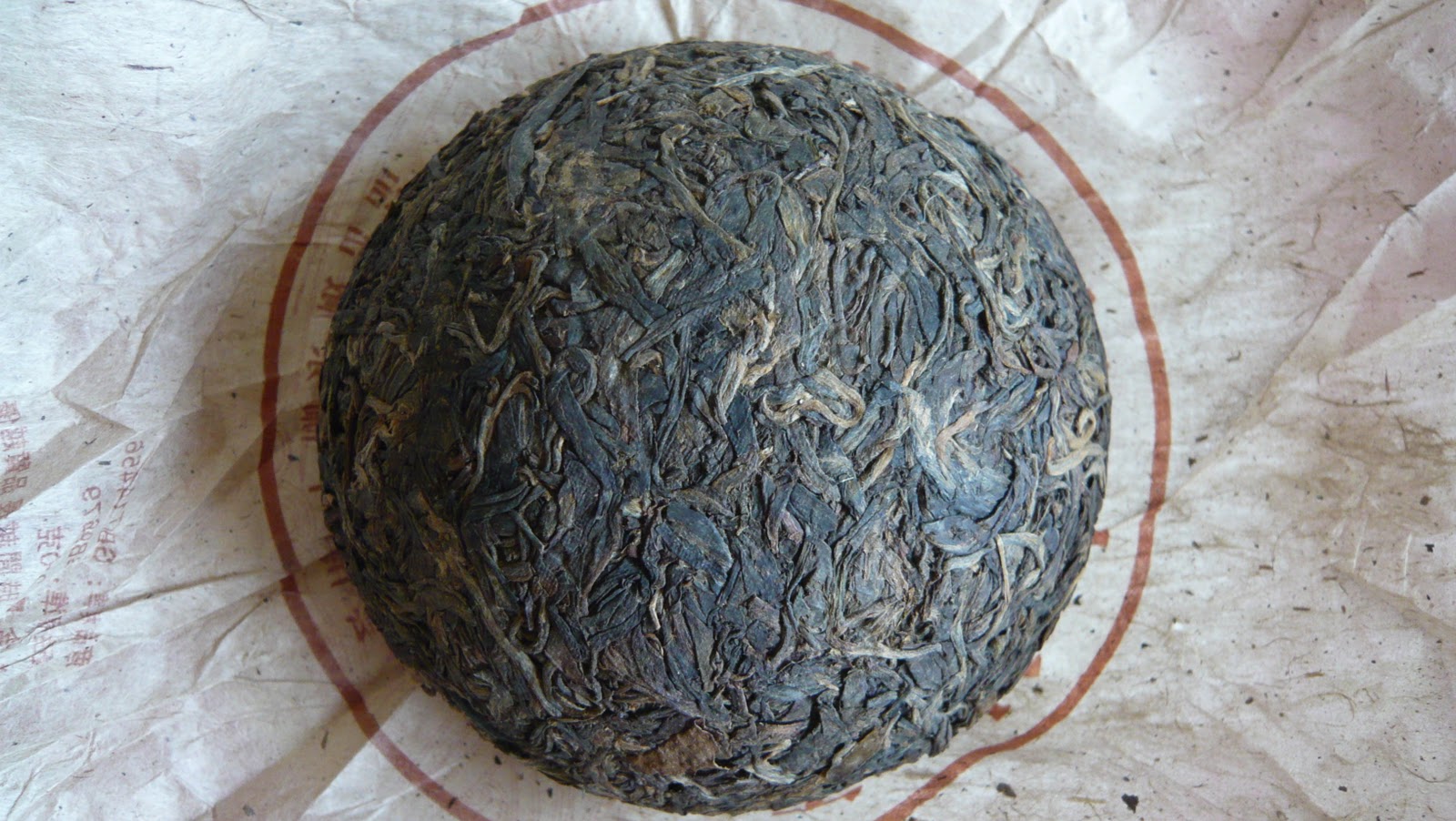

The leaves of this tea are admirable. I wonder leaves of such quality can still be seen at all in modern day Xia Guan products.


As most other products for Taiwan market, the tuo is made very neat. But still, not surprisingly, I found a cotton thread... so far no stones or barley shells found...


The texture of the liquor is smooth and soupy. The front taste is somewhat like shu puerh, minus all post-fermentation taste of shu. It has some "aroma of age", but definitely "aroma of DRY age". What’s most wonderful is its aftertaste, which is like a weak resonance of a typical sheng, bright aromatic, even a little floral, and very sweet. This lingering aftertaste made me elongate the interval between sips and cups, and taste the tea very, very slowly. In between the front taste and aftertaste, I think I’ve tasted something milky and buttery. It’s usually not a feature I find in puerh, either sheng or shu. So it’s possibly just my illusion. But also possibly that’s what the tea mean to be, since I’ve tasted milky flavor from Hei Cha products, which went through post-fermentation as puerh does.


Lovely leaves... easily distinguishable from leaves of tea stored in higher humidity. As I've seen from some other dry-aged sheng, some well aged oolong and some heavily roasted Yan Cha, after all the years or roasting hours, eventually, all their spent leaves  look surprisingly alive and display some vibrant youth!


I’ve seen a lot of discussions on dry storage, Hong Kong storage and wet storage. But currently the missing link is dry-stored old sheng – there aren’t many of them. Many Chinese tea drinkers I know don’t like the taste of Hong Kong storage. But there must be a lot of people, whom I may not personally know, loving it too, especially in Hong Kong and Guangdong.  Currently, many people who don't like high-humid storage don’t have much dry-stored old sheng to choose either. Vast majority of dry-stored sheng in the market is only 5-8 years old. There are a lot of debates about dry storage and Hong Kong storage, because people have to hesitate and struggle between the two options. I believe in future 5-10 years, there will be more dry-stored older sheng (10-15 years, or older) available in the market or in hands of collectors. They will no longer be so rare, and very likely, will not be forbiddingly expensive. Once the direct comparison is widely available to most people, there is no need to debate. One can just compare and choose, without wondering how a tea will age in another number of years. It's just like, few people would argue which is better between green tea and white tea, because they are two different things, both easily accessible and ready to be selected by people of different preferences.

A puerh manufacturer in China (who stores his own tea in Kunming and in controlled dry storage in Guangdong) once said, people who love high humid storage will rarely change their taste, neither will people who love dry storage; so what's the point arguing which way is better? - His comment was in response to the current trend of Kunming-storage advocates rigorously denouncing Hong Kong storage. I don't think he said this just to show either side no offense or to be "politically correct". What he said is quite true.

I guess it's also possible that some people drink high humid storage for years and eventually find out dry storage is their "true love"; or the other way around - some people may drink dry storage for years and eventually wish they had tried high humid storage earlier. It's always important for each person to understand his own taste. But still, there is no need to argue which way is better. 

Apr 15, 2011

discussion on Long Jing (4b) - comparing cultivars

Discussion on Long Jing (4a) is here.

To demonstrate a comparison between the two Long Jing cultivars (Long Jing #43 and Long Jing Jiu Keng Group cultivar), I took samples of similar grade (first day harvest) of the two cultivars from the same Da Fo Long Jing producer, and brew them side by side with the same method.

The brewing method I use here is:

1. Use gaiwan with effective volume of around 70ml. Fill 1/3 of the gaiwan with boiling water. Put the rest of the boiling water in a container and in a thermos for later use.
2. Wait for one to two minutes, and throw 1.5g tea leaves in the gaiwan.
3. Gently swirl the gaiwan for about 20 seconds to allow the tea leaves to be moistured. Then pour in more hot water from the water container. Leave the lid of the gaiwan off.
4. Start drinking from the gaiwan after 1-2 minutes.
5. For the first infusion, when the gaiwan is 1/2 full, add in more hot water from the thermos. In later infusions, when the gaiwan is 1/3 full, add in more hot water from the thermos.

I used this method for comparison because this is the most convenient method that will almost never cause accident. In this method, the water will not be too cool to induce the flavor from tea leaves. With gaiwan releases heat very fast, and with tea thrown in between two times of pouring water, the tea will not be "cooked" by hot water either. Even if the 1-2 minutes waiting time is a little shorter or longer, the impacts of temperature fluctuation will be buffered by the rest of the operation. That's a way to control the brewing without a thermometer. In this brewing, I used a scale for comparison purpose only. Usually you won't need a scale to tell how much tea is enough to put in the gaiwan. In this brewing, later I found out that I would prefer less than 1.5g of tea, probably 1.2g. But for people favoring heavier tastes, 1.5g would be fine.

Following is the comparison of the two cultivars.

Dry tea leaves. #43 on the left; Jiu Keng Group on the right. Overall, #43 leaves have greener color, and Jiu Keng Group leaves look a bit pale and a little yellowish. But the color alone is not enough to tell one from the other. There are many other factors that can affect dry leaf color. For example, age of the tea and processing parameters can both affect dry leaf color.

Leaf shapes are also different between the two cultivars. Overall the #43 leaves look more slender. But leaf shape can be affected by harvesting stage of the tea, so it's not a determining factor to judge on tea cultivar either.

Although the two teas are both first day harvests from the same producer, the first day harvest of Jiu Keng Group cultivar looks younger with more buds than the #43 cultivar. I've seen this phenomenon with almost all Long Jing producers I know. I think there are many reasons behind it. One of the reasons is, the Group culitvar is already late than #43 cultivar, and the price drops from day to day in the harvest period. So there is a motive for farmers to harvest on Group cultivar as soon as they can. 


Dry tea leaves of #43 cultivar.

Dry tea leaves of Jiu Keng Group cultivar.

 At brewing step 2. #43 culitvar on the left.

At brewing step 3. #43 cultivar on the left. 

At the third infusion. #43 on the left.
Usually the #43 leaves look a little "wrinkled" compared with the Group cultivar leavs. But after a few infusions, the leaves of the two cultivars look quite similar to each other. However, throughout the time, #43 leaves looks greener than Group cultivar leaves.

Spent leaves.

Spent leaves of #43.

Spent leaves of Group cultivar.

As I said in the last Long Jing discussion, it's not always possible to tell the culivar from tea product photos (for me, but it's much easier for experienced producers). The flavor differences between the two cultivars are easier to detect. Overall, #43 has a brighter, even floral aroma, while the Group cultivar has a deeper nutty flavor. Traditionally, Long Jing flavor has been described as "roasted chestnut flavor", which obviously fits the Group culitvar, but not exactly #43 cultivar. To me, the flavor of #43 is a little between "roasted chestnut" and green bean aroma. But overall, both cultivars have a light roasted flavor with sweet aftertaste that are typical of Long Jing.

Many seasoned Long Jing drinkers love the traditional cultivar and feel resentful that its production is shrinking in even the most traditional Long Jing regions. I have a lot of sympathy toward it and will keep supporting Xi Hu Long Jing products that use the tradtional cultivar. Meantime, in my personal experience, I've noticed that a lot of people would even prefer #43 for its sweeter, brighter taste. To me, it has a more spring-like taste than the traditional cultivar. In tea drinking, it's not always possible to say which is "the best", or which is better than which. But it's always interesting (sometimes even quite important) to know what cultivar it is and what flavor to expect from it.

Apr 11, 2011

Concept Tea (7) - Camellia sinensis Tea?

What is tea? There are different definitions, some broader, some more peculiar.

This is a joke for people who think tea should only be from Camellia sinensis, a species from Theaceae Family (Tea Family) and Camellia genus. This cup of drink, whether you call it tea or not, is from Camellia sinensis. The sweet little flowers are tea flowers!

I've seen producers of different tea varieties selling tea flowers, by-products of their tea trees. This one is a little more creative. The tea is green tea made with oolong cultivar, processed into curled shape, and the flowers are from the tea trees. 

I thought it was an interesting thing and was curious how it tastes. The taste is not typical for a tea. It's not something that would blow you away, but quite novel to try. The flower flavor is subtle but easily detectable. It's a mix of pollen flavor and very light honey flavor.


In southwestern China, especially Sichuan, there is a type of "tea" people drink in summer. It's not from a plant in Theaceae family. It looks somewhat like tea. It tastes quite different from most teas, but there is probably a tiny bit of similarity in flavor. These leaves contain a lot of tea polyphenols that are almost identical to those poly phenol molecules found in tea leaves.

  
And then there is the famous Ya Bao ("leaf bud") that was sold by a lot of Chinese puerh vendors a few years ago. Many of them are claimed to be leaf bud of wild tea trees. It turned out many, or most, of these "wild tea trees" are not Camellia sinensis, not the same trees people harvest tea leaves from.

Apr 8, 2011

discussion on Long Jing (4a) - comparing cultivars

Discussion on Long Jing (3) is here.
Discussion on Long Jing (4b) is here

In previous discussions, I explained why I think cultivar information is more important than production region information for Long Jing. Here is a comparison between the two most popular Long Jing cultivars, Long Jing #43 and Long Jing Jiu Keng Group cultivar. A third Long Jing cultivar, Long Leaf cultivar is also used by some tea farmers, but not as popular as the first two.

I will first go over the backgrounds of these two cultivars, and then in a later post, I will compare the two cultivars in terms of physical appearance and tastes. However, the purpose of comparison is not to demonstrate how to distinguish one from the other, since it's not always easy to do so by physical appearance. In fact, a comparison may instead demonstrate how similar they look. It's actually easier to detect their differences in taste than in appearance. That's why I believe it's important that producers, suppliers and retailers should always carry the information of cultivar for a Long Jing product.

Long Jing Jiu Keng Group cultivar is the traditional Long Jing cultivar. Long Jing #43 was cultivated through genetic selection on the Jiu Keng Group cultivar. As a result of genetic selection, Long Jing #43 has stronger tolerance to cold weather, it's easier to propagate than the traditional cultivar, and it's leaves and buds are somewhat prettier than those of the traditional cultivar. The cold resistance feature is why Long Jing #43 is the dominant cultivar in most new production regions in Zhejiang province, the home province of Long Jing. However, in recent years, even in Hangzhou, the hometown of Long Jing, many farmers grow Long Jing #43 too. In early spring, even before Qingming (around April 4th of every year), the price of Long Jing varies from day to day. The price difference within a week sometimes can be as much as 300%. Long Jing #43, due to its early harvest (1-2 weeks earlier than the traditional cultivar), is considered more profitable than the traditional cultivar. Meantime, in recent years, expansion of Long Jing #43 and shrinkage of the traditional cultivar growth has made a lot of people cautious, among them many loyal fans of the traditional cultivar. Therefore, some farmers in Hangzhou are committed to growing the traditional cultivar, and many farmers in new production regions have started growing the traditional cultivar to attract more Long Jing lovers.

Among Long Jing lovers, there have been a lot of debates on which cultivar is better, the traditional cultivar or #43 cultivar. But after all, they are genetically related and highly similar to each other. Besides, when it comes to taste, there are always personal preferences.

At the retailer level, #43 cultivar has been adored in the past several years, largely because the tea leaves of #43 cultivar are generally considered prettier than leaves of the traditional cultivar. Dry leaves of #43 cultivar are greener, and look more "well-pressed". But in recent years, many small retailers in China are more committed to the traditional cultivar to meet the demands of a lot of fans.

The early harvest feature of Long Jing #43 sometimes can backfire. For example, last year, when there was severe snow and ice storm in early to mid-March, harvest on Long Jing #43 was greatly impacted and production was reduced a lot. Meantime, the weather impacts on the traditional cultivar, Jiu Keng Group cultivar, were small to none, since the tea buds were not out yet during the snow and ice storms. In such a year with unusually cold March, #43 cultivar, which could bring more profit in other years, would cause great monetary loss for the farmers.

When I was a child, the aunt of mine who lived in Hangzhou was in charge of getting Long Jing for all of us. Every time she sent us many cans Long Jing, she would specify which cans were the highest quality for grandparents or as important gifts, which cans were for daily drink, and which cans were of decent quality. Usually the best tea was pre-Qingming (harvested before early April), and the rest was pre-Guyu (Guyu is around April 19th). Occasionally, in certain years, even the best tea was pre-Guyu, harvested after early April. And Aunt would tell us, "There is no pre-Qingming Long Jing this year, and pre-Guyu is as good as pre-Qingming of last year." Sometimes when there was no pre-Qingmign harvest, the tea could be even better than in other years, because of the cold weather and longer time allowed for tea leaves to accumulate nutrients.

Nowadays, with new cultivars (and probably more or less as a result of global warming), there is always pre-Qingming harvest. Even if cold weather delays tea harvest or damages tea buds, there is usually enough time for more tea buds to grow before early April. I think it's really nice that we can get new tea earlier with the new cultivar. But on the other hand, I think the traditional cultivar is very unique and its production should be maintained.

In my own tea shopping, I would usually buy products of Long Jing #43 from production regions out of Hangzhou, and products of the traditional cultivar from Hangzhou. It's pretty much my personal choice, since there are very good products of both cultvars in and out of Hangzhou. I choose Long Jing #43 from out of Hangzhou, in order to get the earliest harvest at a reasonable price. I'm not able or willing to pay for the earliest harvest of Xi Hu Long Jing from Hangzhou. The price is simply too high, even when the purchase is made directly from tea farmers, because too many people wan it. In some years, I help arrange such purchases for some crazy Long Jing enthusiasts, but I don't want to pay the price myself. Earliest harvest from other production regions (such as the Da Fo Long Jing from Xinchang County) is expensive, but at least the price is more "normal". Then, for the products of the traditional cultivar, I would choose the traditional tea producing villages in Hangzhou. When buying Long Jing of the traditional cultivar from Hangzhou, I would avoid the earliest harvest and wait till the few days before Qingming for the price to drop a little. Although the traditional cultivar is raised in other production regions too, these historical Long Jing villages have the best natural conditions and best processing skills passed on from generation to generation. Besides, as some farmers in Hangzhou have switched to the new cultivar and tea experts start to worry about dwindling of the traditional cultivar, I think currently it's very important to support those Hangzhou farmers who stick to the traditional cultivar.

In the long run, I am not worried very much about the traditional cultivar going to extinct. A cultivar can last only when supported by the consumers. I believe the traditional cultivar will always have a lot of fans. I think both #43 cultivar and the traditional cultivar have unique, nice tastes. But to me, the traditional cultivar has the familiar early spring taste from childhood. Besides, we can imagine, it is the same taste enjoyed by the emperors throughout Qing dynasty :-D

Apr 3, 2011

tea commercials in China

Tea commercial is a new thing in China. Traditionally, tea was treated as a produce,  like apples and peaches - there were famous producing regions and famous traders, but very few brand names. TV commercials of tea appeared only in recent years. Most tea commercials are for bottled tea and teabag products. But there have been a few nice ones for serious tea products. They caused some controversies whether TV commercial would cause inflated tea prices. On the one hand, I think money spent on TV commercial is eventually paid by the consumer, and that's a factor of price inflation. On the other hand, some commercials are really very nice! After all, even prices of most large tea companies are not as inflated as prices of many other commodities in our life.

San He Tang commercial at Guangzhou subway stations. Oh, beautiful! It cost about 1.5 million rmb ($220K). But many fans believe it's money well spent. On the first day when the commercial was put on, some fans went to the subway stations just to show support. 


http://www.youtube.com/watch?v=ZI-xUpryjR4

By the way, did you notice the pornography in San He Tang commercial? No kidding :-p


Dayi commercial at CCTV (a mainstream TV station). Very expensive... It's not as artistic as San He Tang's commercial, but is indeed perfect for TV. Dayi knows how to reach Chinese families. Most puerh consumers in China are middle age city workers, many of them are away from their parents. Dayi's commercial makes people cry...


http://v.youku.com/v_show/id_XMjIzNzE4NTcy.html


Lipton. Not comparable to the other two, but probably it is the most expensive one. The man in the commercial is one of the most expensive actor in Asia. The theme here is, Lipton symbolizes Royal Life. At the end of the commercial, when he holds the paper cup, his line is, "This is my royal moment!" Funny, huh?!

http://v.youku.com/v_show/id_XMjExMDU2NjM2.html

Apr 1, 2011

Tea Nazi

Remember the soup Nazi? :D

A friend of mine, Pan, I call him "tea Nazi". But since he doesn't watch Seinfeld, there is no way I could explain to him about it.

I am not saying he kills with his tea :-p He is the owner of a small teashop, which used to be in Maliandao (the "tea city" of Beijing), and now is in transition, after he got a "real" job in a TV station of Hangzhou.

You know, most small sellers are very nice. Many of them are truly very kind, and some others at least fake smiles to their customers. Pan, I have to say, is not nice to everybody. He has a lot of rules, and says a lot of "no" to customers. For example, for all requests of price reduction or free samples, his answer is usually "no", without additional explanations. He does give free samples to buyers, in my opinion, very generously. The 2005 Bai Mu Dan I blogged is a sample from him. It's a top grade tea of 5 years of aging. The Meng Ding Snow Orchid I blogged is another sample from him, a tea I would otherwise have no way to obtain. And there are a few other very nice samples. But he only "assign" samples to people, and doesn't allow people to request samples. When Pan tells people about a  tea or a brewing method, he sometimes talks in a way like a teacher to a 5th grader. I guess many people don't like his way of conversation, considering he is only 24 years old, and most customers are much older than he. But indeed he is very warmhearted, and wants to help you as much as he can in terms of these questions. Besides, with my experience of dealing with people, I can tell his way of talking is not because he has too much ego (though he does have some, I would say), but because he is truly crazy about the subject matters.

Once Pan told me such a story. A customer in his shop asked him, pointing to a White Peony, "why is your white tea in green color?" Pan said, with a straight face, "yeah, it's green because I dyed it green." The customer immediately escaped the store, scared and puzzled. Pan told me the story with a good laugh. But I was scared too, "How can you ever say something like this to a customer? Now she truly believes it and what if she tells other people you put green dye to your tea!" Pan said, "If she really wants to know, I would explain to her with more details about white tea. But she didn't seem to be that curious at all." This is even worse than telling a customer he didn't want to sell a tea to her, which, of course, Pan has done for a few times too. I didn't know what to say except telling him how buyer-repellent he could be!

To be fair, Pan is a nice guy and loved by a lot friends. Out of his tea store, he looks totally normal, and doesn't offend people as much as when he is in the tea store. There are a lot of people who were not freaked out by him and bought his tea again and again. He is outgoing and very frank to comment on his own teas about their strengths and shortcomings. And he does have a unique collection of tea. Although I do believe he could be milder and more sophisticated, his craziness doesn't bother me at all. I am surrounded by all kinds of crazy friends, and I like a lot of crazy people :D I think it's quite interesting to have one or two (as long as not too many!) soup nazi or tea nazi in real life, and it's even better when they are good guys who bring us good stuff. 

Mar 29, 2011

2008 Jing Mai Ancient Tree cheap small cake sheng

I think this is a lovely little cake. It has the charming Jing Mai aroma, almost no bitter taste and very light astringency which dissolves instantly.


It is a 100g small cake. Unlike most cakes of its size,  this cake is made by manually compressing with a stone mill. The cake is even looser than most manually compressed large cakes and is very easy to dissemble. The loosely compressed cakes may not be suitable for decades of aging. But it's quite drinkable now anyway.


What's good about it being loose is that one doesn't have to crush a lot of leaves when prying on the cake. The cake is composed of consistent leaves from old trees. It's nice to get them as almost whole leaves in brewing.


This cake is very inexpensive. Some of my friends say, unknown small factory inexpensive products of arbor tree or ancient tree can rarely be good... don't buy them... I followed the advice. I didn't buy them. This one was given to me for free and I love free stuff! :-D The manufacturer said, "If you hire someone to do marketing for you, you've got to spend money. If you hire a designer to make your product or store look good, you've got to spend money. If you put on advertisement, you've got to spend money. If you hire people to write good things about your products, you've got to spend money. Then, I thought, instead of doing any of the above, I would rather give up some money by giving tea for free to people so more people will know my products." That's how I got this little cake. And I like the manufacturer's philosophy. Recently, Dayi has put on its smart looking commercial on the major TV station (and the most expensive one) of China, which is said to be a 50 million rmb ($7.5M) deal. We've got to have some puerh manufacturers that give us free tea instead of letting us pay the expensive TV advertising bill.

And this little cheap unknown cake, I ended up liking it a lot. Not that I would start buying unknown cheap little cakes. But I can surely consider buying more after tasting some sample.

The cake is claimed to be a product of ancient tree (but ancient tree in Yunnan can mean any tree of 100 years or older, not necessarily "ancient-ancient"), and from early spring (there are indeed quite a few buds and spring twigs). Still I am not sure of its age-ability (but at least, after its first 3 years, the cake stays well). And of course arbor trees or ancient trees can have different conditions and different levels of rarity. But the price for such a cake surprises me. Anyway, the quality of this little cake is more than reasonable for its price. And I know I've yet to experience more to fully understand why there is such huge price difference between teas, or, in other words, why such huge quality difference between teas of the same price range.

Mar 25, 2011

Discussion on Long Jing (3) - Five dragons

Discussion on Long Jing (2) is here

Photo is from 家在龙井村

She sent me quite a few pictures but this is my favorite. I love those hams hung off the eaves! Hangzhou is one of the food paradises in China. It's so much easier to get tea shipped across the Pacific. But the ham and other food, I can only dream of them.


Long Jing literally means Dragonwell - a well whose name is Dragon. People in Hangzhou (where Dragonwell is located) often say, the title of "Long Jing" include 5 dragons. Here they are:

1. Dragonwell is the name of the above mentioned well. In ancient time, the well didn't dry up even in drought years. Therefore people believed there must be dragon (which is in charge of water in Chinese mythology) living in it. That's how the well gained its name.

2. Dragonwell is the name of a Buddhism temple, which was built in the 10th Century and located near the famous well. But the current temple is 90% newly rebuilt.

3. Dragonwell is the name of a village. Long Jing Village is a center of the famous Shi Feng (Lion Peak) Long Jing. Another famous center of Shi Feng Long Jing is Weng Jia Shan Village, also located on the Lion Peak Mountain.

4. Dragonwell is the name of tea tree cultivars - there are a few commonly used Long Jing cultivars.

5. Dragonwell is the name of the tea product made with traditional Long Jing processing method.

I think the above 3, 4 and 5 are very important when we talk about authenticity of a Long Jing.

For #3, the location is not necessarily Long Jing Village, but should be in or next to Lion Peak Mountain.

#5 is usually not a big problem, because it's easy to tell from the appearance of the tea product. But about tea processing, in recent years, there is rising concern about many producers using machine processing to replace traditional manual processing.

#4 is very often overlooked by tea drinkers pursuing authentic Long Jing, but I think it's often a bigger concern than #3 and #5. I believe genetics is the number 1 important factor that determines the taste of a tea. Traditionally, non-Dragonwell cultivars have been used to make Dragonwell-style tea, but they cannot be called Dragonwell or Long Jing, even if they are grown in Long Jing village.

Mar 21, 2011

Discussion on organic cultivation (3) a piece of news from Menghai

Discussion on organic cultivation (2) is here

It's a piece of news from Agricultural Department of Menghai County. It caught my eyes because it's about Zhang San (章家三队, the 3rd Team of Zhang - "team" is a residential unit in rural China), which, believed by many professionals, may have the best small tree (30-50 years old) puerh in Bulang region.

The news is about the recent pest outbreak. It's supposed to be a normal news. I would like to discuss on it here, because probably I am not the only one who would find it a bit odd, if reading between lines.

Here is a link with the news from the government website:
http://xxgk.yn.gov.cn/canton_model1/newsview.aspx?id=1620701

If you are interested, you can google translate the text. But I will briefly summarize it here.

1st paragraph: There is a pest outbreak involving multiple pest species. Economic loss is in millions of RMB and still increases.

2nd paragraph: Experts are working on it and training farmers to fight against the outbreak.

3rd paragraph: According to analysis of the experts, causes of the outbreak are: (1) Long-term shortage of management, including lack of trimming; (2) lack of fertilizer; (3) climatic factors.

4th paragraph: Currently, people are working on: (1) training farmers on harvesting, fertilization, trimming and pest prevention; (2) trimming off and removing dead and damaged branches with pests; (3) apply fertilizers to strengthen surviving trees; (4) apply pesticides efficiently, including using biological pesticide, application skills and applying all fields simultaneously. 

Well, most of the experts' opinions, I can't say they are wrong. Although we don't like to see pesticides, at a pest outbreak, in order to save the whole village's production, probably that's the only choice. And the experts did recommend some biological pesticide and application strategies. But overall, I feel I would expect more in-depth advice from the experts than above mentioned. Also, I got an impression that the experts' advice just focuses on the current pest outbreak, as if it were not connected to everything else. Or probably this is just what the reporter has taken from the experts - but even in that case, I am still shocked what a superficial view the reporter took out of a pest outbreak.

About the news report, what seems most odd to me is the third paragraph. From a consumer's view, I feel what the experts said about "shortage of management" (lack of trimming, letting the tree grow on their own...) is ideal situation for puerh. Thinking positively - what these experts said make me like my own stock of Zhang San tea even more :-D Thinking negatively - are the experts blaming farmers' way of cultivation for the pest outbreak? :-( Do people think pest outbreak will not happen when "right" management is used?

I think it's fine that the experts train the farmers about everything mentioned in the 4th paragraph in response to such an emergency situation. But as for long term cultivation and management, I doubt the experts are qualified to teach the farmers. Zhang San is a place with tradition of tea production throughout generations. Many tea professionals comment that in Zhang San, farmer's processing skills for Mao Cha (raw tea before compression) are respectable, which makes me think usually the farmers know how to grow tea well before they know how to process tea well. Zhang San is also one of the numerous villages in Yunnan that hadn't even seen pesticides or other modern agricultural technologies by early 1990s.

In China, organic movement is at its beginning stage. As much as I like the idea of organic movement, I always feel some concern about it. While agriculture of some crops in some areas is being converted from non-organic to organic, the opposite is also happening, as it has been happening world wide since the so called "green revolution" in agriculture. My concern is, if all the focus of organic movement is on conversion "from conventional to organic", and not enough prevention action is taken on the change from traditional "cleaner" agriculture to "modernized" agriculture, then we may see some kind of polarization in the future - small amount of agricultural products are made purely organic, and very expensive; meantime, most other agricultural products are made very non-organic, and consumed by most ordinary people. Such polarization is already more or less happening in developed countries. But when it happens in China, it can be much, much worse.

In recent years, food safety of agricultural products in China have caused a lot of concerns nationally and internationally. But it remains a challenge how to address these concerns. In many discussions among Chinese scholars, media workers and officials, strengthening inspection standards and educating farmers are stressed. I have no problem with the first point. As for educating farmers, generally speaking, I think it's necessary and a right thing to do. But then, I think we should also be very cautious on this. In some areas, maybe we have a lot more to learn from the farmers than to teach them. In some other areas where agricultural practice is very unfriendly to the ecosystem, while educating farmers is important, it's as important to examine what have been taught to the farmers in the past 20 years. Many of the unsustainable agricultural practices we blame today, were taught to the farmers as new technologies and blissful means toward "agricultural modernization". Some of the eco-friendly practices we've learned as new lessons today, were known to the farmers 100 years ago. Experts and educators should always be careful what they teach to the farmers.

Mar 17, 2011

Concept Tea (6) - 2008 CNNP sheng, puerh?

Concept Tea (5) is here.

This is a tea with CNNP brand label. Many CNNP products, such as this one, are from unknown factories - CNNP is infamous for contracting out a lot of its production. Generally speaking, this is bad. But on the other hand, it does allow some opportunities for good small factories to contribute. 


The label says "thousand year old tree tea". But of course I have no way to tell how old the trees are.  

The tea leaves are of very high quality and the tuo is well made. I forgot to take a photo of tea in a cup.


I like this tea very much. It's not as aromatic as some other sheng, but it has very long lasting aroma and sweet aftertaste. Its flavor also feels heavy enough to further develop in future years (but this, is just my guess, because I don't really have a methodology to know how it will develop in future years).

This tea is nothing novel. I include it as a Concept Tea mainly for fun :D What causes the question mark after puerh in the title is, the tea leaves in this tuo are from Myanmar. According to the National Standards for Puerh (defined by some official documents in recent years and summarized here), "Puerh is unique geographically-patented products of Yunnan. It is made with Yunnan big-leaf tea tree cultivars grown in locations that are qualified for puerh production regions." Of course Myanmar is not one of above mentioned "puerh production regions". But does it make this tea non-puerh? I believe most people's answer will be "no" - we can't say it's non-puerh just because it's produced out of Yunnan. This tea looks 100% puerh to me. Ecosystems extend above country, province and county borders. This is one of the reasons why many people challenge the idea of geographic patent of tea. 

Another relevant example is the village of Gua Feng Zhai, a rising star of Yi Wu region, sitting inches away from Laos border. Traditionally, people in Gua Feng Zhai set up their toilets on trees. There is a local joke saying that it's not uncommon if you climb up a tree to empty your bladder and find yourself on a tree branch in the air of the Laos side of the border. Gua Feng Zhai produces very high quality puerh. But I guess it's not because the tea is produced on the Chinese side of the border. It's not likely that the Laos side of the border doesn't grow any tea trees, and it's not likely that the Laos tea trees are in any way different from those on the Chinese side.  


In these cases, I guess most people believe the tea should all count as puerh, no matter in which country the tea is made. But there are more debatable cases and more complicated questions on the geographic patents of other teas, such as Xi Hu Long Jing, An Xi Tie Guan Yin and numerous Taiwan oolong products raised in Fujian (or Vietnam, or Thailand) by Taiwanese tea farmers.


Something else interesting about this 2008 CNNP tea is, it was made in 2008, the so called "sequela year" of puerh. Not that every puerh from 2008 is bad. In fact there are some very good ones. But 2008 was the year when, after the puerh madness of 2006-2007, many tea trees were over-harvested and started to yield poorly. I don't know if that's why CNNP got these tea leaves from Myanmar. But even compared with tea leaves from better years of puerh, these leaves are very good and have been carefully processed. I guess, it's very possible that Myanmar, being out of the puerh madness center and with lower labor cost, can produce much higher quality of tea than tea produced in Yunnan with comparable cost.

Mar 14, 2011

Between Green and Black (3) - Southern Fujian Shui Xian

Between Green and Black (2) - Fo Shou is here.

A few times I bumped into questions like "what's your favorite tea?" or "what's your favorite oolong?" There is no way I could answer the questions. I have no clue. Too many choices. My mind would blank out. But if asked "what's your favorite tea cultivar?", I would immediately have "Shui Xian" in my mind, although I am not 100% sure of the answer either. I love Shui Xian very much, because it has various styles, and so far I like every one of them that I've tried.

I've never had very green version of Shui Xian, and don't know if Shui Xian is even suitable for light oxidation, since not all cultivars perform well with very light oxidation. I like the intermediately oxidized Zhang Ping Shui Xian very much. Recently, I was very lucky to have got some charcoal roasted Zhang Ping Shui Xian, privately roasted by a very young Senior Tea Taster in Xiamen.


This mini cake is slightly heavier than the unroasted version, but looks more compact. It's about 9.5-10g. I put one whole cake into a 150ml teapot. But later I thought probably I should have broken it in halves. It's too much tea to take in one time, by myself.


The taste is somewhat similar to that of roasted Tie Guan Yin. But this Shui Xian cake is only medium grade. Top grade roasted Tie Guan Yin can have roasted aroma as well as prominent floral or peachy flavor. I have yet to experience more Shui Xian cake to see if Shui Xian can catch up with Tie Guan Yin in that aspect.

What's in common between the roasted and unroasted Shui Xian cakes is, they both cause prominent honey sweet aftertaste. The roasted version has some dark fruity flavor, but not as fruity or aromatic as the unroasted version. The roasted version has great throat feeling and smooth liquor texture.

First infusion:


Third infusion:


I forgot to take photos afterward. 

All of these cakes came in small sealed bags. I guess, ideally I should take them out of the little bags and put them in a ceramic jar. But the little bags are convenient and safe. So probably I will only break some of them. If they can develop some peachy fruity aroma after several months, like what happens to some roasted Tie Guan Yin, it will be fantastic. But currently I can't predict how they will develop.

Another Southern Fujian Shui Xian I currently have is from last spring. It's in the regular pearl shape, roasted.


It's a very pleasant tea, but not yet a top grade tea. I guess, if higher grade leaves were used, and processed in exactly the same way, the tea could have been even better. Currently in tea market of China, Southern Fujian Shui Xian isn't commonly seen, and there aren't a broad range of products to select from.

A few years ago, I could easily get grocery level Southern Fujian Shui Xian sold by Hong Kong companies (some of those grocery products are not bad at all, but not made of high quality leaf materials). But within the market of mainland China, it was barely seen. In an article, a writer and tea book author once wrote about the abandoned Shui Xian plantations in Southern Fujian. In 1990s, when the state-owned tea companies started to withdraw from business, and with various opportunities of economic development, many tea farmers abandoned their Shui Xian plantations, or chopped down all the tea trees and changed the plantations into orchards - similar story to what happened to Southern Fujian Fo Shou, and somewhat similar story to what's happening to some Yunnan farmers who would switch their tea plantations to coffee fields, as covered by a recent article of Corax at Cha Dao.

What makes me feel very optimistic about Southern Fujian Shui Xian is, in just past few years, I could clearly see it was definitely coming back to the market, more and more. When there is a market for high quality tea, and when tea farmers can make good profits, we will all have better chances to get high quality tea for a reasonable price.

Mar 11, 2011

updated Tea Harvest Calendar

Recently I did some updating on a Tea Harvest Calendar I made a few years ago. From time to time, people send me questions about harvest times of teas. In fact, I am not sure how to make a harvest calendar that's easy to read and inclusive of important tea information. Still, I am afraid I get stuck in between - the current harvest calendar is not easy to read, and it seems forever impossible to be inclusive. But this is the best I can do so far.

In addition, I am not exactly sure why people would like to see a harvest schedule (but indeed many people would like to). Most teas we can't get within the few weeks after harvest. And most teas are not in the best state within weeks after harvest - even for fresh-tasting green teas like Long Jing, old tea farmers would say, the tea starts to taste the best after 1-3 months of careful storage. But as a curious person myself, I can surely understand people's curiosity about tea harvest schedule. Besides, during those winter months, it's always nice to have a harvest schedule so that you would feel there are things to look forward to, especially if you are a green tea lover :D

Another potential challenge of a tea harvest schedule is, up to now, the accessible varieties of Chinese green teas in foreign market are still quite limited (many famous green teas have very small annual production and are of limited amount even in Chinese market) - what's the point including teas that most people cannot get access to? Some of those teas are still on my wish list, and some of them I don't get hold of every year. But I guess one reason to include them on the harvest schedule is, so that we have something to dream of :D The great diversity of today's US specialty tea market may not be something one could dream of 10 years ago. In the years to come, there will surely be more and more varieties and products of quality.

So here is the tea harvest schedule. The image can be clicked to enlarge. A web version is posted here:
http://www.lifeinteacup.com/harvest-calendar

I am sure there is a lot of negligence. I will keep working on it. Feedback and critiques will be highly appreciated.

___________________________________________


Introduction
Throughout the year, the relative positions of the sun and the earth can be expressed by 24 solar terms. Dates marking these 24 solar terms stay almost the same year by year on the international calendar. The 24 solar term marks directed a lot of agricultural activities in traditional society of China, including tea cultivation. On this Tea Harvest Calendar, the harvest dates of various teas are sorted in temporal order based on the solar terms they belong to.
More information about the 24 solar terms can be found on this webpage of Hong Kong government:
(Name translations of the solar terms are slightly different between this Tea Harvest Calendar and above webpage.)
Tea harvest dates vary slightly from year to year. The system of solar terms helps us understand how tea harvest is connected to climatic patterns.
This Tea Harvest Calendar includes names of the 24 solar terms in English and Chinese, their dates on the international calendar, and harvest times of some well-known Chinese teas. Additional notes are made about climatic changes and traditional agricultural events of some solar terms.


Part 1.
Part 2.


Part 3.

Sources of information:
1.     Tea farmers, who are, of course, the best sources of anything pertaining to tea.
2.     中国茶谱 Wan Xiaochun et al. (2007) The Book of Chinese Tea. China Forestry Publishing House, Beijing.
3.     中国茶经 Chen Zongmao et al. (1992) The Tea Classic of China. Shanghai Cultural Publishing House, Shanghai.
4.     中国茶叶大辞典 Chen Zongmao et al. (2000) The Encyclopedia of Chinese Tea. China Light Industries Publishing House, Beijing.
5.     中国名茶图谱 Shi Haigen et al. (2007) The Atlas of Chinese Famous Teas. Shanghai Cultural Publishing House, Shanghai.
6.     品茶图鉴 Chen Zongmao, Yu Yongming, Liang Guobiao & Zhou Zhixiu (2009) An Atlas for Tea Tasting. Yellow Mountain Press, Hefei.
7.     中国乌龙茶 Gong Zhi (2004) China Oolong Tea. Zhejiang Photography Press, Hangzhou.
8.     中国红茶 Gong Zhi (2005) China Red Tea. Zhejiang Photography Press, Hangzhou.
9.     茶文化学 Liu Qinjin et al. (2000) Studies on Tea Culture. China Agriculture Publishing House, Beijing.


Mar 5, 2011

Tibetan Hei Cha Ya Xi Grade (藏茶芽細)

Sichuan is the major supplying province of Tibetan tea. Starting from Qing dynasty, Tibetan tea from Sichuan is categorized into several grades. Ya Xi is the second highest grade. Since its leaves are younger and tender than regular grades of Tibetan tea, this tea is often brewed in a teapot, instead of boiled in a pot on stove top, in consumption. Without an exception, Tibetan tea of Ya Xi grade is made of tea leaves from above 1000m (3000 ft.) elevation with tedious processing. In traditional Tibetan society, Ya Xi grade was exclusively for royal families, Lamas and affluent merchants.

The tea I've got here is packaged in an elegant, hand-woven bamboo encasing. Bamboo is the most common and inexpensive material in the mountains of Sichuan, and hand-crafted packages were common and inexpensive in the old days. But today, hand made packages with natural fibers are less and less seen. So in my eyes, this bamboo encasing is exceptionally adorable.


One has to dis-weave and tear open the bamboo encasing to take out the tea. Breaking such a nice package makes me feel seriously guilty!


Based on my past experience with Tibetan Hei Cha, I have the impression that many of them are quite strong in taste, stronger than what they look like. So I used less tea than I would normally use for other Hei Cha or shu puerh, and brewed the tea in a 150ml small teapot, with 10 seconds infusions. However, I can imagine no real Tibetan would brew Hei Cha in a 150ml teapot. It's just a convenient volume for me. But maybe brewing in a larger pot is more suitable for this tea.


The flavor of this tea is somewhat earthy - it's not the soil type of earthiness found in some shu puerh, but rather the grassy type of earthiness. And there is some mushroom taste that's similar to what's found in some shu puerh. One thing I like very much about Hei Cha is, from time to time, you may find some features in it similar to certain features of shu puerh. But in Hei Cha, you will probably never get the stinky taste of over-fermentation, which is not rare in shu puerh. I think I also got some marine taste (seaweed taste) to a degree that I can enjoy (I dislike marine taste in other types of teas but like it in Hei Cha), as well as some grassy taste (which I think is less enjoyable than the grassy taste of some green teas). The aftertaste is not prominent. I feel the strength of most Hei Cha is not at aftertaste or multiple infusions, but at unique tastes.

The tea tastes stronger than indicated by the liquor color, and last for as many infusions as puerh. This surprised me a bit. Most Hei Cha I've had so far doesn't last for many infusions. They tend to give all they have in the first a few to several infusions. I guess it's mainly because most Hei Cha products are made of older leaves, even with significant amount of stems. This tea is made of much younger and tender leaves (however, still much older-looking than leaves of most other tea types). Besides, the geographic elevation of production must contribute to the durability of the leaves in brewing.


Not surprisingly, this tea mixes with milk very well. The more I drink Hei Cha, the more I tend to believe in the story that Englishmen might have got their milk+sugar style of tea brewing from Tibet, by way of Nepal and India.

Many Tibetan people like to brew a tea, store it in a thermos overnight, and enjoy it the next day. It's probably largely for the convenience. But some people also believe the tea improves by sitting overnight. I don't know if that is true. Since I often have a few different types of tea throughout a day, I usually save left-over tea leaves in the pots and brew them the next day or even a few days later. I did this for a few times on this Tibetan Hei Cha Ya Xi, and noticed I did like the latter infusions better for there was less grassy and earthy taste. But this could be simply because when the tea was weakened in latter infusions, it reached a favorable concentration for my taste buds.

Overall, I like its unique taste, the comfort the tea brings, and its convenience. Along with my beloved Fu Zhuan, this tea and a few other Hei Cha are good for large volume brewing to be saved for casual drinking of a whole day. Mixed with milk (and maybe sugar too), they also make great after-dinner beverage, especially after a heavy meal.