Feb 27, 2012

writing about tea (1)

Last year, The Association of Tea Bloggers had a blog carnival on the topic of Why I Write about Tea. There were quite a few interesting entries on the topic. Here is the host post of the blog carnival by Jason Walker. Here is my participating post in that blog carnival. Besides, Alex Zorach once wrote on "writing about tea" here.

Recently, for various reasons, I thought a lot about writing, especially writing about tea. I'm not a well trained writer, and one of the reasons I feel comfortable about tea blogging is, I could always write whenever I wish, as much as I wish, and however I wish, without worrying if I would get an A or an F :-p So as always, I will just write whatever comes to my mind and try not be be disorganized. Here I will cover:

1. Options of writing about tea online
2. My challenges in tea writing and how I overcame some of them
3. What have I gained from tea writing

1. Options of writing about tea online:

a. Of course, blogs! :-D

b. Teatra.de - by the way I am @gingkoseto there :D
I have been watching this site growing. Although it's not yet the largest online tea community (I guess Steepster is the largest one so far), it has been growing rapidly and I believe it has great potential to get really big. It has a lot of cool features that are not found else where. It hosts tea blogs (I have a mirror site there lifeinteacup.teatra.de). More importantly, it organizes a blog network, which nurtures active communication among bloggers and blog readers. Besides, it has a twitter-like system serving tea enthusiasts. And of course it has online forum too. Basically I feel it has all features modern internet tea surfers want, and from time to time, it creates some feature that nobody had ever thought of.

c. Ratetea.net - It's a tea product review site, so I can't write much there. But I read a lot there. Since it has the focus on product review, one can get very clear and convenient information on what other people think of a specific product. Besides, there are a lot of tea articles on the site that focus on unbiased scientific information, environmental sustainability of tea products and healthy life styles. For active bloggers, another attractive feature of this site is it links reviewer's blog site to his/her ratetea.net profile. So a good product review helps attract traffic of fellow tea drinkers to the reviewer's own blog site.

d. Steepster.com - by the way I am @gingko there :D
I love its tea logging feature, and "logged" about tea there from time to time. I also know some people who don't have a blog site but use steepster as their personal log/database for tea drinking. I enjoy tea logging because it's more relaxing and casual than tea blogging. Although as I said, I don't try to be highly organized in tea blogging, I still would like my blogs more presentable than not. But when I tea-log, it's more like free writing, and present-ability is barely a concern. When I enjoy a tea, it just feels good to write it out at the moment, with the teacup in my hand. This works especially well when I don't have time to write a more organized article but desperately want to document the moment :D Sometimes I would use my tea logs as raw materials, and organize them into blog posts, preferably with photos added. 

Some very serious tea drinkers have complained about the rigid format of steepster's tea log. For example, the shortest infusion time you can choose is 15 seconds, which could be much longer than what you use for a Yan Chan brewed in gongfu style. In addition, there is only one set of infusion time and temperature, while these parameters often change from infusion to infusion, and people like me never give up any tea after merely one infusion :-p In spite of all this, I still love the tea log.

Besides the above mentioned, there are some social network sites that can be used for tea writing. I personally don't like facebook (maybe I am too old to get its meaning haha...), although it does have some writing devices. I suspect I don't get all the fun of facebook or twitter kinds of sites because I barely carry a cell phone with me :-p Well I often carry one of these guys with me and pretend it's my smart phone :D


I enjoy twitter a lot more than facebook though - by the way I am @lifeinteacup there :D I feel it's a nice site to communicate with other people, read smart quotes and share them with other people. But it's not for systematic writing.

Besides above-mentioned options, online tea forums are nice places to communicate with other tea drinkers. I have a list of online tea forums here and try to update the list from time to time.

But I don't think online tea forums are made for systematic writing either. A downside of online forums, including tea forums, is that sometimes they contribute to fragmentation of your thoughts and writing. Online forums sometimes nurture the most interesting discussions. But I hope many of these discussions can be well documented by the discussion participants. I know some people who don't have tea blogs but often give very good thoughts on tea forums. I personally think all these good tea drinkers should establish their own tea blogs, or establish their accounts at teatra.de, ratetea.net and/or steepster.com, so I would know where to visit them if I recall something interesting that they have written and want to recover all the details.

In another aspect, online forums are more for interpersonal communication rather than personal writing. Even in my list of "the most active online forums", there are forums with rather low traffic, because after all, the population of tea drinkers has yet to grow. If there is nobody around to interact, then there is no interpersonal communication. In contrast, with the above a, b, c, d options of tea writing, one could enjoy interpersonal communication, but could also write just for personal reflection or personal documentation. So I would like to see more tea drinkers using the above writing options on top of online forums.

Do you know of other places/options for online tea writing? Please share!

Feb 21, 2012

a personal review of 2011 tea

Due to my winter traveling and the cold I caught after getting home, this review is badly delayed, so was my routine establishment of new year resolutions. But I think I've still caught them all before the Tibetan New Year anyway :-)

I will go over them by which comes to my mind first...

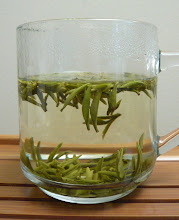
1. My favorite tea of 2011, which was also a new tea experience for me, was this green tea, Bai Mei Hua Jian. It's an unforgettable beauty, and also falls in my favorite scope of Anhui green tea.

2 and 3. Two other green teas that I love very much and considered myself very lucky to have obtained, are Tai Ping Hou Kui and Lu Shan Cloud Mist. There are always some nice, unknown tea varieties that are hard to come by in the market. But Tai Ping Hou Kui and Lu Shan Cloud Mist are two of the most famous Chinese teas that are known by so many people yet still hard to find. Their common problem is small production.

Tai Ping Hou Kui "in a broader meaning" is commonly sold in China. But with increasing labor cost and due to some other factors, it has been ever harder to get the really traditionally made Tai Ping Hou Kui. The difference in taste is much greater than the difference in the outlook of leaves.

I know this man who obtains new harvest Lu Shan Cloud Mist each spring from its central production region. His offerings are usually in a scale of smaller than 10 lbs. for each plantation, and most was sold through his email list before ever making its way to his store. Ever since I knew this man, I have been interested. But I don't buy the tea every year, because it's an expensive tea that people crazily grab off as if it were free. In early spring, it's already stressful enough to haunt producers for Long Jing :-p  But Lu Shan Cloud Mist of 2011 was somewhat special to me. This tea was produced in a below 500m (1500ft.) location of Lu Shan Mountain, not the highest elevation of production. But it was a bad spring for the region. Nearly all locations above 500m of elevation had zero production, and even below 500m locations had many new tea buds killed by the cold weather. And you know I love survivors!

Ok, another excuse for my procrastination of writing on these teas is I didn't want to talk too much about them while they were still in stock of our web store.  I believe background information of a tea is always interesting. But I also believe one should avoid having his/her first experience of a tea influenced too much by fringing information. Like Mark Twain said, "Don't let school interfere with your eduction." ;-)

4. Another new tea experience in 2011, Jing Shan Tea (径山茶). Someday I will write more about this tea. It was a tea on my wishlist for a long time. Not only it's a famous green tea from Zhejiang, it's also an important landmark in the history of zen tea culture, and a connection point between Chinese and Japanese zen tea culture.

5. A bunch of Taiwan *style* oolongs. I've written about this Zealong and plan to write more about the other Zealongs, a Yunnan produced one and a Sichuan produced one.

6. There are a few very unique teas gifted by tea friends, and I've started a blog post about them long time ago. But writing is challenging to me, especially when it comes to more emotional topics. So I haven't managed to finish it yet. 

During this review, I just realized how much overdue homework there is in my tea documenting!

Besides, I feel terribly guilty for not having tasted two very special teas I've got in 2011. One is an organic Tie Guan Yin from my favorite TGY producer. "Organic" is not what makes it unique, but it's the specific organic fertilizer used for this tea. Another one is Song Tea (宋茶 named by Song Dynasty), which is supposedly the ancestor of Dan Cong and said by many people an extincted tea processing method. But a friend brought me some from this island inhabited by descendents of Song Dynasty royal family refugees. Since both of these teas are oolong, they somewhat made me think I didn't have to worry too much about their shelf life. But I think I shall taste them soon!

Feb 18, 2012

Concept Tea (10) - Salute to Xia Guan, with Jing Mei Tang Red Iron Cake

This Jing Mei Tang (静美堂)product, according to its owner, Mr. Huang Chuanfang, a leading figure in Taiwan puerh industry, this tea was made to salute and pay respects to Xia Guan (下关)old style iron cake with red printing on the wrap.

This tea was made in 2007, using primarily leaf material from 2006 (said by the inner ticket of the cake), mixed with some leaf material from 2002 (this is hearsay but somewhat confirmed by the tea leaves).


The wrap and inner tickets are beautiful, as always.


The leaves are a mixture of various grades, dominated by medium-low grades.


I wanted to give it a closed-up side view, because I've found it an interesting and neat technique that's used by a few puerh products that I like very much. This cake is an "iron cake", meaning tightly pressed. But the edge is quite different from the edge of tightly pressed cakes from large tea factories such as Da Yi or Xia Guan. For example, if you compare the following photo with this one (which is a Da Yi Peacock cake), you can see this one has somewhat squared edge and a flat side surface. This type of edge looks and feels tight, but it's actually not that painstaking to break the cake with a prying needle. I have seen this type of technique mainly on tea cakes made by Taiwan producers. A Yunnan native producer that I like very much, Da Dian, uses this technique on his iron cakes too. He is an admirer of Taiwan Chen Yuan Hao (陈远号), and has been telling all the people how much he appreciates tea pressing techniques he has learned from Mr. Chen Huaiyuan, owner of Chen Yuan Hao.


I believe the purpose of such pressing style is to let the tea aging benefit from tight structure of the cake, without making it a huge pain to dissemble the cake. The pressing style of this cake allowed me to pry off some relatively wholesome leaves. I could pry off some wholesome leaves from Da Dian's 2010 iron cakes too. I could never do the same on most other young iron cakes.


The tea liquor looks and tastes quite dark for its age - mind you, this tea has been in purely dry storage of Kunming and New England. The color tone is probably due to: (1) those leaves from 2002; and (2) the medium-low grade leaves that overall age faster than high grade leaves.


I've included this tea as a concept tea, because it was made to embody a few concepts cherished by its producer. These concepts include:

1. Medium-low grade leaves are wonderful. In puerh, high-grade isn't necessarily superior to low-grade. The grades are more of descriptions of leaf size and age, rather than evaluation on them.

But high-grade and low-grade leaves don't have to fight against each other (I've seen people fighting over the comparison and ranking, passionately). I believe either could be good, all depending on whether it's well-made.

2. Blending, the good kind, can do wonders on puerh.

3. You've got to take your time to make a puerh product. As mentioned on the inner ticket of this cake, it was made in 2007, using leaf materials from 2006.

It has been a common practice in big factories that they use leaves from the previous year or years ago. Such practice is partially out of convenience - large factories have overstock each year and will need to use it up at certain point anyway. On the other hand, in the old days, a tea was made based on how much time it was needed to make it, not based on when it should appear in the market.

In recent years, most tea cakes are made in the same year when the leaves are harvested. It's almost an unspoken rule that cakes made of spring leaves must come out before May, or asap - otherwise, some would say, how do you prove it aloud to everybody it's spring tea? But in the wake of "puerh madness", quite a few small producers have started to reflect on the tradition of tea processing, and there have been some products that are not made in a rush.

Besides the above, the pressing technique is also an interesting phenomenon to me.

Feb 12, 2012

Yi Liang "Long Jing" (宜良龙井)

Yi Liang Long Jing (宜良龙井), a.k.a. Bao Hong Tea (宝洪茶) is a historically famous green tea. In the title I put "Long Jing" as quote-and-quote, as it's not the "real" Long Jing from Zhejiang. However, the name Yi Liang Long Jing is not a recent invention and has at least a few hundred years of history. Until recently, I hadn't got a chance to taste it, as its popularity has long gone in tea market. Out of curiosity, I asked my Yunnan black supplier for a couple of samples of this tea.


This tea is produced from Yiliang county of Yunnan. Tea from Yiling has been famous since Tang dynasty. Up till Ming dynasty, Bao Hong Tea was a royal tribute tea all the time, and was given the title of "the best tea of China" by some scholars. I didn't find out when its nickname, Yi Liang Long Jing, started to be used. But I guess it was after the "real" Long Jing became the nation's favorite.

The processing method of this tea is somewhat similar to Long Jing and the physical appearance of the final product is similar to Long Jing too.


Compared with the "real" Long Jing, this tea has more uprising aroma, which may or may not considered a merit. In fact, in spite of the similarity in the outlook, the two "Long Jing" don't have much similarity in their tastes.

I personally still prefer the "real" Long Jing, which has more implicit aroma and a deeper, complex flavor profile. However, who knows if my personal taste is partially a result of the Chinese "main stream" taste formed in the past a few hundred years? I have grown up in a tea culture dominated by green tea, and have been influenced by the tea aesthetics which takes the "real" Long Jing as one of its best representatives. If some people outside this "green tea traditional culture" taste and compare the two "Long Jing", I don't think all of them will prefer one same tea to the other. After all, who is to say "what's the best tea" and "which is the better tea?"

Another nickname of Bao Hong Tea is Ten Mile Aroma. There are also local proverbs saying that "When the tea is fried in one room, the aroma fills the entire courtyard; when the tea is fried in the yard, the aroma fills the street; when one cup of the tea is brewed, the aroma fills the entire room." This reflects how much local people love this tea.

Feb 3, 2012

Song Luo (松萝茶)

I got this tea from a green tea group purchase last year. In the group purchase, there were quite a few high end teas and rare teas. But producer of this tea proudly announced that he was delighted to learn that all other teas cost a lot more than his in the market. In fact, that's a big difference I often see between tea producers (and probably direct traders as well) and business people. Business people are often proud of how expensive their products could be, while tea producers are often proud of how much more quality they could offer under the same price tag.

This tea is not widely available in market, for various reasons. But according to the producer, considering the fresh leaves and processing costs, this tea could be sold well under 110 rmb per jin, that would be approximately $15 per pound. It's not a prestigious tea, its leaves neither the youngest of the season nor from the highest elevation. But I would say this is a sincerely made tea, and it tastes better than some of the not so sincerely made tea under a famous tea label.


I was enthusiastic to obtain this tea because it's said to be made with the traditional Song Luo Tea processing method, which is a tradition almost lost.

Although far from popular in Chinese market or international market nowadays, Song Luo was probably the earliest pan fried green tea. One of the best representatives of Song Luo, Tun Xi Green (from Tun Xi, Anhui), was one of the earliest Chinese green tea imported by the United States, the most popular green in the international market, and the most exported green tea from China. Due to the profit it brought from the international market, Tun Xi Green was once upon a time called "green gold" by tea dealers of Anhui.

Why is Song Luo less popular nowadays? Probably many factors contribute to it. Song Luo is one of the oldest green teas existing nowadays. It has a history of more than 400 years. Most green teas of today (more than 80%, as I estimate) are from the past 200 years. This doesn't include teas with same names as in ancient records but no longer follow the same processing methods or are actually entirely different teas.

As one of the earliest "modern" green teas, Song Luo enjoyed great reputation. Meantime, tea techniques have progressed all the time. Inevitably, Song Luo would be surpassed by a lot of new comers. Personally I think Huang Shan Mao Feng is one of the better new comers. But I'm sure I haven't tasted the best Song Long. So there hasn't been fair comparison yet.

Other factors contributing to Song Long's recession may include market choices and change of people's taste. In my experience with this tea and my previous experience with a Tun Xi Green (which was not yet made with exactly the traditional method), Song Luo tea's taste is relatively bold. This is consistent with historical record of this tea. In the past a few hundred years, Chinese people's appreciation on green tea was more or less dominated by subtle and implicit tastes. This is probably partially why Song Luo is no longer seen as a high end tea. But just because of this, I could see its potential of reviving as a high end tea in international market, as western people seem to generally have heavier taste on tea than Chinese. Even contemporary Chinese, due to the dietary changes, may have heavier and heavier tastes.

Jan 2, 2012

my favorite green tea of 2011

I got a small pack of this tea and fell in love with it. This tea is called "white plum flower mountain peak" (白梅花尖), name after its production area, which is a mountain top with a lot of white plum flower trees. It's a beautiful name for both tea and a place! And you know I love plum flowers!


This tea is from an area right next to the producing region of Huang Shan Mao Feng. The appearance of this tea is quite similar to Huang Shan Mao Feng too, due to the similar processing techniques used. But this tea has a lot of nice nuances, floral, herbal, incense, and something subtle and mysterious that I had never experienced before. I only got a small pack of the first flush harvest. Then the friend who gave it to me said he thought 2nd flush is the best. This just kills me, as I don't know yet if I can get more of this tea next year.

Probably we have to face a fact that there are more teas in this world than we could ever get hold of... So what can we do? Enjoy what we have and keep dreaming for more...

Dec 24, 2011

tea away from home (2)

Here is some previous discussion on tea and tea aware away from home.

Winter solstice! Hanukkah! Christmas! The most wonderful time of the year!

Once upon a time, I wasn't really enthusiastic about this time of the year - cold, dark... But with time being, I feel have deeper understanding of the holiday season, and can see its natural causes. Why do people in different cultures all have various celebration at this time of the year? I believe it's nature's schedule. This is the time when daylight is the shortest, which means we are having more and more daylight from now on. How exciting! The darkest time of the year gives you the most hopeful feelings. Besides, in traditional societies in most regions of the earth, this is the time when there wasn't much agricultural work to do. So it's the time to enjoy the storage from autumn harvest, have a good rest, and prepare for the spring.

For my holidays, I am soon away from home again. Well, I will be visiting my 2nd home and my 3rd home soon! A few updates of this blog have been scheduled for the next a few weeks.

These are some tea ware that I've used on the road, and will take some of them with me on the coming trip.

This is (part of) the kamjove teapot that I discussed here. It's one of my road trip favorite because it can be used for almost all kinds of tea, and the mug is a perfect green tea glass!


This Petr Novák tea bowl is one of my favorites for both trips and home. It can be used for all kinds of tea, and can be used as a perfect brewing vessel for green teas that requires hot brewing temperature and easily sink to the bottom.


This is the above tea bowl paring up with a Yuuki Cha kyusu for yan cha. This is one of my favorite kyusu. It's small enough for gongfu brewing. Besides, it straining screen makes it an excellent vessel for certain types of teas. I discussed on using this kyusu for a puerh brick here. It's price is blissful for its quality! For a few times, I had to hold back my desire to buying a second one of the same kyusu :-p It's just so perfect. Besides, it looks and feels sturdy, and therefore a great piece for trips.


This is a Yunnan Sourcing teapot, which I've seen from photos of quite a few Tea Chatters! It was a great deal, and very well made for its price. It's not a thick-walled teapot, but somehow seems very sturdy. I use it for dark oolong, sheng puerh, and sometimes, shu puerh too, if it's not stinky. On the road, if necessary, I might as well use it for greener oolong. But there hasn't been such needs yet as I usually would carry a gaiwan set anyway.


This is a very convenient heat-resistant plastic bottle with a strainer near the top. I use it a lot in summer for cold brewing tea. Besides, it's good for hot-brewing too, as long as the lid is not screwed tight when the water is still hot (otherwise the built-up steam pressure could be troublesome). In the past summer, on my road trip, I've used it a lot for hot brewing of a favorite Shui Xian. At the beginning, I felt it a little wasteful to brew a good yan cha in this way. But the tea turned out very well brewed in this way, the pot did a perfect job, and the aroma along with the tea dance made people jealous :-)

All this being said, I am not going to take a lot of tea ware with me on the trip. I don't really feel I have to have tea every day. With all the dim sum, Mongolian lamb hot pot, egg tarts, roasting ducks... waiting for me ahead, I will be ok skipping tea for a few days :-D

Dec 11, 2011

a visual aid on 24 solar terms for better understanding of tea calendar

Going through the statistics of this blog, I've noticed that the tea calendar is one of the most popular posts. Although I understand people are keen to learn about tea harvest time line, I was a little surprised to see people's vast interest in that calendar, as I feel I've made it rather geeky and dry :-p

Then, the other day, I was fascinated by a douban (a Chinese social network focusing on books, movies and culture) friend, 青简's photo album of the 24 solar terms. It's absolutely beautiful! For people who are not familiar with the 24 solar terms, these pictures tell all!

All these pictures are taken by 青简,a woman photographer who takes photography merely as a hobby. To tell the truth, I always feel pictures like these are much more enjoyable to me than a lot of million-dollar pictures I saw in some galleries and auction houses. But admittedly, I am a layman and know nearly nothing about arts. So I dare to give silly comments aloud :-p Some of my professional artists friends wouldn't say things like that. Sometimes they wouldn't say it because they have better understanding of arts than I do. Sometimes they wouldn't say it because, as I suspect, they simply want to be polite :-p

China is a large country, just as there are quite a few different climate zones in the States. Some of the pictures in the photo are typical of southern China, and some are typical of the North. However, majority of the Northern Hemisphere share a lot of similarities in the solar terms features. Currently in my life in New England, I observe the 24 solar terms all the time, and would feel somewhat lost if I can't find a Chinese calendar at the beginning of a year. In fact, some of the solar terms, such as solstices and equinoxes are featured on most western calendars too.

Here are 青简's photos, starting from Li Chun (Start of Spring). The sequence is the same as what I've put in my tea calendar. Additional notes are available in the tea calendar if you would like some more references. But, like they said, a picture is better than a thousand words!

1. Start of Spring


2. Rain Water


3. Awakening of Insects


4. Spring Equinox

5-9...

10. Summer Solstice


11-15...

16. Autumn Equinox


17-21...

22. Winter Solstice


23-24...


You can see all the 24 picture in 青简's album here!

Dec 3, 2011

tea world


The fun of tea business, tea blogging and tea swap!

Interestingly, I used to think tea drinking is mostly restricted within a relatively small group of people. But just in few years, tea has led me into interactions with people of more countries than I had ever had interaction with in any university or any metropolis.

I haven't been keeping track of all my tea interactions. So there are probably some flags left out of this picture. But I am sure this picture will be growing!

(In the above picture, Brazil is the only country I haven't had tea interaction with yet. I just couldn't help putting Brazil flag there because Brazilian national soccer team is always in my mind!)

Nov 23, 2011

wondering what 7542 is like after 10 years?


Extra notes: Just because a tea has a wrapper that looks the same as this one, it does NOT necessarily mean it is the same tea. Due to the chaotic system of CNNP, I myself have quite a few teas of this same wrapper (such as the two mentioned here) and I'm sure you would see many more out there. They could be completely different.
________________________________

Before I start, let me clarify that a lot of opinions in this post are my personal opinions. This doesn't mean these opinions are not shared by many people - in fact, they are confirmed by a lot of tea friends and tea professionals. But I do want to point out that in discussions of dry-stored vs. wet-stored puerh, there are always different opinions and different observations. The differences may not be about right or wrong, but rather due to individual tastes and from which angle the observation is made. The collecting and storage process of "88 sheng" is largely from the collector's own narration, so I would take it pretty much as a fact instead of opinion.
________________________________


7542 is one of the most popular Dayi products. It's known for its solid quality, plain price (that's if Dayi doesn't keep inflating prices) and typical Meng Hai style (thick liquor texture and powerful sweet aftertaste). Although 7542 is intrinsically good, it's current reputation has a lot to do with the famous "88 sheng" (88青饼), which is 7542 product from approximately 1988 (most likely from 1989-1993), collected by a Hong Kong merchant Chen Guoyi in 1993, for about $2 a cake (now, everybody is jealous...). 10 years later, in 2003, when Mr. Chen released his collection to the market, it was sold out very fast at unprecedentedly high prices. The current market price for 88 sheng is more than $1500 or even $2000 a cake, that's if one can find an authentic and well-stored cake.

88 sheng is a very interesting phenomenon in a few ways.
1. It's a legend of 7542, an inexpensive tea to begin with. It demonstrates that the value of a tea doesn't entirely depend on original cost of tea leaves.

2. It's a legend of dry storage and relatively dry storage. The tea was stored in Yunnan (supposedly dry storage) for its first a few years, and then stored in non-humidified warehouse in Hong Kong, which was, at that time, very untypical for Hong Kong tea industry. Nowadays, more and more collectors in mainland China, Hong Kong (such as the famous Cloud) and Taiwan (such as the famous Shi Kunmu) favor dry (or relatively dry) storage. More or less, the confidence on dry storage originated from 88 sheng.

3. It's a legend that's Not replicable. Many legends are like this. Once it has happened, it won't easily happen again. Otherwise it's not a legend. Nowadays, 10-year-old 7542, although not extremely easy to obtain, is not rare. But if you see one, including the one in my collection that I am going to talk about, please do NOT think it must be comparable to 88 sheng. In my opinion, 88 sheng is not replicable for several reasons:

a. Although people say, big factory products like Dayi's have "stable formula", it's all relative. Tea, as a biology products, can't possibly have absolutely stable formula. Not 7542 products across all those years are of the "same formula". Besides, life of each batch of aged puerh is unique. Even when strictly controlled storage conditions are used (as nowadays more and more used in Guangdong, China and Malaysia), it's impossible to guarantee the same 10-year outcome.

b. 7542 production is larger and larger. Even for the same quality, probably no one should expect to make as great a fortune out of 7542 as Mr. Chan did. No one should... but "88 sheng" did ignite many people's dream of fortune :-p

c. When 7542 was first released to the market, it was one of the few, if not the only one, (relatively) dry-stored big factory routine product puerh over 10 years of age. It changed many people's view of puerh, especially people who supposed puerh all had damp taste and didn't think they liked puerh at all. So the legend of 88 sheng had its historical background. Later on, such style is more and more commonly seen, and is no longer deemed as so much of a unique style.

d. The early 2000s puerh madness also contributed to the legend of 88 sheng. Some people, after tasting 88 sheng, expressed slight disappointment. Usually it's not because they didn't think the tea was great, but because they had expected more "out-of-the-world" taste that they didn't eventually find in the tea. To my understanding, the problem is less likely of 88 sheng, but more likely of unrealistic expectation.  
___________________________________

Now here is my own version of  13/14-year-old 7542.


I think it's a very powerful tea. The aroma is not as prominent as some other puerh of similar age. But it gives great warmth and strong sweet aftertaste. The tea is already quite drinkable. But it should have great potential for further aging. When it comes to sheng, I am more of an "aroma" person. I value the honey-like aroma in some sheng, and often fear that such aroma would disappear with aging. But the strength of this tea is not at its aroma, but at its rich texture and thick flavor. So to me, there is no fear of loss in aging :-)

Overall, this is one of the sheng puerh that I like very much. But there are a few other sheng that I like better. I don't think this tea is a legendary tea (otherwise I would become so rich haha...). But I think it's a great tea.

Nov 11, 2011

Hua Luogeng - a tea loving mathematician

Today is the 101st birthday of Hua Luogeng (华罗庚,1010-1985), one of the greatest contemporary Chinese mathematicians. He was an academician of Chinese Academy of Sciences and a foreign academician of United States National Academy of Sciences.

The picture above is today's Google logo on its Hong Kong website (google.hk). The 1+1 indicates Hua's significant contribution to solving Goldbach's Conjecture before its "1+1" stage. Up to now, Goldbach's Conjecture is not completely solved yet and deemed by many mathematicians as the most difficult mathematic problem ever.

In China, Hua Luogeng is best known for his innovative work on Integrated Approach, which was applied in many industries, as well as various other aspects of the society. In the google picture, the teapot and teacup indicate this achievement of Hua's. Hua was known to be a tea lover. His work of Integrated Approach germinated when he boiled water for tea and pondered what would be the most efficient plan to boil the water, rinse the tea ware and brew the tea.

Hua was not only a genius scientist, but also a very interesting person.

In 1930, at the age of 20, he was invited to work as an assistant professor in Tsinghua University, one of the best universities in China. By that time, he only had a middle school (equivalent to 10th grade in the States) diploma but was already one of the most promising young mathematicians in China.

Between 1936 and 1938, he was a visiting scholar in Cambridge University and published his influential work on Gaussian theories. At that time (and even today), a graduate degree in a world class university like Cambridge would guarantee one a tenured position in China. But Hua didn't apply for a degree diploma, because he didn't think it would make any difference for his life.  

In 1938, China was already dragged into war, and most provinces of the country were under Japanese military occupation. Some of the best universities and best scholars of China recessed to the Southwest. There, life was hard, people were short of everything, but they continued their academic lives, and drank tea every day! (I expressed my admiration of Kunming Era in this blog.) At that time, for many Chinese overseas, China was the home that they couldn't go back. But in the year of 1938, Hua left Cambridge for Kunming, joined his Tsinghua University colleagues in teaching and mathematics research.

In 1946, Hua was invited by Princeton University as a researcher. He worked there till 1948. In 1948, he was awarded a tenured position as a full professor in University of Illinois Urbana-Champaign. But in 1950, he gave up his tenure and returned to China. In the next decades, throughout all the political storms in China, he wasn't treated fairly all the time. I am sure he and his family would have had a much more peaceful and comfortable life in the States. But by giving up that kind of life, Hua made significant contributions to mathematics research in China. In addition, a whole generation of Chinese mathematicians and computer scientists owed their enlightenment and mentorship to Hua Luogeng.

In 1985, Hua Luogeng died of heart attack in Tokyo, Japan, right after he finished an hour-long research lecture. He experienced a fast death at the podium. I think, this is one of the best and luckiest ways of dying.

So today we raise our cups to celebrate the life of Hua Luogeng.

Nov 2, 2011

blog sale: Petr Novák tea ware (2)

The last blog sale of Petr Novák tea ware generated a wave of excitement. I was contacted by quite a few people about each of the single-copy teapots and tea sets. This enthusiasm (mixed with my own selfish desire of having more of Petr's tea wares...) led to the decision that we should carry Petr's tea ware in our web store. So now we've got more teapots, tea sets and tea bowls!

The last blog sale was very helpful for me to learn about American and Canadian tea drinkers' preferences. Besides, not all Petr Novák fans' wishes were fulfilled from the last blog sale. So before the new shipment of Petr's tea wares go to the web store, they are available in this blog sale, with a special discount. There are various factors to consider for the store prices and they are not finally determined yet. But it's guaranteed that prices in this blog sale are much lower than future in-store prices, and the prices are some of the best that one can get in North America. Those of you who participated in the last blog sale may notice that prices of this sale are even better. For this we thank Petr for coordinating this bulk order!

US domestic shipping for each piece is $7 (insurance included). $2 shipping for each additional piece. 

Shipping to Canada by first class mail is $9. $2 for each additional piece (no insurance, shipment number is available but online tracking is usually unavailable until after the package is delivered... yeah it's silly...). Shipping to Canada by priority mail is$20. $2 for each additional piece (with partial and dwindled insurance, a better online tracking, but sometimes slower than first class mail... it's puzzling...)


People in Europe or on other continents may consider contacting Petr directly through his blog, his website, or by email (which can be found in his blog). It's much better to get it directly him to avoid multiple times of international shipping, save the costs and painful waiting. But of course you are welcome to get it from me if you are so thirsty for a specific piece of work!


Following photos are from Petr's google album. You can find much more photos of his other tea wares in that album. Just watching the album is a lot of fun, especially if you love window shopping ;-)


Sizes are measured with a ruler, precise to + - 5%. 

Volumes are directly from Petr. I didn't re-measure them, but by experience, they all look quite precise to me. I've realized that recently there is the trend of measuring volumes with chemistry lab accuracy :-p So if you feel you really really need the specific volume (I am talking to you science and engineering geeks...), please let me know how you would like it to be measured (e.g., to the rim, room temperature, by weight of water replacement or graduated cylinder...) 


If interested, please email gingkoheight at gmail dot com in 1 week. First come, first serve. All questions are welcome! If I can't answer them, Petr himself will!


Items will be shipped in 1 week but sooner if possible. 


Some complementary "gifts with purchase" are at the bottom of the list.


________________________________


1. White Shiboridashi Set, with one shiboridashi and one tea bowl. 
There are 5 sets of them. All similar but with small color, pattern and size (+ - 3%) variation. 
Volume: 110ml. Diameter of the shiboridashi is 3.75"


2. Black clay teapot.
Volume is 130ml. White glazed surface inside.


3. Shiboridashi set with one shiboridashi and one bowl.
Volume is 140ml. Diameter of the shiboridashi is 4".


4. Black Shiboridashi Set with one shibo and one bowl.
Volume is 110. Diameter of the shiboridashi is 3.75"


5. Snakeskin Shiboridashi Set with one shibo and one bowl. (This style has quite a few fans on teachat!)
Volume: 140ml. Diameter of the shiboridashi: 3.75"


Oh they are all so handsome! I want to keep them all! :-D
_______________________________________________


I am not sure if it's a little too devil to add to the temptation... but here are some complementary "gifts with purchase". Buyers please choose one :-D

These are some teas in my personal collection that's not available in market, at least not before I secure more of them :-)

1. Tie Guan Yin red tea, 2 small packs with 5-7g each. Well I guess you can find some TGY red tea in market, but not this one, because it's made by my friend :-D


2. 1960s Phoenix Dan Cong, 8g. Haha, I know...


3. 1996 Menghai Tuo, 10g. Somewhat similar to the 1996 Xiaguan Butterfly Spring Tuo, with a deeper tone. 


4. 2011 Wild Oolong and 2010 Wild Oolong, 10g each. 


5. Tong Cheng Small Orchid old tree cultivar, 15g. Similar to the Tong Cheng Small Orchid in the web store but from old trees. 


Besides, an option of teacup -
6. Korean celadon small teacup. It holds about 60-75ml. Diameter is 2.75". (I think I only have 2 or 3 of these, so first come, first serve.)