Jul 1, 2013

gossips... this year's biggest puerh gossip (yet)

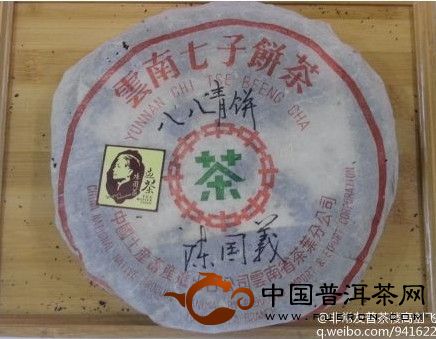
This is the photo of the controversial 88 sheng cake posted on Gao's blog
Ah, Monday! The first 5 days after Sunday are usually the hardest, you know... ;-)

But, there is always time for gossips!

This time it's about "88 sheng" (or "88 qing", "88 green cake"). And this is probably the biggest puerh gossip of the year. I feel people don't talk much about 88 sheng anymore, and think it's *probably* because there have been more and more high quality dry-stored puerh available, and today, many puerh drinkers have dryer tastes than 88 sheng could offer. But anyway, 88 sheng is a legend, and has got to be in the spotlight again and again.

I don't use Chinese counterparts of facebook, twitter or other networks (too many accounts to manage...) So I don't actively follow all the gossips surrounding this issue (more and more are being developed these days...) But here is the core story.

Disclaimer - No personal comments. Purely hearsay... I'm not legally liable for following gossips... :-p

Short version -

In a small tea gathering, Gao Jianfei (a Beijing-based tea celebrity) and a group of tea drinkers compared 88 sheng from Gao's collection and 88 Sheng offered by 1510tea (a commercial tea website in China) in a lottery event that was directly purchased from Chen Guoyi (a Hong Kong-based tea celebrity, the original owner of "88 sheng") at a price of 50k rmb/$8k. According to Gao and some other participants of the tea session, the two 88 sheng tasted and looked completely differently, and the 88 sheng from 1510tea significantly inferior. Afterwards, Gao openly denounced the 88 sheng from 1510tea as a fake. Various tea drinkers who participated the tea comparison session wrote informal passages online to back up Gao's claim. 1510tea wrote to Chen Guoyi to ask for his opinion. The representative of Chen wrote back and pointed out that "Nobody has the right to claim Chen Guoyi's 88 sheng is fake, because Chen is the one who gave 88 sheng its name". 1510tea urges Gao to give open apology. They also claim to reserve the right to sue Gao. So far Gao insists his original claim that 1510tea's 88 sheng is a fake.

Longer versions (google translate required) -

1.
I will put this source the first, because this is from a well-seasoned tea drinker at CYQX (one of the largest Chinese online tea forums), and in my opinion, a low-key and reliable person. Unlike the main characters involved in the gossips, this tea drinker doesn't seem to have any conflict of interests in this issue. He showed some (very casual) photos of the two 88 shengs and described the tea session from his point of view.

http://teabbs.zjol.com.cn/viewthread.php?tid=246904&extra=page\%3D1&page=1


2.
Gao Jianfei's microblog: http://www.weibo.com/u/1633531455 (login required)


3.
1510tea's official webpage about their communication with Chen Guoyi:
http://www.1510tea.com/Home/News/detail/id/372

1510tea's open letter to Gao and description of the source of their 88 sheng:
http://www.1510tea.com/Home/News/detail/id/364


Jun 23, 2013

Lu Shan Cloud Mist (廬山雲霧) made by the uncle "si shu"

Among all the Chinese green teas, probably Long Jing is the most famous and most wanted  - indeed the tea is great but there is also great advertising effect created by Qing dynasty emperors...Besides, the tea is produced near economic center of all eras (Hangzhou), which makes it easy for the tea to get popular.

Lu Shan Cloud Mist (Lu Shan Yun Wu) is another famous green tea, yet it's much harder to obtain than Long Jing. Although sometimes people say it's hard to get authentic Long Jing, I think it's only true if you add "for a reasonable price" at the end of the sentence. There are quite a few elite brands that sell high quality authentic Long Jing, such as Tribute Brand (贡牌), Wu Yu Tai (吴裕泰 whose Tie Guan Yin I wrote about here), Tian Fu (天福), and quite a few more. Tribute Brand, in my opinion, is the best, since I know they get their top notch tea (not sure if all their tea) from Long Jing Village in the past years. Tian Fu is also known as Ten Fu in North America. But Ten Fu in China is a much upper scale store than most (or all) Ten Fu stores in North America. In China, almost all Ten Fu's green teas and oolongs over $800 per pound are of very good qualities - but of course it's a different story who would like to spend that $800... I wouldn't... but for those who have the money, why not.

Of the above mentioned, Tribute Brand specialized in Long Jing. None of Wu Yu Tai, Ten Fu or other elite tea vendors of their level regularly offer high quality Lu Shan Cloud. It's not offered in most tea stores out of its home province, Jiang Xi. That's why I would say it's much, much harder to get good Lu Shan Cloud than getting good Long Jing. And therefore I'm both thrilled and grateful to get Lu Shan Cloud in recent years from Wei, who is an iconic tea person to me.

I'm very reluctant to say which green tea is my favorite, because it's almost impossible to pick one. But I have to say, once I started getting Wei's Lu Shan Yun Wu, I feel I don't want to ever miss it in any future year.

Even within China, I would guess majority of green tea lovers have never had really high quality Lu Shan Yun Wu, because the production is small and there isn't a "brand name" of it run by a large company yet (which is not necessarily a bad thing!). Many people never had a chance to have Lu Shan Yun Wu. Some people only had mediocre ones and couldn't understand why this tea has such a great fame. For many people, including me, Wei's Lu Shan Yun Wu has become the first ever experience to know the true beauty of Lu Shan Yun Wu. Wei is a professional tea researcher but only an amateur tea dealer. His goal is to let more and more people know the beauty of Lu Shan Yun Wu. With this goal in mind, he only carries the best quality, and the amount is usually very small, with a few to several kilograms from each site (and Wei traveled by foot to these mountainous sites to get the tea). Amazingly, tea of each site has some unique characters, although all these sites are within Lu Shan.

This tea showed here is from Zhuo Ma Ling, a historical famous site of Lu Shan Yun Wu. I don't know the origin of this name, but guess it could be translated into "horse-stopping ridge", which indicates how steep the cliffs are. This tea is made by somebody we call "si shu". Year after year, within the small group of Lu Shan Yun Wu drinkers, si shu of Zhuo Ma Ling has become a popular name. Si shu(四叔), literally means "the fourth uncle". In the countryside, everybody is related to everybody else. Si shu is an uncle of Wei's, and now he has become a famous "uncle" among tea drinkers. If Zhuo Ma Ling si shu is mentioned, I would immediately think of the tea that has some unique floral notes and very smooth liquor.

The dry tea leaves don't look extraordinary at all. They are obviously first harvest leaves from early spring, very fresh and vibrant. But in Chinese tea aesthetics, these dry leaves can't be called pretty. Once I discussed this tea with my favorite Tie Guan Yin producer, who barely knows anything about Lu Shan Yun Wu but has very good general sense about tea. He said, the dry leaves could definitely be improved and must be improved if the producer wants the tea to be as high-end as Long Jing or Bi Luo Chun in the market. But he also commented that it's paradoxical that non-commercialized teas don't look perfectly good but have their best natures retained; but once a tea aims to become a high-end tea, you don't know what eventually would be lost from it.

I think that's very interesting comment and to some degree, very true.

Wei often says, Lu Shan Yun Wu is a very "manly" tea (hmm, I'm not sure if I agree with the sexism statement but I got his point). I think its flavor strength and depth of liquor texture are way above vast majority of other green teas. In this sense, I would agree it's more "masculine" than many other teas. The tea is manually fried on top of wood fire. You would always see a lot of "blisters" on the rims of tea leaves, similar to the blisters on Huang Shan Mao Feng, but a lot more and a lot bigger blisters (proportional to the leaf size). While frying the tea, a good worker would fry it thoroughly without creating too many burnt spots on the tea leaves. But it's impossible to have none. There will always be some dark burnt spots on tea leaves, and there are usually a lot more dark burnt spots than those found on the manually processed versions of other tea types. For example, in the photo on the left, we could see a dark spot on the leaf at lower right corner. Overall, Lu Shan Yun Wu is made heavy-handedly. That's the style of Lu Shan Yun Wu, and uncle si shu is one who carries out this style perfectly.

Uncle si shu is the best tea worker in his village, and throughout his life, he is one of the best known tea workers in Lu Shan region. He is also a Buddhist, a gongfu (martial gongfu, not gongfu tea) and a locally well-known chiropractor who helped a lot of people with his skills. He is known for a lot of great things. But he is never called a "tea master", "martial artist" or "medical master" - these fancy words are not in the vocabulary of countrymen.


Jun 9, 2013

one of the most influential Chinese tea books


Chinese Teas, 2nd print book cover

Below is an introduction written by Dr. Miles Xian Liu (comparative literature researcher, English professor and tea enthusiast) and me. And you could see the writing is much better-trimmed than my usual blog articles.

Dr. Liu and I have been working on the English translation of this book and are looking for cooperation of a publisher in the US. We hope to make English version of this book available in a couple of years. 

I read this book in (around?) 2007 and started my communication with Dr. Wan Xiaochun in 2008. After many conversations with him and reading some of his peer-reviewed research articles in tea biochemistry, I've got a thorough understanding about his passion in tea and his scientific vision that embraces this book.

Back then, this was one of the few encyclopedia style tea books. Later one, there are more books following this style, including a few high quality books written or edited by leading tea scientists in China. But among all, this is still my favorite encyclopedia style tea book, and probably the most influential contemporary Chinese tea book (and probably there is no "one of" in front of "most").


Chinese Teas, 1st print book cover
A little bit extra that was not included in the formal introduction. The making of this book took 3.5 years (from early 2003 to late 2006). Several leading tea research institutions in China and dozens of the best tea scientists participated in the discussions for this book. From 2003 to 2006, these people traveled across country to get together for three formal meetings for this book. More than 300 top-grade tea samples were collected from more than 20 tea-producing provinces for the photography of this book. This kind of work, considering the amount of efforts and human resources involved, can hardly be replicated. This is probably why this book remains the most influential tea book of its genre in China.


The book, Chinese Teas (中国茶谱 ISBN: 978-7-5038-5854-3), is a single volume of comprehensive tea study by the leading experts in China.  Already two editions within three years testify to its significance and popularity.  Although a little pedantic in tone, the book is intended for general tea enthusiasts across the world. 

Comprehensive in its coverage and scientific in its discussion, the book—Chinese Teas—offers encyclopedia-like deliberation on a wide variety of teas in China.  The first of its two main sections chronicles tea origins, classification, history, and arts of tea ceremonies, with extensive illustrations.  It provides both the latest scientific analysis of health benefits of tea drinking and intriguing descriptions of twenty local tea drinking customs throughout China. The second section illustrates a hundred and twenty-nine varieties of Green Tea, five kinds of Yellow Tea, thirteen types of Dark Tea, two categories of White Tea, eighteen kinds of Oolong Tea, nine varieties of Black Tea, and several “Scented Tea.”  These hundred and eighty samples best represent many thousand teas in China.  With color photos throughout, a reader can get a quick overview of a tea, its history, producing region, and preparation process.  Whether for a casual read or academic research, this book can serve as an encyclopedia on Chinese teas.

Its general editor—Wan Xiaochun  (宛晓春)—is one of the utmost Chinese tea authorities, and his contributors range from botanists, professors, tea scholars to expert tea growers across China.  The wealth of information in the book thus represents the latest developments of tea research in China. The need for two editions within three years—2007 and 2010 respectively—shows the market demand for this book inside China.  

__________________________________

About the author:


Wan, Xiaochun (宛晓春)—the general editor of Chinese Teas—is one of the utmost authorities on Chinese teas.  A leading scientist of tea research in China, he serves as President of Anhui Agricultural University and Deputy Director of China Tea Science Society.  He has written several books on tea, including a college textbook of tea science widely adopted by universities across China, and contributed more than sixty tea research articles to influential science journals both in China and abroad.  To write this book, Professor Wan has marshaled ten tea experts and scholars as his assistant editors from several universities and research institutions across China and published what many has regarded as the most authoritative source of tea knowledge among all Chinese tea books so far and the most influential book in its genre.

Jun 7, 2013

Yixing Jade Bamboo (宜興翠竹)

Yixing bamboo in yixing eggplant :-D
My first time ever having this tea. Such moments are always exciting!

This tea is produced in Yixing, the hometown of yixing tea ware. The tea is named after its shape - the dry leaves look like tiny bamboo leaves. This tea has a more famous cousin - Tai Lake Jade Bamboo, which is supposed to be very similar to this tea, but is produced in Wuxi, another region of Jiangsu province. Wuxi and Yixing are not far from each other and they are about 40 miles apart. Wuxi has very good soil/mud resource, which is used to make the famous Wuxi small figurines.

I had never had Tai Lak Jade Bamboo either. So I didn't know what to expect from this tea. The dry tea leaves look quite similar to those of Bamboo Leaf Green.

It's said that more than half of all green teas of Jiangsu province is produced in Yixing region. This is both surprising and not so surprising. I was a little surprised because Jingsu has quite a few famous green teas and Yixing green tea is not as famous as them. Meantime, it's not really that surprising, because Yixing was a famous green tea producing region throughout history. It was praised for its green teas long before it was praised for its teapots. Yixing has become a famous town of tea ware, not only because of its unique clay resources, but also because of its tea culture background.


Since this is a low-profile tea, I didn't expect it to be super good. But it surprised me with its floral, sweet taste. Good producing location, good manual processing, high grade leaves, and freshness, the tea has got it all. In traditional green tea culture, the leaf shape and outlook of brewed tea are very important. This tea has got them too. Brewed in a tea bowl, the little leaf buds all "stand up" and look like a green flower.


In the past a few years, I've got this same question for several times - "Is yixing tea ware not suitable for green tea because of its porousness?" Actually, yixing teapots are great for green tea. They were invented for green tea (at that time, other types of tea were either not invented yet or not in the mainstream culture yet). People have been using them for green tea for centuries, and are still using them for green tea today too.

Then, why would some people say yixing is not suitable for green tea? Here are my thoughts:
1. I think it's not 100% correct, but has its reasons.

2. Yixing teapot could be great for green tea. Yixing pitchers (like the above-showed eggplant) could be great for green tea too.

3. Some yixing clays are more absorptive than others. So indeed some clays might be less suitable for green tea than other clays. But it's all relative. A good yixing teapot won't be so terrible to ruin a green tea no matter what. Some more absorptive clays, after being used for a while, would become better seasoned. If one drinks green tea all day long (like in 18th century when there was barely any other tea in most part of China and most people didn't have as many yixing teapots as modern day shopaholics :-p) then it doesn't take long to have a yixing teapot well seasoned.

4. This myth of "yixing teapots not suitable for green tea" may somehow reflect the dwindling yixing teapots quality in modern time. Generally speaking, even when we talk about authentic yixing clay, there are a lot more low quality yixing teapots in modern day market than in the past. Historically, Yixing was famous not only for its clay tea ware, but also for larger clay wares such as plant pots. Typically the clay used for plant pots is of lower quality than the clay used for teapots, and the lower quality clay cannot go through very high kiln temperature without being broken. But in today's market, many yixing teapots are made by the clay that would have been only qualified for plant pots in the old days. And there are a lot of clays of borderline quality, better than the plant pots clay, but not good enough to sustain high kiln temperature. With compromised kiln temperature, the teapots would end up of lower density, and more porous than it's supposed to be. Such teapots would undermine taste of any high quality tea, and especially green tea.

Jun 2, 2013

purely dry storage 1996 Menghai tuo (covered by white stuff)

I started writing this right after I wrote the blog post about the 8972 brick, where I mentioned this tea. Somehow this post fell into the split of time and I forgot about it all this time...

And the "covered by white stuff" part of the title was added recently, which I will explain later in this post. And I have to admit that part of the title was added to catch attention and coax more people to click into this post... The tea is not really "covered" by white stuff. But don't be disappointed and don't feel cheated. I will show you some "white stuff" soon :-p

This is a tea that I would call "purely dry storage", and by now, I'm sure most of you know about my definition of "purely dry storage", which, hopefully, is consistent with the definition in most people's minds (but I don't really know).

The photo on the very top shows the spent leaves. The color bias is little (in spite of my poor photography skills), and I hope the photo can tell aloud that the leaves don't seem to have experienced any humid storage.

Now the tea liquor (one of the infusions... don't remember which one, probably five-ish):


This is a CNNP tea labeled Menghai Tuo. It might be a product made for export. There isn't any date labeling with this tea. The production year of 1996 is according to the dealer who offered this tea, and he got this date from his source of purchase. So this is a fuzzy date. But it's generally consistent with my impression with the taste of this tea. Yunnan dry-stored tea ages much slower than tea stored in more humid places. I think the tea tastes like a typical Yunnan dry-stored tea, and it would take these many years for a tea to age to this level. But there is no way for me to tell whether it's exactly from 1996, or an adjacent year.


The tea doesn't have a inner ticket (nei piao) or tuo ticket (neifei). I like this tea very much. But in my opinion based on previously discussed criteria, this is a tea for drink instead of a tea that can make money for its collector, due to the fact that it doesn't come with full package and it doesn't have a whole set of paperwork with it.


This tea doesn't have as prominent aromatic aftertaste as the butterfly tuo and 8972, which might be why I like those two teas better than this one. But I do think this tea has nice features of a Menghai tea, and its strength is probably not at aroma. The liquor has a nice texture that feels thicker and stickier than the other two teas. The aftertaste is not strong but lasts quite long.  

Now, as promised, I shall show you some white stuff!

I didn't think much of the white stuff until a teachat discussion last year about a photo of the xia guan butterfly tuo. I don't have an intention to defend the butterfly tuo (because I like it, I own it, I probably can't be objective about it, and I think it's so great that it doesn't really need any defense). But I've found it somewhat interesting that a number of people do have deep concerns about the white stuff being mold, yet I had never related it to mold because I wouldn't think the dry storage allows mold growth.

Then, a year later, I bought a 2003 Chang Tai Yi Chang Hao small cake, a quite popular and somewhat rare cake, at a rather low price. I will write more about this cake later. The reason for the relatively low price is that there was a debate going on among a group of Chinese tea drinkers about whether this cake was of "bad, wet storage". I was interested in studying outcomes of storage styles. I even got some humid-storage tea (which I rarely buy) like one of these, and a bad-storage tea like one of these, so I got this little cake as well. It turned out, in my eyes, this 2003 cake is a purely dry storage and even drier than some other teas from this seller. I couldn't find a hint of bad storage or wet storage on it... but there was some "white stuff" mentioned by the seller of this tea and some other buyers of this tea.

This incidence made me further realize that how much impact the "white stuff" could make. But what else could I say. People believe what they choose to believe. And indeed the market is confusing and indeed there are a lot bad-storage teas out there. So I guess some tea drinkers were immediately freaked out by the white stuff on the tea and immediately returned the tea to the seller without even tasting it. In this case, I wonder how hard I should try to make it a point to others that I think this tea is a great dry-stored tea... after all, because of some people disliking it, I got it for a nice low price...

Many dry-storage teas I've had don't have white stuff. But I've also had quite a few dry-stored teas with white stuff on them, such as the above-mentioned butterfly tuo, and this one!


From this photo, you could see that it's not entirely exaggeration to say this tea is "covered by white stuff". In fact, this tuo has a lot more "white stuff" than any of the butterfly tuos that I've opened. There are a lot of white spots here, most abundant on tea stems and cut ends of tea stems (this is also what I've observed on several other dry-storage teas with white stuff,. I don't know why though. It might have something to do with the surface layer of the leaves and stems). 


There is a Chinese saying that "A melon seller would always tell you his melons are the sweetest in the world." :-D  To some degree, it's true and it's people's perceptions. So sometimes I consciously hold back from giving too much explanation about my own tea (because of course I love them and think they are excellent...) This is not because I'm social phobia, but rather because there is no way to make everybody agree with what everybody else says (however, I believe, everybody would agree with this last sentence ha ha~). So probably we should save the time and find something more fruitful to do.

About the white stuff, there is a little more explanation. Not from me, but from somebody much greater than me - Shi Kunmu. In his book Classic Puerh: Term Explanations, Shi Kunmu mentioned that "white frost" could happen in humid storage as well as in "low temperature (lower than 26 C), low humidity (lower than 80% relative humidity)" storage. He didn't put it in detail (because it's a term explanation book almost like a dictionary, with a concise style), but I believe the "white frosts" in humid storage and in dry storage he talked about are not the same kind of "white frost". He did mention that compared with the "white frost" in humid storage, the "white frost" in dry storage is more evenly distributed throughout the compressed tea (this is consistent with my personal observation) and is overall good for the aging of the tea (this is his opinion, and he didn't explain it. I don't get it though how the white frost could help aging, and think the "white frost" in humid storage might not be that bad either).

This is Shi Kunmu's explanation and I've found it quite reasonable. But on the other hand, this doesn't mean everybody would agree with it. In puerh world, Shi Kunmu, a very peaceful person, is sometimes a controversial figure. I don't agree with everything he said, but have enjoyed many of his articles and respect him a lot. Many people enjoy Shi Kunmu's products and have benefited from his teaching of tea knowledge. But I've also heard quite a few people bad-mouthing him (I like and respect some of those people too, without agreeing with them on bad-mouthing each other...). I feel, this Shi Kunmu phenomenon somewhat demonstrates that in tea world (or the entire world), nobody could be liked by everybody, nothing would be agreed upon by everybody, and debates will be going on, forever.

May 25, 2013

reunion of another pair of twins - good storage and bad storage

In the last episode of "reunion of twins", I posted about a dry storage version and a Hong Kong humid storage version of a same tea. Although neither of them is perfect - I wish the dry storage version gets smoother and wish the HK storage version without the hint of "wet straw" taste - I enjoy both of them fairly well. I could drink either of them every day for weeks without any complaints. So for those two versions of storage, I think they provide an interesting comparison of two styles, but not a contrast of "good" or "bad".

Here I got another pair of twins. And this time, I would simply call one of them "good storage" and the other one "bad storage". It's possible that some people would even like the "bad storage" in my eyes (because it's actually not that bad... I've seen much, much worse ones). But would anybody prefer the "bad" to the "good"? Hmm... anything is possible. But for this scenario, I guess the chance is really really small.

In the photos to come, you may notice that this time, I didn't take any "group photos" of these two brothers, yet last time for the other twin brothers, I took most of the photos with the two cakes side by side. That basically reflects my feelings about these two pairs of twins. For these current two cakes, I couldn't bear with putting them next to each other, seeing one of them as a "contamination source".

How did this type of twins/brothers comparisons start? I once wrote about the different styles of puerh purchases. Of the three styles mentioned, one is "philatelists" style - basically, buying a little bit of this and a little bit of that, so to have a diverse collection. I guess many people have some tendency of being philatelists. For me, a big motivation (or excuse) of philatelists style purchase is, when I have an interesting tea, I would be also interested in getting its brothers, cousins, spouses, twins, etc. For example, I got these 3 brothers, the above mentioned twins, these cousins (I got a few more of their green stamp cousins too), the spouse of this tea, and could build up other family trees among my teas.

The tea discussed in this post, is one of my favorite puerh (when well stored). It's not the "giving you a strong kick" kind of puerh or super old puerh many people seek for (it's a 2004 tea) . I can't quite sort out why I like it so much, but I think it's pretty much what an ideally aged Yiwu is like in my mind (although this tea has Menghai tea blended in as well).

The bad storage version was for sale at a price much lower price than I had ever seen (and I somewhat knew nobody would bother to fake this tea) and the seller did mention to me that the tea needed to be aired out a bit as it had some storage smell. So in spite of the bad storage, I'm ok with the seller and actually still think his price is quite fair (because the bad is only relative to the good storage, and is not that bad). The tea is not commonly seen in the market, so I was glad to have a chance to have a twins reunion to compare the storage, whether they are two styles or contrast of good and bad. Besides, I thought if the storage smell mentioned by the seller was not that bad, maybe I would just stock up some and air it out. But eventually, I've figured out that I'm already old enough to treasure my time, and I live in one of the most expensive cities of the country, so basically, I can't afford any time, money or space for the bad storage tea, although it's not that bad. The bad storage tea could serve as a specimen and be examined again in a few years.

This time I will put the show-and-tell in a reverse order.

The photo on top of this post is from the bad storage. The loose leaves look not bad at all. Without smelling it or tasting it, I would have thought it was totally fine.

The bad storage being brewed. The leaves are actually adorable and don't look very different from my normal version of this tea.


I didn't take brewing photos of the good storage tea, but actually they don't look that different in small amount of leaves and in brewing. It's somewhat surprising, and also makes me cautious that without tasting contrast of various version of the same tea, sometimes it's really, really hard to tell whether the final quality of a tea results from the tea leaves themselves, the storage, or other factors.  

There are a few rather counter-intuitive things about this bad storage tea.

1. The liquor color doesn't reflect wet storage. But later we will see some photos of this tea indicating that the tea suffered from at least short-term dampness.

2. More surprisingly, this tea doesn't have much of the "typical wet storage taste" either. The "Ji Feng Yuan" twins in a earlier post include one Hong Kong humid storage tea that has some "wet storage taste" in a rather mild way and the taste has already faded a lot during the follow-up dry storage (which is an essential stage of professional Hong Kong humid storage). I also had some humid-stored tea whose "wet storage taste" didn't recover that well and would be a little harsh. But overall, this tea doesn't have that wet taste, yet we could see this tea did suffer from dampness (from whole cake photos), in a way much worse than proper humid storage.

3. The spent leaves look quite adorable. Not that much different from the good storage version, at least in this small amount. I guess this means that, the bad storage didn't kill this tea and probably this tea could recover more in the years to come. On the other hand, this demonstrates that the appearance could be very deceiving. Because after all, this tea tastes quite different from the good storage version.

4. After the above 1, 2 and 3, you may wonder, so, this tea doesn't look wet storage, doesn't have wet storage taste, and doesn't look that bad, then what's wrong with it? The tea tastes much bitter than the good storage version, and doesn't have the nice, gentle, fruity taste and unique aroma that I have always enjoyed from the good storage. Still, it's not such a bad tea. It still has some nice aftertaste. But it's by far not comparable to its good storage "twin brother".

5. I'm afraid the the worst thing about this tea is, it's very confusing and probably deceiving. It looks pretty good. It doesn't taste horrible, but rather underwhelming, with its nice leaves and good fame. The taste is not as suspicious as the smell of the tea cake. So if one has never tasted a good storage version and just tastes this bad storage version, one may think it's just the tea and it's just a mediocre tea. If one knows about the tea being water-flashed (which is not hard to tell from the whole cake outlook), then one may blame wet storage for its mediocre taste and its bitterness. However, it's the bad storage, not wet storage that caused the problem (I will explain more about its bad storage smell later). If one only looks at the liquor color, then one may think the bitterness is due to a rather young age of this tea through dry storage, then the water disaster history of this tea might be disguised by its liquor color and even taste.

Now here is the back of the bad storage cake:


We can ignore the straw - that's not a problem and just a regular "gift of purchase" as with many puerh products. But if we focus on the 12'o clock to 2'o clock region, we can see the surface is somewhat "smeared". And below is an enlarged view of that region:

 But still, not much other than the smeared region. No "white stuff" that is supposed to be a common criminal evidence of damp storage. Actually the Hong Kong storage version of the "Ji Feng Yuan" twins does have some subtle hint of "white stuff", likely residues of white mold from humid storage, yet I wouldn't call it a bad storage.

Below is the back of a good storage cake for comparison:


The front side of the bad storage cake doesn't look that bad at all, probably just a little more dull. But the good storage cake looks brilliant! Sometimes good and bad are just relative. A bad is only bad when compared with the good!

Below is the front side of the bad storage cake (the double cake ticket is not a real problem here but a small accident, I guess):

Below is the front side of the good storage cake (it has a "gift of purchase" too, this time, a plastic string!)


And a few more photos of the good storage cake... It actually looks even better than the photos!


The bad storage cake has some bug bite holes on the wrapper. But that's not a problem for me. Quite a few nice aged puerh I've had have bug bite holes on the wrapper too. But it seems that the bugs were only interested in the paper and didn't mean to hurt the tea. I've heard of teas that were severely damaged by bugs but have never seen any. I guess it's generally not a problem in dry storage, and shouldn't be a problem in proper humid storage.

The wrapper of the bad storage tea looks not that bad at all. So overall my impression is, this tea might have suffered from some accidental water flash problem instead of going through intentional humid storage. This also makes the tea confusing and probably deceiving. Although not everyone likes humid storage teas (I myself could enjoy very few of them), accidental dampness is always much worse than professional humid storage. In quite a few occasions, I've seen people blaming the bad taste of a cake resulting from its humid storage, while the cake actually went through destructive water disaster. Also in quite a few occasions, I've seen people praising a cake for its proper humid storage and called it "not as harsh as dry stored cakes", while the cake looked obviously purely dry storage in my eyes. All this, I think, is because puerh could be very confusing overall. So probably one thing for sure is we will always be confused. And probably it's good to be aware that we can easily be confused and will be confused for many more times in the future. With this awareness, we have the hope of being confused in a higher level with time being :-)

Below is the bad storage cake:


Below is the good storage cake. It has got some bug bit holes too.

And I haven't explained it yet why I would call it bad storage to begin with (the smeared cake surface itself might not serve as strong enough criminal evidence). It smells bad! It has a typical damp warehouse smell that I'm familiar with through my clothing purchase from Southern China.

I buy fairly amount of my clothes on Taobao, because I've found quite a few nice small business designers there, and overall it's easier to get shorter sizes in China. Most of my clothing purchases come from Southeastern China. Many of them have a "wet storage smell" on arrival. Although I'm thinning my list of sellers to those whose clothes don't have such warehouse smell, there are some sellers' stuff that I've got to buy (because they are adorable!) in spite of the bad warehouse smell. And it's understandable that sellers have to use unlivable space (such as damp basement) as warehouse (not equally understandable for tea though). For clothes, it's much simpler to deal with the storage smell. I simply hang them in the attic till the smell fades. And if it doesn't fade from a piece, I would just wash it.

This bad storage tea has exactly the same warehouse smell as found on some of my clothes purchases. When I enjoy the good storage version of this tea, I've always thought of it as having an aroma of mountain spring rising from the surface of tea cake. Obviously such aroma can't survive a warehouse smell. Interestingly, when I took photos of the bad storage version, I noticed that after being exposed in the air for a while, the bad smell faded significantly, and the "mountain spring" smell came back a bit (it could completely be my illusion though...) Then when I left the tea wrapped up for a while and opened it again, the tea was full of the bad storage smell again. Same thing happens when I left some of the bad storage version in a box to "wake up" the tea. So I guess, the bad smell would fade, little by little. But with the loss of bad smell, I'm afraid other good characters would be lost more or less. Maybe after several years, the bad storage version will no longer smell bad or taste bitter. By then one may or may not be able to tell about its dark history. But even if the bad storage tea recovers well, I don't believe it could ever get nearly as good as the good storage version.
May 19, 2013

quick udpate - Tea Nazi is back!

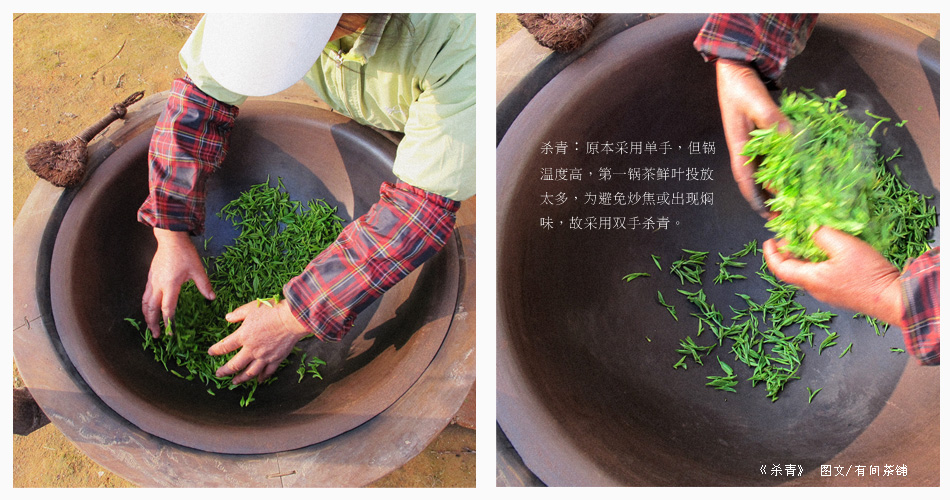
(The photo is from Pan's Tea Travel webpage, explaining the green tea processing.)

Here are of Tea Nazi that I wrote two years ago.

Ok... I admit I was really blunt to call him "tea nazi", as he is by far not as harsh as the "soup nazi", and he is really a nice guy!

This spring I got "official" announcement from Pan that he is back to tea business - on part-time basis, but in some sense, more devoted than a lot of full-timers in tea world. I know a bunch of "amateur" tea people, part-timers, moonlighters, or "hobby sellers(?)". In fact, among my favorite tea friends, tea suppliers and tea "colleagues (?)", there are probably more part-timers than full-timers. Thinking of that just surprised me! I haven't had any business relation with Pan yet. But I sort of like it that he has come back to tea business on part-time basis!

Now I know it's easier than ever for foreigners to shop on taobao. So here is Pan's taobao store:
http://youjianchapu.taobao.com/search.htm?spm=a1z10.1.w28-18216832851.5.3q9noD

His store name is the same as the name of his store before he "retired" from tea business last time. It literally means "Here's a Tea Store". I think it's a lovely name!

There aren't many items yet there. And I've already asked him "would you please add more stuff in the store and make it more business-like?!"

Pan told me that he will add more items to the taobao store, but probably not a lot and not very fast. So far, he would visit every of the production site or collection source of his teas, and he would only carry teas that don't use any pesticide. He will not do a lot of business in a short time. But he will maintain very high standards for quality and health of the teas, as always!

I think it's not hard to tell that one can hardly make a living selling tea in this way, especially in China, where there are about a few million tea sellers doing business more efficiently on lower budgets. But it may work out just fine as Pan keeps his day job, which is an interesting job anyway.

If you look for more things to see, his "tea travel" page is very cool:
http://shop58835027.taobao.com/view_page-43393581.htm?spm=a1z10.3.w3-18202084498.4.9cTPU6

And I'm sure he will add more photos and writing to this page to document his tea journey and his teas. I've already suggested him to put his writings in text format on the webpage so that non-Chinese readers could use google translate to read them. But so far photos dominate and photos tell most of the stories already!

Besides, anybody who are Chinese-English bilingual, if you are interested, please feel free to translate his writings, publish the English version online and link back to his webpage.