Feb 10, 2009

Tea Calendar - Teas to look foward to all year around

Just for fun. I sorted out some notes and summarized tea time around the 24 annual solar terms. It's only possible to include a small number of teas, mostly those I am interested in :D The summary table definitely needs to be polished and more information needs to be added in.

Chinese calendar is a lunar calendar with indications of sun motion. There are 24 days in Chinese calendar marking the 24 solar terms throughout a year. Their dates stay *almost* the same year by year on western calendar, which is a solar calendar. The 24 solar term marks directed a lot of agricultural activities in traditional society of China, including tea cultivation.

A lot of good information about the 24 solar terms can be found at wikipedia:
http://en.wikipedia.org/wiki/Solar_term

Most solar term names in following table are consistent with above wiki information, with a few different.

Some additional notes:

* Date may vary by 1 day.

** There are variations due to climate changes and early growth new varietals.

*** The notes focus on climatic changes and agricultural events (with large variations existing across the country).

**** Start of Spring, Start of Summer, Start of Autumn, and Start of Winter are 4 of the Solar Term days that mark the start of seasons. However, when each of them comes, most part of the country is still in the previous season.

Please click to see the full image.


Feb 6, 2009

High Mountain Zhi Lan (Iris and Orchid?) Flavor Dan Cong (高山芝蘭單欉)

I am not sure what "Zhi Lan" is in English. Google translate says (iris and orchid). The flower is something like this:
http://www.guilinlife.com/enews/uploadfile/2007-11-15/2007111510251483.jpg

As many other Dan Cong, this is named after a plant, with its fragrance mimicking that plant.

I like it very much. It has non-aggressive yet long-lasting fragrance.


First infusion:

Second infusion:

Third infusion, with leaves still tight:
I guess I did a dozen infusions or more. There was still subtle flavor left, but it got late and I ran out of time. For this tea, I think 8 or more infusions should be done in order not to be wasteful. I used 5 seconds for the first 7 infusions, then 10 seconds for the following a few. But I was being conservative. I somewhat felt slightly longer infusion time should be fine as well.

The end. As a high mountain varietal, it has leaves nice and tight till the end.

Charcoal Roast Lao Cong (Old Bush) Shui Xian (碳焙老欉水仙)

I like it very much! I normally am very cautious about anything "charcoal roasted", because while it's supposed to be rich, warm throat feeling, sometimes it could bear hot, smokey flavor. I guess some people even like the smokey flavor and some tea is featured by it, but I would rather not have much of it.

This charcoal roast shui xian is very nice, not smokey at all, but very warm and soothing. It almost feels like a "throat massage" - well this isn't really accurate description... :-p


First infusion (haha, got shadows of my orchid and chestnut wall decor...)

Second infusion:

Jan 28, 2009

Post-Winter Tea Si Ji Chun (四季春,冬片)

Since I have seen some Dong Ding whose flavor is undermined by Si Ji Chun, I generally have a negative impression about Si Ji Chun. But this tea is very good, I think, because it's a post-winter harvest. Leaves are generally small, and therefore don't have harsh chemicals accumulated in them. It is a very good example of Si Ji Chun.

It doesn't give much more than 3 or 4 infusions. But the first a few infusions are very nice. The fragrance is subtle, closer to the green tea way, yet still the unique oolong style of floral taste.


First infusion:


High Mountain Honey Orchid Dan Cong (山峰蜜蘭香)

I like it very much. It's somewhat similar to the honey fragrance TGY I got from Wu Yu Tai (吳裕泰). I didn't try the two side by side, but feel this can almost replace that one from my personal tea list, and that will be probably 50% saving of cost! But of course that's assuming quality is stable every year. Wu Yu Tai is generally expensive in everything but famous for its high quality standards.

Dry leaves:

First infusion:

3rd infusion and leaves:

The end:

The other day I spotted this post about somebody else's Honey Orchid Dan Cong. It looks great! No need for translation. The pictures just look delicious!
http://teabbs.zjol.com.cn/thread-51906-1-1.html

Jan 27, 2009

First tea party of this year & a gift

Who is that lucky one in the poll to have one tea party every week OR MORE? :D

I had only 2 tea parties last year - not many tea drinkers around, people are busy, tea drinkers are mostly somewhat introvert... I guess these are why. But will try to have more tea gathering this year. Just because we are somewhat introvert, we should try harder reaching out for each other :D In fact, preparing a tea party is so much easier than other kinds of parties, and the food/drink is generally healthier.

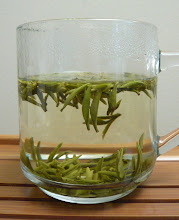
And I got this nice gift from a friend. It's Meng Ding Snow Bud (or Meng Ding Yellow Bud, 蒙頂雪芽)! The tea leaves are so adorable, as its flavor. I could stare at the leaves for a long, long time! It's quite green for a yellow tea, but I guess, that's the trend in recent years.


"Almond Flavor" Dan Cong (鋸朵仔)

It's just ok.

Dry leaves:

First infusion:

Second infusion:

Wet leaves:

Jan 16, 2009

Xue Pian (winter tea) Ba Xian (8 immortals) Dan Cong (雪片八仙單樅)

Ah! Very fragrant. There was an emperor who commented on Bee Luo Chun (碧螺春)by calling it "frighteningly fragrant". I would call this Ba Xian "frighteningly fragrant", admiringly. Haha.

Not expensive at all. It's Dan Cong by modern concept (from single bush propagation group), not literally single bush. Thanks to modern propagation techniques.

Dry leaves:

Warm-up infusion (3 sec.). So fragrant. I drank it anyway to avoid being wasteful.

First infusion:

Second infusion:

Third infusion:

Wet leaves after 3 infusions, still tight

Tea water and wet leaves after 6 infusions

I lost track here, guess it's after 10-12 infusions.

The end. I didn't around 18-20 infusions. After about 15 infusions, it was mainly just background flavor and fragrance, but it was intensive background, with a taste of sweetness backward on the side of tongue. RS said, sweet without being sweet... hehe...

Overall the fragrance faded very, very slowly, and meantime astringency (in the nice way) picked up very, very slowly. I liked the pace of flavor change in this tea. Because I was "frightened" a bit by the intensive fragrance, I did 5-8 sec. for all first 10 infusions, and less than 15 sec. until near the end. I wasn't sure if that was optimal infusion time, just thinking shorter infusions are generally safer.

If giving some critics, I would say, the flavor and fragrance are not implicit or subtle enough. It's rather intensive and expressive. Implicitness is a very important value in Chinese aesthetics, hence in Chinese tea aesthetics. But no I won't criticize this tea. I am not tired of crazy fragrance yet and am very happy with this tea.

Jan 11, 2009

Little bowl

Please click pictures for enlarged view.


Jan 9, 2009

Questions you may want to ask about your Dong Ding (2)

First, I believe a very important question to ask is "what is the composition of the tea". There are 4 common oolong varietals in Taiwan oolong, Qing Xin (Green Heart) Oolong, Jin Xuan (Golden Lily), Cui Yu (Green Jade) and Si Ji Chun (Four Season Spring), and this is also roughly the sequence from most expensive to least expensive (but price also depends on leaf quality, and Jin Xuan and Cui Yu have similar price range).

In near past, if a Taiwan oolong is named after its production location, for example, Dong Ding, Alishan, Lishan... then Qing Xin Oolong, the most prestigeous varietal was by default used. Products of other varietals would be labeled with their varietal names. It was not law kind of thing, but pretty much the unwritten rule. Therefore in the past, I wouldn't feel comfortable asking a vender if his Dong Ding or Alishan was entirely composed of Qing Xin Oolong. Of course it was supposed to be Qing Xin, therefore the question, I think, would sound offensive. But in recent years, I've seen more and more Dong Ding and Alisha composed of all 4 varietals. It seems such a common practice that even some good Dong Ding and Alishan are made from different varietals, not just Qing Xin.

And here comes the problem - I did find larger amound of Si Ji Chun in less tasty oolong products. I personally don't like Si Ji Chun, not that it's a "bad" variety. Following photo A shows a winter Si Ji Chun with very young leaves, and it's actually a very pleasant tea. But when older (larger) Si Ji Chun leaves are blended in oolong products, very often, they add in significant bitter flavor in the tea, and sometimes entirely shade out flavors of other tea leaves.

Of course this is just my personal preference. But if you have a particular preference in Jin Xuan or Cui Yu, it would also be helpful to know the composition of the tea.

Among following photos, "A" is a Si Ji Chun. "B, H, I" are Alishan Oolong with blend of different varieties. The rest are Dong Ding Oolong with blend of different varieties.

When you buy tea product of specific varietal, you can recognize features of its taste and tea leaves. Here, "A" is an example of young Si Ji Chun, but there is a bigger leaf there. Usually the bigger leaves show more distinguishable feature.

I didn't start to collect photos like this until recently, so don't have a photo sample of product with Qing Xin Oolong only. Actually I started to wonder about this only after I found most Dong Ding and Alishan I've got these days are blends of different varieties.

Not all leaves in my photos show typical features. But the easily recognized ones include:

Qing Xi Oolong: E2, F3, G3, H1
Jin Xuan: E3, I2 and an example here from a pure Jin Xuan product.
Cui Yu: B1, B2, B3, D1, D2, G1, I1.
Si Ji Chun: All in "A", C4, F2

A. Si Ji Chun winter harvest:

B. Alishan

C.

D.

E

F

G

H. Alishan

I. Alishan

Questions you may want to ask about your Dong Ding (1)

(1) Why should you want to ask questions

Dong Ding Oolong is one of my favorite. I used to just spot it, notice the price and description, then buy it. Before the internet shopping era, there were few suppliers that I could go for Dong Ding, and generally few choices of quality grades. But almost every Dong Ding I got was great. Dong Ding Oolong is exclusively produced in Lugu Villiage, Nantou County of Taiwan. After all, when suppliers took all the troubles importing them from Taiwan, they had better get some Dong Ding of good grades.

However in recent years, I've noticed some changes in Dong Ding Oolong market.Of course my observation is limited, and there are always better teas and not-so-great teas in market. But I've got the impression that in recent years, generally speaking, there has been a wider range of quality. One Dong Ding could be great, while another could be disappointing. I've also heard people talking about bad harvesting seasons that resulted in unstable quality of Dong Ding. I personally don't believe climate is the major factor. There are other factors that can affect a Dong Ding Oolong's quality more directly.

Therefore I would like to talk about questions that we may want to ask about our Dong Ding Oolong. If Dong Ding is still new to you, then probably you want to just go to a reliable retailer and try it first, before asking these questions. If you are already absorbed by Dong Ding, asking questions before purchasing may help you get Dong Ding of stable, desirable quality.