In early March of this year, many Chinese tea producing regions suffered from snow and frost. Mt. Wudong, home of Phoenix Dan Cong, is one of the regions that suffered the most.
These are some typical scenes of tea trees being frozen and withered leaves after thawing of frost. (Scroll down the page for photos.)
http://www.tianyutea.com/bbs/dispbbs.asp?boardID=12&ID=34329
It's the worst natural disaster in tea plantations of Mt. Wudong since 1943. It's estimated that spring production of Dan Cong was reduced by more than 60% percent. Even worse, most damages happened to the best tea trees - those at 600m (1800 ft.) elevation or higher.
I was both glad and excited when Zhi, a young farmer of Mt. Wudong, told me about his Red (black) Tea Dan Cong. On the morning of March 10th, when he saw acre after acre of frozen leaves, Zhi's heart sank. It was the day when many tea farmers witnessed their tea leaves, even some tea trees, killed by ice and frost, just five days or so before spring harvest. On the day many people lost their entire spring production, Zhi didn't want to give up. He made a quick decision and did something I had never heard of. Actually it's something that even Zhi had never heard of. It was just a thought that came to his mind, and he grabbed the thought. Zhi called up all his friends and assistant works, and they spent the whole day harvesting on the frost-damaged tea leaves. Plant tissues respond to various environmental shocks, including freezing shock, with oxidation. Therefore, when the semi-frozen leaves were harvested, they were already heavily oxidized. Overly oxidized leaves are not suitable to make the delicate Phoenix Dan Cong. But they can still be used to make some tea. While rush-handling all the frost-damaged leaves in one day, Zhi and his companions didn't have time to categorize the leaves by cultivars. They had all the leaves mixed while processing them, and made this Red (black) Tea Dan Cong. Theoretically this tea is no longer "single cultivar", with leaves of various cultivars mixed together. But all the leaves are high quality, high mountain tea leaves which were supposed to be leaf materials for Dan Cong. Therefore I would still prefer to call this tea "Dan Cong".
As soon as Zhi told me about this tea, I decided to get some. I was very curious about how a red tea Dan Cong would taste like. And I was very much impressed by Zhi's creativity and decisiveness. In addition, this tea is much less expensive than regular Dan Cong products, because, after all, it's a product of accident. By making it, the tea farmer and his friends only expected to have some production, instead of nothing, from these frost-damaged leaves. It sounds like a great tea with very reasonable price. Besides, darker oolong and red tea both have relatively long shelf life. So I thought, I would like to get some no matter what. Even if it doesn't turn out as great as expected, I will just take it as souvenir of the historic frost calamity of 2010.
The dry leaves of the tea looks just like normal Dan Cong.

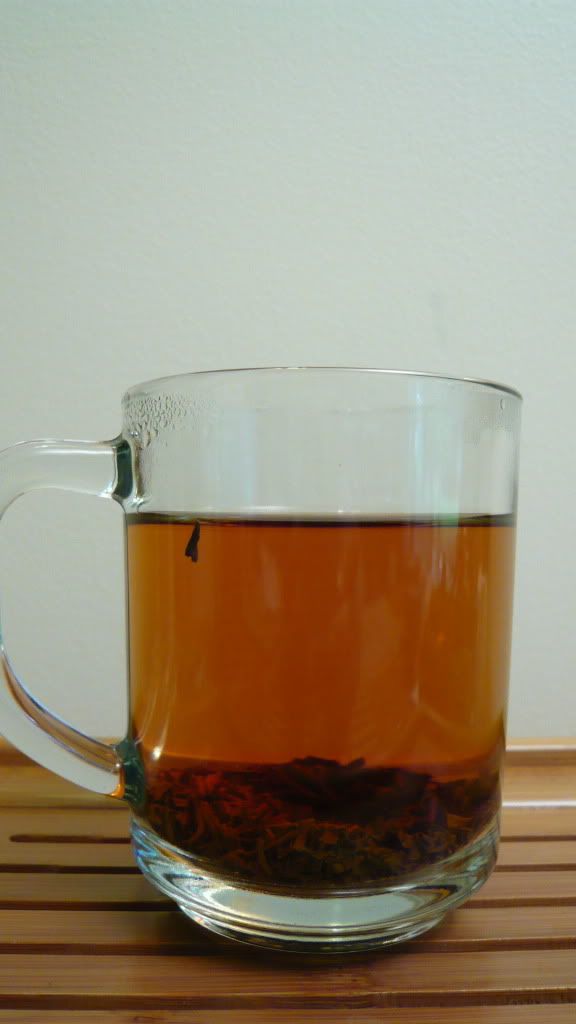
First infusion:

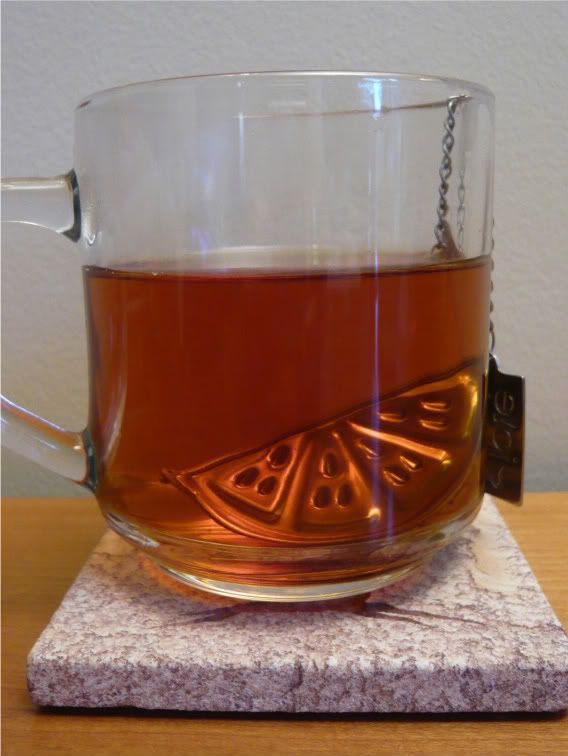
Seventh infusion:

The tea liquor looks bright and silky. The flavor is somewhat like Mi Lan (honey orchid) Dan Cong, and somewhat like Almond Dan Cong. Made with leaves of various cultivars mixed, this tea doesn't have as focused as a flavor profile as most Dan Cong products. The fragrance is not as prominent as high quality Dan Cong products. But the flavor is rich and powerful. The aftertaste has great aroma, and the sweet aftertaste is strong. It looks like that overly oxidation caused the tea to lose some fragrance, but the flavor of the tea was largely saved by Zhi's timely processing. Something else that I like very much about this tea is, the texture of the liquor is very smooth. It's the "rice soup" or "oily" texture as how Chinese oolong drinkers would describe it. Such liquor texture is only found from top level high mountain leaves with great inner characters. I enjoy this tea very much, and meantime, I can't help thinking what a pity it is - if it were not for the frost disaster, this tea could have been even a lot better. And then, I also feel lucky that after all, the leaves were not wasted, and were still made into good tea. Besides, as a product of accident, this tea does have some red tea characters that I had never seen from a Dan Cong tea.
I don't know yet if this tea will be made again next year when the climate is normal and leaves are fine. But anyway, I would like to include this tea in my "Concept Tea" collection, because I think it's really unique. Chinese people often say, "The taste of tea is the taste of life." Sometimes one may have the best qualities but not the best of luck, just like whatever good tea leaves there are, a snow storm can easily ruin them. Sometimes there is no way to argue with the nature or the fate, but it's possible to negotiate our way to get the best results within our limits. We all know it's much easier saying it than living it. Therefore I admire what Zhi has done with this Red Tea Dan Cong. From what I know about him, this young man in his early 20s has great expectations in tea!
Also worth mentioning is that all the tea leaves are from Zhi's plantation in transition for organic cultivation. His plantation has been on an organic transition certificate, and he plans to obtain the organic certificate in a few years when the transition period is finished. Zhi and I also exchanged some conversations about challenges in organic cultivation and possible solutions, which I will include in future blog entries.
I’ve set aside some samples of this tea for fellow bloggers. Please see recent events for blogger free sample information (you will need to scroll down to the bottom of the linked page).
________________________________
This spring has not been easy for tea farmers. In southern Fujian, first, in early March, new leaves of Huang Jin Gui (Golden Osmanthus) cultivar were largely killed by the snow and frost. Then in early May, after several excellent sunny days with great Tie Guan Yin harvest, it rained for weeks. When the rain started, a Tie Guan Yin farmer told me, "Our most expensive leaves are still in the tea tree, and we can't harvest on them in the rain!" And yesterday he said to me regretfully, "Many of our best leaves grew old in the tree while it was raining!" But he also told me that we should feel grateful for the great weather from late April to early May, when harvest was smooth and great tea was made. He said, "If we don't get a lot of leaves good for light-oxidized Tie Guan Yin, we will make more medium-oxidized product. If we don't get as much Mao Xie and Ben Shan, let's hope we can still make plenty of Qi Lan." He was a little sad, but not gloomy. "Tea is a gift of the Nature. Sometimes we get more, and sometimes we get less. We have to take whatever it is, and life is going on." To me, what's great about getting into tea business is, I've come to appreciate the tea in my cup more than ever.








 Posts
Posts


