Feb 28, 2010

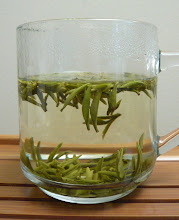
2010 Shincha News - Da Fo Long Jing

Exciting! Exciting! Mouth watering... heart beating... :-D

According to CCTV news report on Feb. 25, 2010, harvest on Da Fo Long Jing started on that day! To be more specific, the Wu Niu Zao (Black Buffalo Early) cultivar's harvest has started. We are still patiently waiting for our "real" Long Jing cultivar. But it won't be long before it's harvested too!

Let me mention our Da Fo Long Jing 2010 pre-order/group purchase, before I move on to write about the confusing situation of Long Jing - because sometimes even I myself would feel a bit exhausted after going over this issue :-p

I wrote a blog entry about Da Fo Long Jing a few weeks ago. Here is a little more explanation about the cultivars of Da Fo Long Jing.

Long Jing, sometimes is taken as a tea processing method, and sometimes is taken as name of a tea cultivar named Long Jing (actually a few similar cultivars). The second definition is surely less confusing, but both definitions are commonly in use in China now. I personally always prefer to use the term Long Jing only for Long Jing cultivar.

Wu Niu Zao (Black Buffalo Early) is a historically famous tea cultivar. It's from the Black Buffalo town of Zhejiang province, and the earliest green tea of Zhejiang - hence comes its name. It's a good tea, but coming out early means it's usually very expensive. The tea leaves are usually very young and refreshing, but most people believe its inner characters are not comparable to Long Jing cultivar. Wu Niu Zao is cultivated in Hangzhou (the central producing region of Zhejiang) tea plantations too, and the Wu Niu Zao products from Hangzhou will be labeled Hangzhou Long Jing, or Xi Hu (West Lake) Long Jing. However, I believe there is great discrepancy between Hangzhou Long Jing that's made with Wu Niu Zao and Hangzhou Long Jing that's made with Long Jing cultivar.

Currently, management on Long Jing title is stricter in the aspect of geographic origins. Only Long Jing from Hangzhou can be called Hangzhou Long Jing, and only Long Jing from within Zhejiang can be called Zhejiang Long Jing. Such regulation is helpful for consumer to recognize the "authentic" Long Jing, but it focuses more on geographic patent than cultivar labeling.

Now back to the above-mentioned Da Fo Long Jing. For price's sake, I plan to stick to Da Fo Long Jing rather than Hangzhou Long Jing in future a few years. And for flavor's sake, I plan to stick to the Long Jing cultivar rather than Wu Niu Zao cultivar. But for people who are really eager to get the shincha early, Wu Niu Zao does provide the fresh spring flavor the earliest, and spares you almost 6 weeks' time.

Feb 25, 2010

Another granny tea (or huang pian, yellow flake)

This is the second granny tea (huang pian) I've ever had. The first one was a "granny" of a king grade Shui Xian. Behind every Yan Cha product, there is "granny tea", the older leaves that are selected out. Since there are not many Yan Cha teabag products, I guess most granny tea is consumed by tea farmers, if it's still good.

Compared to the last one, this one is more interesting to me, because I happen to have the fine product of this tea, a gold medal Rou Gui. As someone who is not particularly enthusiastic about Rou Gui, I instantly fell in love with this gold medal Rou Gui. I was gifted only one 7g pack, and am still drooping for more.

The granny tea of this Rou Gui has larger, greener and yellower leaves. The leaves have not been highly roasted. After all, who will pay the effort to roast a huang pian. It looks and smells like a greener style Yan Cha. At the beginning, the look and smell of the tea leaves worried me a bit. I've seen some poorly made greener style Yan Cha that smells very good but tastes bitter, which, I guess, is due to inadequate oxidation. But it turned out pretty good.


I used a 120ml gaiwan, and moderately filled the gaiwan with tea leaves. After rinsing, time for each of the first infusions was about 10 seconds. 

Tea color of the first infusion is darker than modern greener style Yan Cha, but much lighter than normal Yan Cha, and it's a big contrast to the final product of the gold medal Rou Gui. The flavor is light fruity, with slight peppery taste. The overall aroma is not as strong as a typical fully roasted Yan Cha, and not typical Rou Gui flavor, but is quite nice and prominent. The liquor is mellow, without any bitterness or astringency. But I didn't attempt to give it long infusions, so I don't know how tolerant it can be. The following a few infusions yield mild but consistent flavors. 


Later I ran out of time and stopped after 5 infusions, although I believe it could go a little longer, not as long as a typical Yan Cha, but maybe 7-8 infusions. As a granny tea, I think its leaf conditions are admirable. The spent leaves after 5 infusions look almost like some normal product tea, very in shape and vibrant. This is indeed a generous granny tea!


I've ordered some sealable tea bags, and will make some tasty cheap tea and crushed tea leaves into teabags. This tea probably makes excellent teabag materials :D

Feb 17, 2010

amazed by all this growth

Look at all this growth in tea communities! I am amazed.

From time to time, some people would ask where to find more online tea forums. As I remember, just a couple of years ago, the answer would be, not many. Now, there are more, and more. I've been keeping a list of online forums. In recent month, I had to update it for a few times. And the list doesn't even include forums that are not actively attended by North Americans. Well, there are only nine forums on my list, and not all of them are equally active. But I think this is really a lot more than a couple of years ago. A few of them are fairly new, growing rapidly and with neat forum features. I can't predict how many more will appear in the coming months!

In China, from late 1990s, Tie Guan Yin has become popularized, with full support of its local government. Wuyi government and tea farmers soon caught up. Then more tea regions and more tea varieties join them. Such movements, I believe, mean a lot to tea communities, even in China where tea has been always abundant. These movements help promote national trends of specific tea varietals such as TGY and Wuyi Rock Tea. Before that, tea drinking in China had distinctive regional patterns, with specific teas restrictively consumed in specific provinces. Before mid-1990s, in Beijing (where no tea is agriculturally grown), good TGY and Wuyi could be found in market, but just a few representative products carried by the few renowned vendors. Today, there is at least one "tea city (mall)" in every city district of Beijing, with dozens of TGY and Wuyi sellers, along with other specialist vendors. Well, as a Chinese tea drinker in mid-30s, I do have many reasons to have nostalgia for the pre-1990s tea market. But I have no doubt that today's tea market is the best for tea drinkers.

I believe this is just the start. There are still so many teas recorded in books but can be hardly found in market. Meantime, there are so many popular teas that are not yet covered by academic tea books. A tea book I have in hands records about 200 types of Chinese tea, but only lists Wuyi Yan Cha and Feng Huang Dan Cong as 2 entries. It takes another book to go over just Yan Cha and yet another book to go over just Dan Cong. A tea drinker's pursuit of new flavors can be endless. When it becomes easier and easier for tea drinkers to buy tea of great variety, small tea producers and farmers of small tea varietals enjoy better market opportunities. Therefore, even with all the emerging problems in today's tea world, I still believe we are the luckiest tea drinkers ever.

Feb 15, 2010

A tuition shoe paste yixing

Additional words on 02/16/10
These photos were induced by this discussion. Many people experience a few pieces of crappy tea ware and bad tea along the way. People call them tuition tea ware and tuition tea (as for tea, I guess, mostly happens on puerh).

Some fake Yixing teapots are treated with paint oil (shoe paste or something of its kind) to mimic color of good clay. Once the teapot arrived, it wasn't hard to tell. In short, after I casually touched the inside of the teapot, for the whole afternoon, I couldn't wash my fingers clean :-p I should have taken a photo of my black fingers!

I took the photos a couple of months ago to show a friend and ask "can you tell what's wrong with this just by the photo". Well, I knew he knew so much better than me and could tell anyway. This teapot, I still think the shape looks nice. I washed it a bit so the "makeup" on the lid was largely "damaged". Otherwise it would "look better". Just from the photo, I am not qualified to judge the quality of clay. What's amazing (I think) about this teapot is, in the photo, the surface looks healthy sandy (of course in my unprofessional eyes). But felt in hands, the surface is actually glass smooth. Inside of the teapot appears crude clay structure like that of bricks. Maybe it was made by mixing sand and crude clay, and then polished.

Lesson learned: avoid any hint of suspicious black color!
_________________________

Uploading the photos in order to get a small size image and paste the image link on a tea forum. I've found it a relevant convenient way to post photos on tea forums :D


And by the way this is my tuition shoe paste Yixing teapot. Luckily so far this happened only twice, so it's not that painful to look back. I am generally a conservative buyer, but I swear this one looked really nice in photo of the selling page. The seller was not a tea/teapot specialized seller (an expensive seller though...) so I thought there wasn't much common ground to argue with them about the clay materials. So I just kept it as a decor piece on shelf. Most of my friends are not frequent tea drinkers, so they don't realize this is an evidence that I goofed :D

Feb 14, 2010

Meng Ku Rong Shi (勐库戎氏)2007 shu puerh loose tea

I am not a big fan of puerh. But when it comes to health needs, puerh is what I think of the first. For a long time (maybe even up to today) in my mind is the tea in soy sauce color, without much taste, no offensive taste, that people drink during dim sum sessions but rarely else where. Later on I tried some sheng puerh, and (relatively) liked some of them. Shu puerh in my mind kind of stays where it was. But I turn to shu puerh when there are real needs. When I have a really big meal and need some tea to facilitate digestion, when I have a stomach upset but still want hot fluid, and when I need something to drink at night, I would go for shu puerh.

This tea from Meng Ku Rong Shi is one of the loose puerh that I relatively like. Still I think it's not very flavorful (as most shu puerh without mold flavor). But it does have very smooth and soupy liquor texture, and the tea lasts for good several infusions. The tea leaves look very clean (cleanness of shu puerh is a big issue for me), and taste very clean (no mold or "wodui" flavor).

Friday morning I got a little stomach upset. I didn't want to go shopping with the condition because I don't want to miss my routine cappuccino and canoli in the nice farm store. So I postponed the shopping trip to the afternoon and had this puerh all morning. First it made me burp for a few times, which is a good sign (according to my mom) for one to be released from stomach pain. The hot, rice-soup like liquor was very soothing. I have to say, after 5 infusions or so, I felt much better. But I also have to say, when I took the first sip of my cappuccino with the first bite of canoli in the dear farm store, I felt entirely well. I know these things are supposed to upset the stomach when one already feels some stomachache. But oddly and mysteriously, they just instantly cured me :D


Jan 30, 2010

Old Bush Wuyi Shui Xian (武夷老欉水仙)with broken leaves

This is one of my favorite inexpensive tea, from one of my favorite suppliers. When its package arrived, I was instantly driven mad by how the tea was packed. It was no fault of the supplier. She packed all this tea in individual 8g small packs, which is a common practice, especially when the tea is semi-precious. I don't favor this way of packing, but don't detest it either. The problem is, our new shipping agent, who obviously doesn't care much about tea, spread these little 8g packs all over the parcel, so they literally served as cushions. And of course the tea leaves are largely broken.

I took 2 small packs, sifted the tea over the sink to get enough leaves for one tea session. The powder and crumbs fell into the sink, touched the water and smelt intoxicating. What a pity! Maybe next time I will save all the crumbs and make them into teabags.

To my joyful surprise, the tea is not a bit bitter, even with broken leaves. I've seen some wonderful Wuyi and Dan Cong teas that were devastated into bitterness and astringency when leaves are broken. Fortunately it's not the case for this tea.

Leaves:


First infusion:

Fifth infusion:

Jan 19, 2010

Da Fo (Great Buddha) Long Jing (Dragonwell), 大佛龍井


Da Fo Long Jing, or Great Buddh Dragonwell, is one of the earliest harvested green teas in China (see Tea Calendar here). It is produced in Xinchang county of Zhejiang province, about 100km southeast to Hangzhou, hometown of the most famous Dragonwell green tea.

Great Buddha Dragonwell as a tea product was developed in 1980s. However it has been a long tradition that regions other than Hangzhou produce dragonwell style green teas, some of which are harvested earlier than Hangzhou Dragonwell. Great Buddha Dragonwell is made from the same tea varietals used for Hangzhou Dragonwell. It is less famous than Hangzhou Dragonwell, and hence much less expensive. As the earliest green tea of Zhejiang province (and primarily earliest in entire China), Great Buddha Dragonwell is favored by tea drinkers especially in early spring. It quenches the thirst of tea drinkers, after they've been longing for months for new green tea.

Although not as famous as Hangzhou Dragonwell, Great Buddha Dragonwell is of very high quality and has a few important advantages. First of all, most Great Buddha Dragonwell tea plantations in Xinchang are distributed at 300-600m (1200-1800ft) above sea level. This is considered great elevation for green tea cultivation and most part of Xinchang producing region is of even higher elevation than producing region of Hangzhou Dragonwell. Besides, Xinchang is located far away from any industrial pollution regions and enjoys pristine natural environment. In addition, as a relatively new tea producing region, Xinchang tea plantations focus more on organic cultivation and producing early spring fine tea products.

As a tea drinker, I see Great Buddha Dragonwell as a more "accessible" great tea than many other more famous teas. Price of top notch Great Buddha Dragonwell is quite modest, compared with mediocre-level products of more famous teas like Hangzhou Dragonwell and Bi Luo Chun.

Although the earliest green tea of Xinchang hit the market in as early as late February, the high mountain organic Great Buddha Dragonwell will appear in the market much later, in early April. Thanks to modern communication and transportation, we can expect to get it by mid-late April in North America!

Jan 18, 2010

Teabags, Granny Tea and crumbs of good tea

Talking about informal brewing... I recently had some dhp teabag and shui xian "grandma tea" (huang pian) sent to me by a Wuyi farmer along with my other tea. I wouldn't otherwise buy them because postage is a lot more than the tea itself. But I have to say they are pretty good :D

The teabag is made with the crumbs from the last refining step of making dhp, entirely different from commercial teabag, which, according to tea farmers, is simply made from floor dust from earlier steps of tea processing - maybe they have some exaggeration here but I can imagine many commercial teabags are not much better than that.

The "grandma tea" (huang pian) is the older, bigger leaves selected out from the final tea product. It's often drunk by "grandmas" of tea families, hence the name. Another saying is, the leaves are older than others so that can be seen as "grandmas". The one I got is some selected out leaves from a king grade shui xian. It didn't last for more than 5 infusions (because older leaves are not that flavorful) but the fragrance of the first a few infusions is great.

Quite a few tea farmers and dealers mentioned to me how much they drink their homemade teabags or grandma tea. I guess most of them are rich enough to afford the top grade tea they sell, but as seen from many tea people, they just hate to waste any good stuff, even crumbs of good stuff.


Jan 8, 2010

Gold Medal Rou Gui

It was given to me with a name Gold Medal Rou Gui. I have no idea where it got its gold medal, but I would have no problem giving it one. It's indeed exceptional. Now the struggle left for me is, should I get a lot of this tea?

Dry leaves:

First infusion:
Then I was interrupted. Otherwise I would usually take a 5th or 7th infusion.

Spent leaves after a few dozen infusions. These leaves make me suspect I didn't give them enough infusions, since they don't look that much "spent".

Spent leaves in water:

Dec 30, 2009

What's on your calendar in the year of Tiger?

I can't believe it's tiger year again. Time goes faster when people get older!


Dec 13, 2009

3 major styles of Tie Guan Yin (鐵觀音) - a precursor

1. Modern green style Tie Guan Yin
Dry leaves

Tea water at 2nd infusion:

2. Traditional green style Tie Guan Yin
Dry leaves:

2nd infusion:

5th infusion:

Spent leaves:

3. Traditional Heavy Roast Tie Guan Yin:
Dry leaves:

Tea water at 2nd infusion:

Modern Green Style: light oxidation, explicit floral fragrance. Kept in cool or fridge temperature when sealed.
Traditional Green Style: More implicit floral fragrance. Flavor is not as strong as in modern style, but more stable over infusions, and last for more infusions. Longer shelf life. Kept in cool room temperature.
Traditional Heavy Roast Style: Fruity and sugary fragrance. Long shelf life. Kept in cool room temperature.

Dec 6, 2009

Ben Shan Oolong (本山)Traditional Processing

So far this is the best Ben Shan I've had. Nowadays when most market focus goes to Tie Guan Yin, Ben Shan carefully made like this is very rarely seen. What's even more unique about this Ben Shan is its traditional processing (medium fermentation plus other traditional procedures), which is very rare in Southern Fujian nowadays either for Tie Guan Yin or other oolongs.

What's great about traditional processing is, due to the medium fermentation, the tea last very well, and taste may even evolve a bit in the next 1-2 years. No fridge preservation is needed (actually room temperature is recommended). Besides, the spent leaves are more complete and pretty, in contrast to the more broken leaves in modern Southern Fujian oolongs.

Dry leaves

2nd infusion

5th infusion

Spent leaves