Apr 16, 2012

development and tea opportunities (1)

I have been thinking about this for a while, on a few teas and tea regions. But I wasn't sure where to start. So I will just write whatever comes to my mind first, under the influence of recent green tea influx :-)

First of all, over the past weekend, a lot of new green tea arrived :-) including 2 different Huang Shan Mao Feng. I wrote about the semi-wild Huang Shan Mao Feng before. These days, it's the other one, the 1400m Huang Shan Mao Feng, that makes me think.

This is the dry tea leaves of the first harvest.

The supplier, Mr. Wang told me, some tea vendors asked him if he could supply "even higher grade". First he didn't understand - "This is already the earliest harvest from the highest elevation. It's our highest grade!" But then he was told that the demand of "even higher grade" has no offense to the current tea. But if the tea could get their larger leaves removed and mainly buds and young leaves of consistent size remained, then the tea would look of "much higher grade" and would be sold out very fast. (In Chinese market, people are crazy about physical appearance of green tea!) Some vendor says, "Nowadays there are more and more affluent people in my region. They don't hesitate to spend big money but they demand the best of the best."

But I told Mr. Wang that I vote for no more removing and trimming of leaves! I don't think it will improve the taste a lot, if at all. And it cost a lot of labor hours, hence money! I don't think I speak just for my own economic interest and because I don't want t spend more money. Indeed I don't want to spend more money just for better look, but my main concern is, over-refining an already good tea product just doesn't make sense to me and isn't something the tea world should nurture.

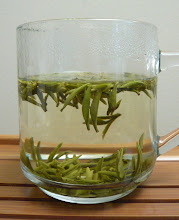
Besides, I think although the untrimmed tea may not look as good as trimmed tea in dry tea leaves, it looks just as beautiful once brewed in hot water. I've found this in quite a few rough looking tea, including the Tong Cheng Small Orchid that I love.

What do you think? ;-)


What led me to this tea was sort of "tea karma". In April of 2010, earthquake catastrophe broke out in Yushu, Qinghai, very close to the hometown of a best friend of mine (who shares hometown with Dalai Lama). Then, on a Chinese online tea forum, I saw an announcement of charity sale of Huang Shan Mao Feng run by Mr. Wang. He put some of his best tea on sale and donated all the money to the earthquake region. So I bought some tea from him. It didn't cost me any extra. I just bought some very nice tea for a very fair price. It was him who made the donation of tea and money. But still he thanked me for a few times and told me I was the first buyer in the charity sale. Because of this charity sale, I've known Mr. Wang as a man who cares a lot for people and society beyond his own life. And Mr. Wang appreciated my support in the sale. Hence started our friendship.

Later I learned that Mr. Wang is a part-time tea seller (just as I am!) who is son of a farmer's family from a remote village of Yellow Mountain (Huang Shan). He has a well-paid job in Hefei, a big city 100 miles away from Yellow Mountain, and selling tea by far can't compensate him as well as his day job. But he feels like to do it because he strongly dislikes the tea middlemen who come to his village every year and offer lowest price for their high quality tea. Their village is 8km (5 miles) away from the nearest road. In all those years, most farmers have no other choice but selling tea to middlemen for a rather low price, despite that their village is one of the most elevated ones for Huang Shan Mao Feng cultivation, and their tea is of the top quality. So a few years ago, Mr. Wang started to take his family tea to Hefei City, selling it to his colleagues, friends, and then, later on, friends' friends. Then, some neighbors in his village asked him to help sell their tea too. So he started taking pre-orders each spring, among friends and on a popular online tea forum, to determine how much tea he could sell from various farmers in his village. Each year, the tea would be carried by either Mr. Wang or a cousin of his, on foot, for 5 miles down the mountain. Usually it takes multiple carriers or multiple trips of some carriers. Then the tea would travel by train to Hefei City. Then, as you know, some of the tea would travel by air to America :-)

In the past a few years, Mr. Wang told me, again and again, that besides selling tea for his family and village, another issue that he can't get off mind is getting a road built toward his village. Currently, his village is the only one in the region that's not accessible by an automobile road. The road project has been on the agenda of the county for more than 10 years, but was delayed again and again due to budget or various other reasons. As a young man who has the most education among his villagers and works in the "big city", Mr. Wang carries a lot of hope of his fellow villagers. He often says he is determined to use all his network and "lobbying power" to make the road happen as soon as possible.

When I first heard of Mr. Wang's dream of a road, my first response was, "No...!" Mr. Wang convinced me for a few times that his village is the one in the deepest mountain, and therefore will be the end of the road and will not have much passing traffic even with a road. He said, "You don't have to worry about automobile contamination on the tea fields." But actually my concern was not the contamination problem. What stroke me was thinking of a paradise lost. Yellow Mountain is the dream paradise of Chinese people of generations. The village in the mountain is like where paradise and human world connects. But, have you seen a paradise with automobile roads? No...! Meantime, I knew it was not my say, and it would be rather selfish to want the village stay road-less. But deep in my heart, I felt I was still 70% against the road. Then, recently, Mr. Wang showed me a few pictures he took on their mountain trails. The pictures left me speechless and now I think I'm mostly for the road project (although I don't have any power to push it forward anyway...)


This is the best part of the mountain trail. Villagers need to travel on it every a few days to buy food and household items. Children need to travel on it every day to go to school, all the 5 miles, round trip! Patients need to be carried down the mountain to see the doctor in the nearest town. In fact, when seeing these pictures, I feel even the previously mentioned "tea middlemen" are not that bad. They buy tea for low prices and villagers don't like them. But they have to work harder than many other middlemen anyway, because they have to travel on this trail up and down too, to carry the tea out of the mountain. A traveler would think the remote village at the end of the scenic trail is paradise. But only people living there know how hard life could be. So I feel if I can't handle every day life in a remote village like this for many years, I shouldn't expect local people to live like this without access to a road.

I believe there will be a road in a few years. Mr. Wang is still fighting for it. But I'm sure he will make it happen. I have all the best wishes for the road and for the village, and I believe the road will bring better life to local people. Not without a little sentimentality though, and it reminds me of many other things we have gained and lost in modern life.

Apr 12, 2012

Yunnan coffee - is it enemy of tea?

What?! Coffee?!  :-D

Probably some of you know I love coffee, and I've told my story about how I started drinking coffee.

Last time when I bought some arbor tree green tea from Yunnan (which, by the way, is great! and I will write about it later), the seller told me they had coffee too. I had always been curious about Yunnan coffee. In supermarkets of Beijing, coffee products are not yet common, and most of them are imported. So by that time, I hadn't got a chance to taste Yunnan coffee yet. Therefore, I bought some Yunnan small-grain arabica coffee beans with my tea :-D


It's not bad at all. The taste is strong, not has as much "kick" as the coffee we got from Guatemala, but overall is quite ok. If not counting most of the Chinese consumers of Starbucks who enjoyed the environment of a cafe more than coffee itself, consumers of coffee are still very few in China. But a blank market often means a market with great potential to grow. In recent years, more and more people are talking about coffee cultivation in Yunnan. Many people believe Yunnan is very suitable for coffee cultivation, and many people believe coffee would be more profitable than a lot of other cultivations in Yunnan.

In fact, it has happened in some regions of Yunnan where farmers chopped down tea trees to convert the fields into coffee plantations. Traditionally, Yunnan teas has been the least expensive ones among Chinese teas, and tea has been very inexpensive within Yunnan. But coffee is foreign, novel, fancy, and supposedly expensive. In recent years, the rapid increase in Yunnan tea prices somewhat reversed the trend. But in the long run, coffee cultivation still seems more profitable than tea cultivation.

So, is coffee a threat to Yunnan tea? First of all, I hope not. And secondly, I don't believe coffee is a large threat to tea. And here are some of my thoughts about why.

1. From what I've learned about coffee, good coffee requires good ecosystem. Such requirement is consistent with that of good tea cultivation. In this sense, coffee and tea are not enemies of each other. At certain point, coffee may take away some agricultural fields from tea. But I don't believe it will turn tea cultivation upside down.

2. In Yunnan, threats to tea exist. Some of them are very bad, and could potentially be threats to both tea and coffee.

Rubber tree plantation is one of the worst. Rubber tree (that produces raw material of industrial rubber) is fast growing and highly profitable. Nowadays in Yunnan, many people know that if you pass by a village surrounded by rubber tree forests, then you know this village is rich, or is going to be very, very rich in near future. Many people are highly motivated to convert hundreds of acres of fields into rubber tree forests, and there is a whole industry behind it, urging/enticing people to do it. There are quite a few detrimental effects of rubber tree plantation. First of all, it ruins the soil and make it unsuitable to grow anything with delicate flavors, such as tea and coffee. Secondly, it's typical industrialized monoculture and destroys the biodiversity of the ecosystem. The consequence is what people would call "green desert" - a poor ecosystem with pretty much of nothing by one type of plants. Thirdly, because of its monoculture, it will require heavy use of pesticide. And because rubber is not food material, use of pesticide is quite loose on it, and much worse than in regular crops. On the other hand, tea and coffee usually have the most strict regulations in pesticide use among all food materials.

Besides rubber tree forests, paper industry is another great potential threat to the ecosystem. In the past decades, large international corporations have expanded their fast growing eucalyptus forests, another type of "green desert", in southeastern Asia. Eucalyptus is a native economic tree species in Southeastern Asia, and has unique values when blended nicely with the rest of the ecosystem. But the paper companies are interested in creating large areas of monoculture of eucalyptus. This does not only have many detrimental effects similar to those caused by rubber tree forests, but also changes local climate. Many tea drinkers, especially puerh lovers, are familiar with the 2010 drought disaster. In fact, 2010 was only the worst year, and drought is becoming a repetitive phenomenon in some regions of Yunnan. Many scientists believe climate change caused by fast growing eucalyptus monoculture is the single leading cause of the drought of Yunnan.

In addition, the modern paper making industry also threats Yunnan's traditional paper production. I personally use some hand-made traditional paper from Yunnan as additional wraps to some older puerh cakes whose original wraps wore. These traditional paper wraps look and feel more coarse than modern paper, but they are sturdy, clean and eco-friendly. Traditional paper making is as much an art as tea making, and Yunnan has been historically the paper supplying province to the entire country. But nobody knows if traditional paper will continue to be made when modern paper industry encroaches more and more, and when more local people are busying working on rubber tree or eucalyptus forests. In recent year, I've seen some art works of Yunnan traditional paper, made and purchased by people who care about the traditional paper and want to preserve the culture. On one hand, it's a good thing. On the other hand, I can't help feeling a little sad that the traditional paper, once most common and for daily use, is now gradually becoming a cultural specimen.

Now I realize this is too much to think over a cup of coffee! :-p

But in general, I feel coffee and tea are never enemies to each other, although sometimes tea people and coffee people like to tease each other :-) Personally I see food and drink as some of the most important things in my life. Love of food and drink is deeply rooted in Chinese culture and many other traditional cultures. Currently, Yunnan and the rest of China are facing great challenges of agriculture and food safety. On top of all other problems, Monsanto has been permeating into China and has been more active in China in recent years - I'm worried this could become a bigger problem than most of the already existing ones, yet many Chinese people aren't even aware of what Monsanto is. With all these problems and challenges, I feel a lot of our hope is on people's love of food and drink. If we refuse to compromise with industrially made inferior food products, if we keep demanding high quality tea, coffee, fresh fruits and fresh eggs, if we don't allow junk food to ruin the taste of our next generation, then we are probably helping with some of the problems of the world. In this sense, coffee and tea are not enemies, but allies!

Apr 5, 2012

top 10 search keywords in this blog

It was only recently that I discovered that blogspot has this "statistics" function and can track "traffic sources" of blogs. It's quite interesting to look into it! On the "traffic source" page, there is a list of top 10 search keywords. My understanding is, these are the keywords that lead people to my blog when they carried out a web search with them. I'm not sure if this understanding is correct, and some of the search key words really puzzled me!

The first one in the list, or the number 1 search keyword... I almost didn't want to tell you, and feel somewhat embarrassed by it! But I will go ahead and tell you anyway. It's a phrase - "real human skull". When I first saw it, I was like, "what???" Ok, I do remember I wrote one (and only one!) blog with an image of human skull. But it puzzles me why people would search for "real human skull" and how they are led to my blog for 65 times :-p

The second one is "petr novak". This is a little surprising to me but not entirely surprising. I remember the first time when I looked for Petr Novák's tea ware, I searched it online and visited quite a few websites that contain information about it. I guess that's what other people are doing too!

The third one is "jin jun mei". That's quite out of my expectation. I wrote about Jin Jun Mei only once and I'm not crazy about this tea (although I did enjoy those two that I wrote about). I guess that's a tea many people want to know about yet there aren't many information sources of it. 

The fourth one is, hmm... again, "infraorbital foramen", a surface anatomy on human skull, mentioned only once in that skull post. I wonder what's going on with skull search!

The fifth and sixth one are 2 slightly different spellings of "yong xi huo qing". I love this tea and wrote about it once.

The seventh is "jiu keng group long jing". Actually I had thought Long Jing would be the most searched for tea. Yet it's topped by Jin Jun Mei and Yong Xi Huo Qing on the list. I guess it's because there are already many discussions on Long Jing and not as many on the other two teas.

The eight is kamjove - the convenient gongfu teapot.

The ninth is "mango milk tea".

The tenth is gingkobay.blogspot.com, the web address of this blog.

It's quite interesting and few of them were what I had expected!

What are the top search keywords on your blog? Or what kind of web search leads you to blogs?

Mar 28, 2012

tea pictures, Yixing picture book and blog sale

Here I have three things to show. The first two are sets of post cards, and the third is a Yixing picture book. None of them is a "must have" item. I just thought they are interesting and would like to offer a channel if some people are interested in getting them. For the two sets of post cards, I'm posting the scanned image of all of them and hope they can start some interesting discussions.

The postcards are made with retro style dark paper, and the original paintings seem to be between water color and gouache, so the colors are not very bright. The scanned image looks like those under strong light. The real color of the cards are darker. They are all of the regular postcard size. There is English caption on each card, but I think I've spotted a few typos on one of the cards that has a longer paragraph. But generally the English caption conveys the meaning all right.

Shipping for the postcards within North America is $3 regardless of amount. Shipping for the book within the US by media mail is $7 (insurance included) or to be determined if other shipping method is preferred.

Please contact me for shipping to other countries. The book may not cost more shipped to other countries than shipped to North America.

Neither the postcards nor the book has cover pockets or packaging. They will be packed carefully though.

I have quite a few sets of each type of postcard sets. The book, I have only 2 copies in hands. But a discount price is available for people who are willing to wait for 3-4 weeks. 

This blog sale is valid till the end of April or till the items last.
 
1. Set of 12 postcards with historical paintings about Chinese tea making and tea industry.

(You can click the pictures to get an enlarged view.)

The first four shows the cultivation. But I have doubts about the sowing, plowing and fertilizing pictures as the fields don't really look like tea fields, and most new tea bushes are not planted by sowing the seeds. Those pictures could be interpreted as cultivation of other things too.

On the back of the first card (sowing), there is also a note that these pictures were painted for foreign merchants to take home as souvenirs. So probably the main purpose of these pictures was to illustrate scenes of Chinese agricultural society, and the accuracy of cultivation probably wasn't important.


In the next 4 pictures, the "pounding tea" puzzles me. Where and when does this happen? Although Hakka people have "pounded tea", the picture doesn't look like it. The pictures of trading site (Hong) and transportation are not necessarily specifically about tea trade. But they were the common scene of that time for trading of various goods, including tea. 


The next four pictures are about tea processing. 


 2. Set of 8 postcards about porcelain/ceramic ware making.

The water-powered hammer looks quite novel and interesting to me :-)


3. Yixing picture book - An Atlas of the Best Yixing Zisha. It's big, 400 pages, 5 lb.

Due to the years of warehousing and international transportation, I can't guarantee each copy of the book is spotless new. There might be some small dents at the corners or on the cover. But over all the book should look new. The hard cover of the book also protects it quite well through storage and transportation.

It's a book in Chinese. But I would like to introduce this book to Yixing fans in any country because this book has very little text and primarily composed of pictures. Basically you don't have to "read" to "watch" this book. In China, many Yixing fans call this book "the bible of Yixing", for a number of good reasons:

First of all, this book is edited by Gu Jingzhou (顾景舟), the most recent "Godfather" of Yixing.

Secondly, this book has more than 500 nice photos of yixing ware (mostly teapots but also including vases, plant pots, and yixing sculptures). Each of them was hand picked and carefully inspected by Gu Jingzhou himself. Many of them are from collection of top-notch museums or the best yixing collectors. I can't imagine there could be another book with this number and this level of yixing image collection.

Thirdly, this book was made in planned-economy era. The efforts made to gather the image materials and write the book can't be evaluated by money, and the book wasn't made with a budget or profit in plan. That's also why a second book of this level of image collection is not likely to be seen in the current commercialized society.

This book was published in 1992. There is a Hong Kong version and a Taiwan version (same contents, different covers). This one is the Taiwan version by Taiwan Far East Publishing House. The retail price in 1992 is NT2800 (about US$70-80). The price of Hong Kong version is a little more expensive. The price didn't change much in the past 20 years (its current market price in mainland China is about US$90-100). I guess it's because this book has a small market - only people crazy about yixing would buy it, and this price is not very affordable to many people in Asia. Even when you are into yixing, there is always this dilemma between buying one decent yixing teapot for $100+ and buying a book of 500 yixing pictures for the same money! :-p

Here are some pictures of this book, for you to get a sense what it looks like.

It's about the size of A4 office supply printing paper.


A typical page is like this. The text is minimum and mainly about the names, seals and the names of collectors of the artworks. Even if you don't read Chinese, you don't miss much.

It also includes some yixing sculptures. 

More yixing sculptures.

These pages are about the most text-dense pages in the book. Out of the 400 pages, there are about 26 pages with a mix of text and pictures. All the rest are primarily composed of pictures as showed above.

Earlier pages of the book shows scenes of Yixing and yixing production.

I hope you have enjoyed watching the pictures :-) If there is a stream of demands, we will consider putting some of these items in our store. But I somehow feel only crazy people are into these sort of things  :-p

Mar 24, 2012

what affects shelf life of a green tea (1)

(The discussion is limited within Chinese green tea. Since there are very few "steamed green" type of Chinese green tea, most discussion here is about green tea using pan-frying to dis-active the oxidation enzymes in the leaves.)

While waiting for the new green tea, I was finishing up some 2011 green teas. The one in the picture is a Huang Shan Mao Feng, 10 months after its production. It's still quite fresh and enjoyable. Usually when new tea arrives and when you taste a new year and a previous-year green tea side by side, the difference is big. But before that, a well-made, well-stored previous-year green tea can serve you nicely. I put "well-made" before "well-stored", because I believe among all factors affecting a green tea's shelf life, processing is the most important. So here is a list of all these factors, in a sequence of importance/significance in my mind.

1. Processing.

When comparing a few puerh products, their quality/taste rank could be vastly different at two time points 10 years apart, or few years apart. This may even happen to some oolong products. But this doesn't happen to most green teas. Most green teas don't "age to become better". So usually a green tea must be well-made to still taste good after a year. However, when I mentioned well-made earlier, I was not just talking about the tea being made delicious when new. In green tea, it happens, from time to time, that a tea could taste nice and fresh when new, but deteriorate rather fast.

Once I got a sealed can of Long Jing from an aunt. I got it in late November of the production year, and the tea can was vacuum sealed. The tea leaves and buds look lovely and they were definitely from a very early harvest of that year. When I opened the can and start drinking the tea, I found the tea not superb but nice. But one or two months later, I found the taste of the tea significantly heavier and bitter. After a few more months, the bitterness got even stronger. I was quite frustrated and couldn't figure out why. I wondered if there was something wrong with the tea cultivar that I couldn't tell. I showed the tea to quite a few tea professionals, and all of them said the tea looked fine, authentic Long Jing #43 cultivar. But then, a few of them pointed out that the bitterness was most likely from the water content in the tea. Since the tea was vacuum sealed and then stored during the winter months in my dryly heated apartment, the most possible cause of the bitterness was not humid from the environment, but water content in the tea.

Typically, fresh leaves of green tea are pan-fried to have their oxidation enzymes killed. In the process, inevitably, the leaves will lose some aromas and flavor, while some new aromas and flavors will be generated. Besides, when the leaves are being manipulated in the pan, inevitably, tears and wears happen to some leaves, and leaf color changes as chlorophyll (the green pigment) in the tea is degraded by the hot temperature. In Chinese green tea industry, the outlook of the leaves is extremely important for tea grading, and torn leaves would be removed from high end tea. The more crushed leaves there are, the less final product can be obtained from the same initial amount of fresh leaves. So the tea worker has to find a balance between killing the enzymes in the leaves, coaxing the best aroma from tea leaves, minimizing loss of fresh flavor due to frying and minimizing leaf tears.

Sometimes, leaf shape and color do indicate the quality of the tea. For example, whole leaves often have less astringency than crushed leaves. Leaves that are over-fried both have dark spots and over-toasty flavor. On the other hand, the pursuit of perfect leaf shape and "fresh" leaf color sometimes causes problems. It puts pressures on the tea workers to pan-fry tea leaves less thoroughly than it's supposed to be. In recent years, this pressure is more and more found on teas such as Huang Shan Mao Feng, Xin Yang Mao Jian and quite a few others, which are not supposed to look as green as some other teas such as Bi Luo Chun. Green teas are of very different shades of green. But somehow in the market, "greener" color sells better. I didn't see this as much of a problem, because I thought tea processing was pretty much ruled by the tea workers. After all, they are the ones who know what to do. But in recent a couple of years, I've heard quite a bit complaints from tea farmers that how some merchants urge them to produce tea that looks "greener" and how some tea of improperly "greener" color would sell better than tea of perfectly darker green color. Market demands sometimes could shape production in a good way. But this case looks like an example of bad influence.

When an early spring green tea is not pan-fried as thoroughly as it should be, usually the leaves look greener and there might be less tear and wear (still depending on the worker's skill). So the tea could look "prettier". But such a tea usually tastes more grassy than it should. Such grassy taste is not as pleasant as the natural grassy, vegetal tastes found in some green teas. Even if the grassy taste is not a big problem for drinkers, the water content retained in the tea would be a bigger problem, as water accelerates biochemical processes in the tea leaves to make the tea turn bitter fast.

When going over factors affecting green tea's shelf life, I would like to put "processing" the first because I believe the intrinsic quality of the tea is the determining factor and much more important than how a consumer store the tea afterwards (which is important, but not that important as long as the tea is not abused).  However, in my observation, tea processing is often overlooked as a determining factor by both vendors and consumers.

Personally, I don't even think storage at the consumer's end is the second important factor. The second important factor, I believe, is packaging quality from producers/suppliers/vendors.

Mar 18, 2012

Long Jing Village's cultivation policies

(* Before the start, quick reports - (1) our earliest 2012 green tea has arrived; (2) 2012 harvests of Long Jing and quite a few other green teas are expected to be 5-15 days later than last year.)

China's political system is highly centralized. Sometimes the government is like the patriarch of a clan. It issues orders without giving people options of "yes" or "no". The system has a lot of problems, but people don't have an option to choose the system either. But sometimes it gets things done fast - this makes "bad" worse but makes good things happen sometimes. For example, in the "Olympic year" (2008), the government suddenly issued an order that all privately owned cars in Beijing could only run on the street half of the days each month, either even number days, or odd number days, depending on the last digit of the license plate number. Even today, there is a day during each week that a car can't run on the street of Beijing. To be honest, I'm quite happy about it. But is it fair? Probably not, considering the government initiated the expansion of automobile industry and automobile sales to begin with. 


In the same year, for the same reason (preparing a better environment for the Olympics), the government issued an order that no plastic bags should be given for free in any supermarkets or groceries nationwide. Suddenly, most people were forced into the life style of carrying fabric bags to shopping. There must be complaints. But surprisingly I didn't hear much complaint. I guess it's because this was just the life style people had merely 20 years ago, and after all, it was not that hard to go back to it. This is a typical non-democratic decision, but at least this one was not at the cost of anybody - or anybody I would care for :-p Till now, I still think this is one of the best things Olympics has brought to China. By the way, many of you have probably seen the tote in the photo on the left. It's a product of the above-mentioned time period :-D

The cultivation policies of Long Jing Village is another example of top-down policy. But what distinguishes them from many other government policies is probably that at the local level, it's well understood that everybody's economic benefits rely on it.

The photo on the left is from 家住龙井村. The paper is an official document from the village council (the lowest level of government office in rural China) to the villagers. It emphasizes the policies of "no artificial fertilizer, no pesticide before the end of spring harvest season". The document also points out that random inspection will be carried out to enforce these policies, and any violation will cause the farmer to be punished (it doesn't mention how) and lose all future subsidies for tea cultivation. The subsidies, according to my friend who lives in Long Jing village, basically include all costs of winter soybean paddy fertilization and all costs of pesticide. These two expenses are largest expenses of Long Jing cultivation next to labor costs. So nobody wants to risk losing the subsidies. Besides, the document also mentions that the policies are made to maintain a good reputation of West Lake Long Jing, and to maximize individual economic benefits of the villagers.

Obvious ecological benefits aside, the policy of "no artificial fertilizer" before spring harvest is quite important to the quality of Long Jing and nearly all tea. Supposedly the best time of fertilization is winter, when the tea trees "take a rest". And the best fertilizers are the traditional ones, such as those made with soybean debris used in Long Jing Village. During the spring season, it's important to let the tea trees take their time to grow, and any accelerated growth caused by artificial fertilizers. Since the price of Long Jing changes by the date of harvest, there is potential monetary incentive to have the tea growth artificially encouraged. Therefore, strict administration is necessary.

The rationale of "no pesticide before spring harvest" is quite obvious too. It should be practiced by all farmers, and as far as I know, a lot of farmers who care about their tea quality and their reputation would  strictly follow this rule.

Quite a few tea drinkers have asked this question, is there organic Long Jing cultivation in Hangzhou, the central producing region of Long Jing? I can't say "no" because I don't have knowledge of all plantations. But in general, pesticide is commonly used in summer and early autumn throughout the region. In China, organic pesticides are not an industry yet, and the research of organic pesticides is quite challenging. Internationally, there has been some research on organic pesticides, but not much has focused on tea cultivation. While there isn't yet option of organic pesticide, cultivation of Long Jing can hardly be free of non-organic pesticides.

The photos showed on the left were taken by another friend of mine who also lives in the Lion Peak (Shi Feng) region of Hangzhou. One day in the past February, this guy was wandering around the Lion Peak Mountain, and found a few small pieces of lands with tea bushes that suffered severely from bug bites. From the bites on the older leaves, he could tell this happened in last summer or autumn, and that's what tea bushes would typically look like when there is nothing to fight against the pests. Some bushes seemed completely dead. He had no clue why these tea bushes weren't received pesticide last year. It looks like an abandoned field. Probably something happened to the owner and s/he stopped taking care of the fields.  


These photos somewhat give us an idea about how hard organic cultivation could be. It requires a lot of fundamental scientific research in large scale, preferably sponsored by the government and conducted by authoritative organizations such as universities and research institutes. Before there is enough national investment on research, and before there are many scientists who actively participates in studies of organic cultivation, I wouldn't blame the farmers for not practicing completely organic cultivation.

Although the Long Jing farmers can't give up non-organic pesticides yet, there are indeed a lot of indigenous strategies to reduce the use of pesticides. In Long Jing Village, as well as a lot of other tea producing areas, it's common that tea farmer families raise chicken and let the chicken range in the tea fields. Birds, including chicken, are very efficient in eliminating bug of certain size. Usually, the real headache is from some smaller bugs that don't fit in the "diet" of birds. In Long Jing Village, the use of pesticides is not only strictly controlled within the range of milder types and within time periods far off the harvest season, there is also the policy that the entire village should have simultaneous application of pesticides. Other villages in the region have the same policy for their tea cultivation. It has turned out that simultaneous application can make pest control more efficient and therefore it's also the most economic use of pesticides. In addition, due to the high market price of Long Jing, many Long Jing farmers can afford hiring migrating workers to manually care for the tea fields, and therefore reduce the needs of pesticides.

A very important characteristic of Chinese tea production is that most of the best teas are from small scale production carried out by individual families or small work units (such as village co-ops). However, even when high end Long Jing is dominated by family production, no family is an island entire of itself. Sustainable agricultural practice benefits from collective actions, as well as advocates within the community. 

Mar 13, 2012

how to deal with obsessive tea shopping...

This blog entry is inspired by a recent discussion on Steepster.com, How do you stop the compulsion of buy buy BUY more tea?!
 
Currently I don't have much of obsessive tea shopping behaviors - well, it helps that I do tea shopping for "business" instead of for personal obsessions. But I have semi-obsessive (just to be moderate) personality, and I somewhat knew it long time ago and have tried to deal with it. I think I did make a lot of progress. To be honest, I still get obsessive on things from time to time, and still LOVE shopping... But to put a positive note, if I hadn't been working on reducing my obsessions, things could be much, much worse ;-)

Generally, I'm not an A type person, and I'm a believer of "do what you want". But somehow I get along with A type people very well, and quite a few of my best friends are A type people - goal oriented, self-disciplined, perfect control on everything, including themselves! I used to tease my A type friends a lot about their strict self-control. And of course, they teased me about my corruptible life style too. Now we've reached such a stage of life where many of my A type friends have started to learn to relax, and on the other hand, I've started to really appreciate and respect self-discipline.

A few year ago, in a meditation retreat, I heard this from Rev. Ryūmon Hilda Gutiérrez Baldoquín, a Soto Zen (曹洞宗) priest. She said, "Freedom is from discipline." It was an empathetic moment for me. As a person who values freedom more than most other things in life, for the first time, I had realized my pursuit of freedom was, more often than not, in the wrong direction. This sentence has since become my motto. Not that I've done well in self-discipline. I won't beat myself hard for my "human weakness", but to me, the awareness and willingness to work on it are both important.

I know tea shopping is fun, especially the options of tea varieties can never be exhausted! I didn't mean to ruin the party but I believe tea appreciation can be fun, and more fun, without compulsive shopping or over-spending. So here is a collection of suggestions from tea drinkers about how to deal with compulsive shopping, along with some of my thoughts. As you will see, I didn't include some of the most rigorous (or cruel) methods. All of them are mild and easy, yet effective!

1. Create a wish list and put on it things that you would like to have but don't have to get immediately.

A lot of shoppers recognized this rule and indeed it could help a lot.

This works especially well on vendors with a free shipping/flat shipping threshold. When I was more shopaholic and stingy at the same time, I would constantly fall into the loop of "the more you buy, the more you save!" Sometimes, you do save by buying more at one time and enjoying the free shipping. But I guess most people end up buying extra things just to meet the free shipping threshold (it happened to me at least). In fact, you only save when you buy what you plan to buy, and group your purchases into larger ones, instead of enlarging your purchase plans! This is very common sense when you keep a level head, which, however, is often lost during shopping :-p So if you keep everything you want in a wish list, and draw from it, and only from it, during shopping, you can more easily meet the shipping threshold without buying extra (and often useless) stuff or leave something out (which becomes the excuse of another purchase soon).

Overall, I think wish list is an easy approach that doesn't infringe much of the fun of shopping. But, let's face it, it doesn't touch the root of the shopaholic problem either! So I think it can be one approach, but not the only one.

2. "Shop your stash!" method as recommended by steepsterite Erin.

Erin said this approach is pretty much from her hobby of cosmetics collection. I have similar experience. Several years ago, there was half a year that I didn't have any income and used up all my savings taking my parents to travel around the northeastern states when they came all the way from China to attend my commencement. Then I knew I had to cut off my spending on skincare and cosmetics. It was then that I realized how much I had stocked up! In fact, my stock pile supplied me all the way through the first two years of my new job. When I used up full size products, I pool small samples of the same kind in empty jars and they supplied me for almost another full year!

Sometimes you just don't realize how much you've already stocked up. Pretty much the same for tea and many other things! "Shop your stash" makes you recognize how much you've already got, and how much in your stock is not put in use yet.

Besides, as we know, owning nice things often brings us feeling of satisfaction - not that it's good, but ah human weakness... :-p Going through your collection could feel like a general going by parades of his soldiers. When you enjoy the satisfaction by going over what you've already got, you may not need to gain satisfaction from immediate shopping. Needless to say, the former satisfaction doesn't cost you anything!

3. "Keep track of your spending" as recommended by steepsterite MadelineAlyce. She also recommended this smart phone App. "loot" which is free and can track your expenses.

I'm very reluctant to spend the time tracking my spending though. I guess it depends on how easy it is to track it and how bad the problem is :-p

4. Don't shop, swap!

Tea swap not only brings you new tea, but also friendly communication. And it barely costs anything. It's also a way to get rid of teas that you dislike but are too good to just throw away.

5. Draw a clear line between the degree of purchase and the degree of appreciation.

This is quite obvious, however, sometimes ignored. Many tea drinkers, especially new tea drinkers, are eager to learn more about tea. That's what's unique about tea. It's not only a beverage, but also a culture. However, in modern life, things are much easier to obtain, even when they are from the other end of the earth. Then sometimes we can easily fall into the consumption loop and deviate from our original pursuit. This doesn't just happen in tea. My photographer friends often rant about how often conversations about photography deviate toward discussion on equipment (expensive camera, expensive lens, etc.). Consumption is always easy, and people tend to fall into it.

Although tasting tea is one of the most important approaches of learning about tea, it's not always true that "the more (expensive) you taste/buy, the more you learn". There are other learning approaches that can be well combined with tea tasting, and that cost little. Reading is an excellent one. 

In addition, here is a side story. Long time ago, I always assumed those who grew up in families carrying tea business for generations must have had the most prestigious tea since they were toddlers. Then, what I've heard from quite a few such people is quite the contrary. All of them told me most of the tea they had in their childhood was of much lower grades than consumed by average tea drinkers. (However lower grade tea is not necessarily poor tea, and I have some examples here.) There is thrifty factor in it. But more importantly, to learn about tea, it could be very important to start from the basic. A friend from a oolong business family told me, she started drinking tea at the age of 5, but before she was 9, all she had was all sorts of "debris of tea". And then she started drinking tea of slightly higher grades, and then even slightly higher grades... Her grandpa used to tell her, people who only drink high grade tea (for example the emperors) would be able to tell great tea from poor tea, but that's all. Only people who have experience with tea of different grades can develop the capability of recognizing subtle features of tea of various types and various grades. Of course this is about the training of a tea professional, and we don't have to follow that path by spending a lot of time drinking debris of tea or low grade tea. But I believe such stories tell us that learning is not always from buying more tea and buying more expensive tea. Of course from time to time we can still pamper ourselves by getting excellent teas. But let's face it, it's consumption, not learning :-p

6. Shift your time and attention from consumption onto creation/production.

Here, production doesn't necessarily mean heavy labor or complicated work. And creation doesn't necessarily mean professional level artistic work. For example, taking photos of your tea or tea ware and make them into Christmas card is sort of small production. It may not serve the human society in large, but it serves your family well. Similarly, writing a blog is a small creation. It may not be that meaningful to other people, but could mean a lot to you if you keep doing it!

As a person with slight obsessive tendency, here is what I think - if you have to be obsessive on something, try to be obsessive on production behaviors rather than consumption behaviors. Not that obsessions are good, but some are worse than others!

Now, what are your tips and thoughts about dealing with compulsive shopping?

Mar 8, 2012

what do you think about tea-of-month club?

I want to ask this question to all of you, because so far I haven't got it yet what product-of-month club means for tea.

I have an impression/guess that the product-of-month club originates from the business of gourmet coffee. For coffee, I can better understand the merits of such a project. I myself am not too picky on the freshness of coffee bean. But I know some coffee aficionados would only use beans that have been roasted within the past few weeks, and would keep the beans in a freezer to retain its freshness. So I guess a big incentive of coffee-of-month club is getting freshly roasted coffee each month. Similar merit doesn't seem to exist in tea.

My thoughts on business are largely based on my own shopping experience and shopping preferences. Inevitably, my thoughts are somehow restricted by my own experience. So I would love to hear from more people what they think about tea-of-month club.

Here are my thoughts -
Advantages:
1. It's a way of giving buyers royalty reward. If someone participates in a tea-of-month club, that means she would buy at least 12 shipments of products each year, and therefore, this program recognizes the most enthusiastic buyers and can possibly use member-only prices or other means to reward them.

However, as a buyer, I would rather have a reward program that tracks the total amount of purchase or the total number of purchase and enjoy discounts accordingly.

That being said, I could see that with all the shipments scheduled at the same time each month, and amount of sales planned ahead of time, it's almost like a group purchase, and saves the buyer a lot of time, labor and operational costs. Therefore, there is greater potential for discount, compared with other reward programs. So this is the biggest advantage I could see from tea-of-month club so far.

2. The buyer can get diverse products from month to month.

However, this is not so big an advantage in my eyes, because as a shopaholic, I would rather pick diverse products whenever I want, instead of on a monthly schedule.

3. The buyer doesn't have to worry about re-ordering, and tea will be delivered monthly.

However, this would be almost a disadvantage for buyers of my style. It almost feels as if the fun of shopping is taken away. I know a famous socks website does this scheduled delivery thing with great success. But that's sock, something you have to buy but would rather not spend too much time on. (Besides most of their buyers are busy, mid-aged males anyway.) But the fun of shopping often lies on things that you do NOT have to buy but would rather spend time on, even if it's just window shopping. For many tea lovers, tea shopping falls in this category, right?

Disadvantages:
1. Lack of flexibility on the buyer's end about what to obtain each month. What if it's a tea the buyer is not thrilled about?

This problem can be to some degree solved if the program is like a gift card program that the members pay for the tea-of-month club but pick whatever they want each month by themselves. But then, the club will not be very different from other types of royalty rewarding programs.

2. Delivery costs. Since there will be 12 deliveries each month, even if the shipping is said to be free, the cost must be from the buyers (either included in the price or in other forms) eventually. When shopping online, many people would plan carefully and buy the optimal amount each time, so that they don't have to pay for multiple shipments. Many people don't buy from one online store every month. Nowadays shipping is expensive, and I am sure USPS will raise prices again (if not again and again) in the next 2-3 years.

3. Because of the above mentioned delivery costs, it's most likely that only domestic buyers can enjoy such a program.

From the above "however's", probably you can tell I'm not too excited about tea-of-month club. But as I said, my vision is largely constrained by my own experience. So I would love to learn what YOU think about tea-of-month club!

Feb 27, 2012

writing about tea (1)

Last year, The Association of Tea Bloggers had a blog carnival on the topic of Why I Write about Tea. There were quite a few interesting entries on the topic. Here is the host post of the blog carnival by Jason Walker. Here is my participating post in that blog carnival. Besides, Alex Zorach once wrote on "writing about tea" here.

Recently, for various reasons, I thought a lot about writing, especially writing about tea. I'm not a well trained writer, and one of the reasons I feel comfortable about tea blogging is, I could always write whenever I wish, as much as I wish, and however I wish, without worrying if I would get an A or an F :-p So as always, I will just write whatever comes to my mind and try not be be disorganized. Here I will cover:

1. Options of writing about tea online
2. My challenges in tea writing and how I overcame some of them
3. What have I gained from tea writing

1. Options of writing about tea online:

a. Of course, blogs! :-D

b. Teatra.de - by the way I am @gingkoseto there :D
I have been watching this site growing. Although it's not yet the largest online tea community (I guess Steepster is the largest one so far), it has been growing rapidly and I believe it has great potential to get really big. It has a lot of cool features that are not found else where. It hosts tea blogs (I have a mirror site there lifeinteacup.teatra.de). More importantly, it organizes a blog network, which nurtures active communication among bloggers and blog readers. Besides, it has a twitter-like system serving tea enthusiasts. And of course it has online forum too. Basically I feel it has all features modern internet tea surfers want, and from time to time, it creates some feature that nobody had ever thought of.

c. Ratetea.net - It's a tea product review site, so I can't write much there. But I read a lot there. Since it has the focus on product review, one can get very clear and convenient information on what other people think of a specific product. Besides, there are a lot of tea articles on the site that focus on unbiased scientific information, environmental sustainability of tea products and healthy life styles. For active bloggers, another attractive feature of this site is it links reviewer's blog site to his/her ratetea.net profile. So a good product review helps attract traffic of fellow tea drinkers to the reviewer's own blog site.

d. Steepster.com - by the way I am @gingko there :D
I love its tea logging feature, and "logged" about tea there from time to time. I also know some people who don't have a blog site but use steepster as their personal log/database for tea drinking. I enjoy tea logging because it's more relaxing and casual than tea blogging. Although as I said, I don't try to be highly organized in tea blogging, I still would like my blogs more presentable than not. But when I tea-log, it's more like free writing, and present-ability is barely a concern. When I enjoy a tea, it just feels good to write it out at the moment, with the teacup in my hand. This works especially well when I don't have time to write a more organized article but desperately want to document the moment :D Sometimes I would use my tea logs as raw materials, and organize them into blog posts, preferably with photos added. 

Some very serious tea drinkers have complained about the rigid format of steepster's tea log. For example, the shortest infusion time you can choose is 15 seconds, which could be much longer than what you use for a Yan Chan brewed in gongfu style. In addition, there is only one set of infusion time and temperature, while these parameters often change from infusion to infusion, and people like me never give up any tea after merely one infusion :-p In spite of all this, I still love the tea log.

Besides the above mentioned, there are some social network sites that can be used for tea writing. I personally don't like facebook (maybe I am too old to get its meaning haha...), although it does have some writing devices. I suspect I don't get all the fun of facebook or twitter kinds of sites because I barely carry a cell phone with me :-p Well I often carry one of these guys with me and pretend it's my smart phone :D


I enjoy twitter a lot more than facebook though - by the way I am @lifeinteacup there :D I feel it's a nice site to communicate with other people, read smart quotes and share them with other people. But it's not for systematic writing.

Besides above-mentioned options, online tea forums are nice places to communicate with other tea drinkers. I have a list of online tea forums here and try to update the list from time to time.

But I don't think online tea forums are made for systematic writing either. A downside of online forums, including tea forums, is that sometimes they contribute to fragmentation of your thoughts and writing. Online forums sometimes nurture the most interesting discussions. But I hope many of these discussions can be well documented by the discussion participants. I know some people who don't have tea blogs but often give very good thoughts on tea forums. I personally think all these good tea drinkers should establish their own tea blogs, or establish their accounts at teatra.de, ratetea.net and/or steepster.com, so I would know where to visit them if I recall something interesting that they have written and want to recover all the details.

In another aspect, online forums are more for interpersonal communication rather than personal writing. Even in my list of "the most active online forums", there are forums with rather low traffic, because after all, the population of tea drinkers has yet to grow. If there is nobody around to interact, then there is no interpersonal communication. In contrast, with the above a, b, c, d options of tea writing, one could enjoy interpersonal communication, but could also write just for personal reflection or personal documentation. So I would like to see more tea drinkers using the above writing options on top of online forums.

Do you know of other places/options for online tea writing? Please share!

Feb 21, 2012

a personal review of 2011 tea

Due to my winter traveling and the cold I caught after getting home, this review is badly delayed, so was my routine establishment of new year resolutions. But I think I've still caught them all before the Tibetan New Year anyway :-)

I will go over them by which comes to my mind first...

1. My favorite tea of 2011, which was also a new tea experience for me, was this green tea, Bai Mei Hua Jian. It's an unforgettable beauty, and also falls in my favorite scope of Anhui green tea.

2 and 3. Two other green teas that I love very much and considered myself very lucky to have obtained, are Tai Ping Hou Kui and Lu Shan Cloud Mist. There are always some nice, unknown tea varieties that are hard to come by in the market. But Tai Ping Hou Kui and Lu Shan Cloud Mist are two of the most famous Chinese teas that are known by so many people yet still hard to find. Their common problem is small production.

Tai Ping Hou Kui "in a broader meaning" is commonly sold in China. But with increasing labor cost and due to some other factors, it has been ever harder to get the really traditionally made Tai Ping Hou Kui. The difference in taste is much greater than the difference in the outlook of leaves.

I know this man who obtains new harvest Lu Shan Cloud Mist each spring from its central production region. His offerings are usually in a scale of smaller than 10 lbs. for each plantation, and most was sold through his email list before ever making its way to his store. Ever since I knew this man, I have been interested. But I don't buy the tea every year, because it's an expensive tea that people crazily grab off as if it were free. In early spring, it's already stressful enough to haunt producers for Long Jing :-p  But Lu Shan Cloud Mist of 2011 was somewhat special to me. This tea was produced in a below 500m (1500ft.) location of Lu Shan Mountain, not the highest elevation of production. But it was a bad spring for the region. Nearly all locations above 500m of elevation had zero production, and even below 500m locations had many new tea buds killed by the cold weather. And you know I love survivors!

Ok, another excuse for my procrastination of writing on these teas is I didn't want to talk too much about them while they were still in stock of our web store.  I believe background information of a tea is always interesting. But I also believe one should avoid having his/her first experience of a tea influenced too much by fringing information. Like Mark Twain said, "Don't let school interfere with your eduction." ;-)

4. Another new tea experience in 2011, Jing Shan Tea (径山茶). Someday I will write more about this tea. It was a tea on my wishlist for a long time. Not only it's a famous green tea from Zhejiang, it's also an important landmark in the history of zen tea culture, and a connection point between Chinese and Japanese zen tea culture.

5. A bunch of Taiwan *style* oolongs. I've written about this Zealong and plan to write more about the other Zealongs, a Yunnan produced one and a Sichuan produced one.

6. There are a few very unique teas gifted by tea friends, and I've started a blog post about them long time ago. But writing is challenging to me, especially when it comes to more emotional topics. So I haven't managed to finish it yet. 

During this review, I just realized how much overdue homework there is in my tea documenting!

Besides, I feel terribly guilty for not having tasted two very special teas I've got in 2011. One is an organic Tie Guan Yin from my favorite TGY producer. "Organic" is not what makes it unique, but it's the specific organic fertilizer used for this tea. Another one is Song Tea (宋茶 named by Song Dynasty), which is supposedly the ancestor of Dan Cong and said by many people an extincted tea processing method. But a friend brought me some from this island inhabited by descendents of Song Dynasty royal family refugees. Since both of these teas are oolong, they somewhat made me think I didn't have to worry too much about their shelf life. But I think I shall taste them soon!

Feb 18, 2012

Concept Tea (10) - Salute to Xia Guan, with Jing Mei Tang Red Iron Cake

This Jing Mei Tang (静美堂)product, according to its owner, Mr. Huang Chuanfang, a leading figure in Taiwan puerh industry, this tea was made to salute and pay respects to Xia Guan (下关)old style iron cake with red printing on the wrap.

This tea was made in 2007, using primarily leaf material from 2006 (said by the inner ticket of the cake), mixed with some leaf material from 2002 (this is hearsay but somewhat confirmed by the tea leaves).


The wrap and inner tickets are beautiful, as always.


The leaves are a mixture of various grades, dominated by medium-low grades.


I wanted to give it a closed-up side view, because I've found it an interesting and neat technique that's used by a few puerh products that I like very much. This cake is an "iron cake", meaning tightly pressed. But the edge is quite different from the edge of tightly pressed cakes from large tea factories such as Da Yi or Xia Guan. For example, if you compare the following photo with this one (which is a Da Yi Peacock cake), you can see this one has somewhat squared edge and a flat side surface. This type of edge looks and feels tight, but it's actually not that painstaking to break the cake with a prying needle. I have seen this type of technique mainly on tea cakes made by Taiwan producers. A Yunnan native producer that I like very much, Da Dian, uses this technique on his iron cakes too. He is an admirer of Taiwan Chen Yuan Hao (陈远号), and has been telling all the people how much he appreciates tea pressing techniques he has learned from Mr. Chen Huaiyuan, owner of Chen Yuan Hao.


I believe the purpose of such pressing style is to let the tea aging benefit from tight structure of the cake, without making it a huge pain to dissemble the cake. The pressing style of this cake allowed me to pry off some relatively wholesome leaves. I could pry off some wholesome leaves from Da Dian's 2010 iron cakes too. I could never do the same on most other young iron cakes.


The tea liquor looks and tastes quite dark for its age - mind you, this tea has been in purely dry storage of Kunming and New England. The color tone is probably due to: (1) those leaves from 2002; and (2) the medium-low grade leaves that overall age faster than high grade leaves.


I've included this tea as a concept tea, because it was made to embody a few concepts cherished by its producer. These concepts include:

1. Medium-low grade leaves are wonderful. In puerh, high-grade isn't necessarily superior to low-grade. The grades are more of descriptions of leaf size and age, rather than evaluation on them.

But high-grade and low-grade leaves don't have to fight against each other (I've seen people fighting over the comparison and ranking, passionately). I believe either could be good, all depending on whether it's well-made.

2. Blending, the good kind, can do wonders on puerh.

3. You've got to take your time to make a puerh product. As mentioned on the inner ticket of this cake, it was made in 2007, using leaf materials from 2006.

It has been a common practice in big factories that they use leaves from the previous year or years ago. Such practice is partially out of convenience - large factories have overstock each year and will need to use it up at certain point anyway. On the other hand, in the old days, a tea was made based on how much time it was needed to make it, not based on when it should appear in the market.

In recent years, most tea cakes are made in the same year when the leaves are harvested. It's almost an unspoken rule that cakes made of spring leaves must come out before May, or asap - otherwise, some would say, how do you prove it aloud to everybody it's spring tea? But in the wake of "puerh madness", quite a few small producers have started to reflect on the tradition of tea processing, and there have been some products that are not made in a rush.

Besides the above, the pressing technique is also an interesting phenomenon to me.

Feb 12, 2012

Yi Liang "Long Jing" (宜良龙井)

Yi Liang Long Jing (宜良龙井), a.k.a. Bao Hong Tea (宝洪茶) is a historically famous green tea. In the title I put "Long Jing" as quote-and-quote, as it's not the "real" Long Jing from Zhejiang. However, the name Yi Liang Long Jing is not a recent invention and has at least a few hundred years of history. Until recently, I hadn't got a chance to taste it, as its popularity has long gone in tea market. Out of curiosity, I asked my Yunnan black supplier for a couple of samples of this tea.


This tea is produced from Yiliang county of Yunnan. Tea from Yiling has been famous since Tang dynasty. Up till Ming dynasty, Bao Hong Tea was a royal tribute tea all the time, and was given the title of "the best tea of China" by some scholars. I didn't find out when its nickname, Yi Liang Long Jing, started to be used. But I guess it was after the "real" Long Jing became the nation's favorite.

The processing method of this tea is somewhat similar to Long Jing and the physical appearance of the final product is similar to Long Jing too.


Compared with the "real" Long Jing, this tea has more uprising aroma, which may or may not considered a merit. In fact, in spite of the similarity in the outlook, the two "Long Jing" don't have much similarity in their tastes.

I personally still prefer the "real" Long Jing, which has more implicit aroma and a deeper, complex flavor profile. However, who knows if my personal taste is partially a result of the Chinese "main stream" taste formed in the past a few hundred years? I have grown up in a tea culture dominated by green tea, and have been influenced by the tea aesthetics which takes the "real" Long Jing as one of its best representatives. If some people outside this "green tea traditional culture" taste and compare the two "Long Jing", I don't think all of them will prefer one same tea to the other. After all, who is to say "what's the best tea" and "which is the better tea?"

Another nickname of Bao Hong Tea is Ten Mile Aroma. There are also local proverbs saying that "When the tea is fried in one room, the aroma fills the entire courtyard; when the tea is fried in the yard, the aroma fills the street; when one cup of the tea is brewed, the aroma fills the entire room." This reflects how much local people love this tea.

Feb 3, 2012

Song Luo (松萝茶)

I got this tea from a green tea group purchase last year. In the group purchase, there were quite a few high end teas and rare teas. But producer of this tea proudly announced that he was delighted to learn that all other teas cost a lot more than his in the market. In fact, that's a big difference I often see between tea producers (and probably direct traders as well) and business people. Business people are often proud of how expensive their products could be, while tea producers are often proud of how much more quality they could offer under the same price tag.

This tea is not widely available in market, for various reasons. But according to the producer, considering the fresh leaves and processing costs, this tea could be sold well under 110 rmb per jin, that would be approximately $15 per pound. It's not a prestigious tea, its leaves neither the youngest of the season nor from the highest elevation. But I would say this is a sincerely made tea, and it tastes better than some of the not so sincerely made tea under a famous tea label.


I was enthusiastic to obtain this tea because it's said to be made with the traditional Song Luo Tea processing method, which is a tradition almost lost.

Although far from popular in Chinese market or international market nowadays, Song Luo was probably the earliest pan fried green tea. One of the best representatives of Song Luo, Tun Xi Green (from Tun Xi, Anhui), was one of the earliest Chinese green tea imported by the United States, the most popular green in the international market, and the most exported green tea from China. Due to the profit it brought from the international market, Tun Xi Green was once upon a time called "green gold" by tea dealers of Anhui.

Why is Song Luo less popular nowadays? Probably many factors contribute to it. Song Luo is one of the oldest green teas existing nowadays. It has a history of more than 400 years. Most green teas of today (more than 80%, as I estimate) are from the past 200 years. This doesn't include teas with same names as in ancient records but no longer follow the same processing methods or are actually entirely different teas.

As one of the earliest "modern" green teas, Song Luo enjoyed great reputation. Meantime, tea techniques have progressed all the time. Inevitably, Song Luo would be surpassed by a lot of new comers. Personally I think Huang Shan Mao Feng is one of the better new comers. But I'm sure I haven't tasted the best Song Long. So there hasn't been fair comparison yet.

Other factors contributing to Song Long's recession may include market choices and change of people's taste. In my experience with this tea and my previous experience with a Tun Xi Green (which was not yet made with exactly the traditional method), Song Luo tea's taste is relatively bold. This is consistent with historical record of this tea. In the past a few hundred years, Chinese people's appreciation on green tea was more or less dominated by subtle and implicit tastes. This is probably partially why Song Luo is no longer seen as a high end tea. But just because of this, I could see its potential of reviving as a high end tea in international market, as western people seem to generally have heavier taste on tea than Chinese. Even contemporary Chinese, due to the dietary changes, may have heavier and heavier tastes.

Jan 2, 2012

my favorite green tea of 2011

I got a small pack of this tea and fell in love with it. This tea is called "white plum flower mountain peak" (白梅花尖), name after its production area, which is a mountain top with a lot of white plum flower trees. It's a beautiful name for both tea and a place! And you know I love plum flowers!


This tea is from an area right next to the producing region of Huang Shan Mao Feng. The appearance of this tea is quite similar to Huang Shan Mao Feng too, due to the similar processing techniques used. But this tea has a lot of nice nuances, floral, herbal, incense, and something subtle and mysterious that I had never experienced before. I only got a small pack of the first flush harvest. Then the friend who gave it to me said he thought 2nd flush is the best. This just kills me, as I don't know yet if I can get more of this tea next year.

Probably we have to face a fact that there are more teas in this world than we could ever get hold of... So what can we do? Enjoy what we have and keep dreaming for more...