Dec 13, 2009

3 major styles of Tie Guan Yin (鐵觀音) - a precursor

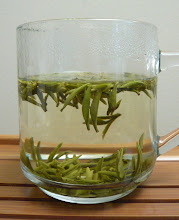
1. Modern green style Tie Guan Yin
Dry leaves

Tea water at 2nd infusion:

2. Traditional green style Tie Guan Yin
Dry leaves:

2nd infusion:

5th infusion:

Spent leaves:

3. Traditional Heavy Roast Tie Guan Yin:
Dry leaves:

Tea water at 2nd infusion:

Modern Green Style: light oxidation, explicit floral fragrance. Kept in cool or fridge temperature when sealed.
Traditional Green Style: More implicit floral fragrance. Flavor is not as strong as in modern style, but more stable over infusions, and last for more infusions. Longer shelf life. Kept in cool room temperature.
Traditional Heavy Roast Style: Fruity and sugary fragrance. Long shelf life. Kept in cool room temperature.

Dec 6, 2009

Ben Shan Oolong (本山)Traditional Processing

So far this is the best Ben Shan I've had. Nowadays when most market focus goes to Tie Guan Yin, Ben Shan carefully made like this is very rarely seen. What's even more unique about this Ben Shan is its traditional processing (medium fermentation plus other traditional procedures), which is very rare in Southern Fujian nowadays either for Tie Guan Yin or other oolongs.

What's great about traditional processing is, due to the medium fermentation, the tea last very well, and taste may even evolve a bit in the next 1-2 years. No fridge preservation is needed (actually room temperature is recommended). Besides, the spent leaves are more complete and pretty, in contrast to the more broken leaves in modern Southern Fujian oolongs.

Dry leaves

2nd infusion

5th infusion

Spent leaves

Dec 5, 2009

Li Shan High Mountain Oolong (梨山烏龍)

Dry leaves


2nd infusion

5th infusion

Spent leaves

Competition Tea Traditional Roast Dong Ding (凍頂烏龍)

Dry tea leaves

2nd infusion

Wu Yi Jin Fo (金佛)or Fo Shou (佛手) or Xue Li (雪梨)

A tea made by Luo Shengcai (罗盛财)
Dry tea leaves


1st infusion

Spent leaves

Spent leaves in water


Da Yu Ling High Mountain Oolong (大禹嶺高山烏龍)

Dry leaves


2nd infusion


5th infusion

At the end, infused with cold water over night

Packs

Made my own Tea Grapefruit!


My mom and my partner's mom both have chronic bronchitis problems. So one day, we thought, why don't we make some Tea Pomelos for moms! Tea Pomelos and Tea Citrus are long-time traditions of Cantonese and other Chinese southerners. By putting puerh or roasted oolong into citrus fruit peels, people would preserve tea for many years, and believe "after 3 years, tea becomes a perfect herbal medicine". This tradition has largely faded in modern time, and neither of us has seen any home-made Tea Citrus, and we don't know how it tastes like.

After some time groping around, I finally decided I liked grapefruit the best for this project. Pomelo actually is more preferred. But it's not easy or cheap to find pomelos where I live, let alone organic ones (organic is preferred since the outside of the peel will have long-term contact with the preserved tea). Besides, pomelos are big. Grapefruits are just more convenient to control and to preserve. As for tangerines and oranges, I had a hard time turning inside-out the peel without breaking them!

In the first grapefruit, I put in some loose shu puerh. Since I don't have much of it and I am not a big fan of puerh, later I decided to put a Taiwan Wuyi in most of the grapefruits. First because I subjectively think this Taiwan Wuyi is much richer in taste than shu puerh. Secondly this Taiwan Wuyi is in fisted shape, which makes it very easy to fit the tea into the grapefruit.

It takes a few days to let the grapefruit dry. Luckily climate is dry and nice here. I heard in southern China, usually only early autumn is the suitable season to make tea citrus and sometimes the citrus fruits and the tea can grow mold if they don't try thoroughly.

I have seen some tea citrus products before but none of them looked too appealing to me. Puerh Tangerine (桔普)is a tradition of Cantonese. The tangerines from Xin Hui (新會)are the best material for Aged Peels (陳皮)because they have unusually large oily sacs on their peels, which are sources of therapeutic ingredients. Tea Pomelo (柚子茶) is another southern Chinese tradition and roasted oolong was often used.

The biggest difference between commercial and home-made tea citrus is which side of the peel is in contact with the tea. Ideally the peel should be turned inside out, so that the oily sacs of the peel will have direct contact with the tea. But that's is not possible in mass production, because it takes time, with skillful hands, to do it.

Good thing about the industrially made tea citrus is, the products are usually heated and with tea steamed before stuffed in the citrus fruit. Thus the tea may blend with citrus oil faster and better. But the roasting treatment may damage some nutrients of the citrus, and most of the nutrients are on the citrus surface, without thorough contact with the tea.

Besides quality control, a best thing about home-made citrus is the flexibility of tea choices. I don't plan to use the most tasty teas (sounds like a waste sitting them for years). The current plan is using mainly shu puerh, roasted oolong and maybe some black tea, those teas that seem good as "background teas".

Next step - they will be wrapped in paper and stored in a dry place. Then I plan to open a tea grapefruit for inspection a few months in the future, to see how the tea tastes, and "guestimate" how long the tea should be preserved before using. Besides, in every a few years, at certain points, I guess the grapefruits should be light-roasted in warm temperature, to have any possible moisture removed.

If the procedure is well-established in future, sheng puerh can also be considered for long term tea grapefruits :D

Sep 11, 2009

another travel tea kit

Good for urban traveling. Including: a travel tea set, a vacuum bottle, a chocolate box (I love Maxim's chocolate box as much as its contents!), then a few pieces of simple kitchen ware from where I stayed.


my tea kit for summer traveling

The bottle is convenient to use for cold brewing, and easy to carry around. I believe it's designed for hot water brewing, but I can't think of any of my tea that can be hot brewed in this way. I use it for a few Taiwan oolong that I didn't like in normal brewing but later found nice in cold brewing. A couple of green teas work well in this way too.

The major drawbacks are: 1) it's still plastic (but so far I don't like carrying glass bottle or non-transparent bottle); 2) Its tea cage is quite small. I wish it were at least twice as large.


Aug 1, 2009

vegetarian baked buns

Made them as party finger food!

The wrap is made from frozen packed buttermilk biscuit dough. Each dough is made into 1 wrap. I used to make steam buns with these doughs and they work fine. Recently I tried for the first time bake, instead of steam, the buns, so that it's more suitable for parties.

The biscuit doughs are not the healthiest food though. For steamed buns in meals, now I've switched to home-made (with bread machine) doughs. These buttery doughs are convenient for parties and are rich of flavor as appetizers.

The stuffing is vegetarian, with Chinese cabbage, a bit celery, and a bit rehydrated shitaki mushrooms. Green vegetables are chopped with an electric food processor - not the best way but I don't have a large enough cut board (or the energy) to manually chop them - and then, they need to be squeezed in cheese cloth to have water content removed.


Eggs scrambled in vegetable oil. Minced rehydrated thin green bean vermicelli. All mixed together with salt and sesame oil.


The final products. 425F for 20 minutes. This kind of wraps change color fast in the last a few minutes. I would watch the oven in the last a few minutes to make sure they turn golden but not over burnt.

Jul 20, 2009

green tea pop ice and green tea latte

I love making pop ice! This one is made with green tea powder, light cream, water and maple sugar. RS thinks it's too icy but not creamy enough. But I love it just as it is. Commercial pop ice is creamy just due to starch and other cheap ingredients in it.

I am not at all a fan of matcha, but I love those desserts made with green tea powder!


I like this green tea powder product from Asian grocery. It's labeled "matcha" on the package but it's really just green tea powder. But it's fine enough to be used in desserts. It's about $7 for half a pound. I don't think I could ever possibly finish this big pack.


Using the same green tea powder product, I like making green tea latte too. Besides green tea powder, only milk and sugar (or honey or maple sugar) are needed.


With the electric milk froth maker, "bubble green tea" can be made, with rich foam.